
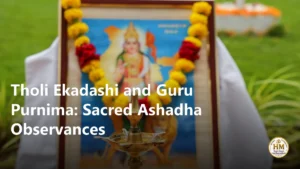
Pleasured by King Bali’s unwavering devotion, Lord Vishnu granted him a boon and agreed to guard the netherworld of Patala. Beginning on Tholi Ekadashi in the sacred month of Ashadha, the Lord enters divine Yoga Nidra for four months, commencing the holy Chaturmasya period celebrated alongside Guru Purnima.
The sacred month of Ashadha heralds a profound transformation in Sanatana Dharma. As monsoon winds bring life-giving rains across the Indian subcontinent, they also initiate a deeply contemplative period dedicated to spiritual inwardness and inner renewal. The auspicious twin observances of Tholi Ekadashi, also known as Devashayani Ekadashi, and Guru Purnima define this holy month, presenting devotees with a timeless gateway to cleanse bodily impurities, still restless thoughts, and surrender personal ego to the supreme consciousness.
Tholi Ekadashi marks the revered moment when Lord Sri Maha Vishnu enters his mystical slumber, known as Yoga Nidra, resting upon the celestial serpent bed of Adi Shesha in the Kshira Sagara. Just four days later, the bright full moon of Ashadha illuminates Guru Purnima, celebrated as Vyasa Purnima in honor of Maharshi Veda Vyasa, the great codifier of the Vedas. Together, these sacred days form the bedrock of Chaturmasya, a four-month spiritual vow observed by saints, mendicants, and householders through deep meditation, disciplined fasting, and philosophical study.
In our contemporary fast-paced lives, these sacred observances connect ancient scriptural wisdom with practical daily mindfulness. The seasonal changes encourage humanity to slow down, regulate physical consumption through conscious dietary control, and revere the enlightened preceptors who illuminate the path to liberation. By harmonizing rigorous self-discipline with wholehearted devotion, seekers experience emotional serenity, moral clarity, and enduring spiritual elevation.
Read the complete Telugu edition of this article.
The Puranic Legend of Tholi Ekadashi and Lord Vishnu’s Cosmic Slumber
According to Sanatana Dharma traditions, Lord Sri Maha Vishnu, the supreme preserver among the divine Trinity, begins his four-month cosmic rest on Ashadha Shukla Ekadashi. This celestial occurrence is intimately connected with the celebrated Puranic episode of the Vamana Avatara and the virtuous Asura king, Bali Chakravarthi. King Bali was renowned across the three worlds for his peerless generosity, righteous governance, and unyielding adherence to charity. However, his unmatched power and expanding dominion over the heavens fostered a subtle pride that disrupted the cosmic balance maintained by the Devas.
To restore harmony without destroying the noble king, Lord Vishnu descended as Vamana, a humble young Brahmin dwarf, and requested three paces of land measured by his own feet. When Bali readily granted the boon, Vamana expanded into Trivikrama, encompassing the terrestrial realm with his first stride and the celestial heavens with his second. Having no place remaining for the promised third step, King Bali surrendered his own head in humility. Pleased by such absolute surrender, the Lord placed his foot on Bali’s head, elevating him to the realm of Patala and granting him eternal protection. When the Lord offered a boon, Bali requested that Vishnu personally guard the gateways of the netherworld. Honoring his devotee’s plea, Sri Hari resided in Patala from Ashadha Shukla Ekadashi until Kartika Shukla Ekadashi, a sacred duration revered by sages as the Lord’s transcendent Yoga Nidra.
RECOMMENDED BOOK

The Maya Simulation: Quantum Physics and the Science of Consciousness
by A. Ravinder
A guide that bridges the ancient wisdom of the Yoga Vasistha with quantum physics and modern consciousness science — for readers ready to question the nature of reality and calm the mind with practical tools like the Zero Voice Technique.
As an Amazon Associate, RamthaMedia can earn from qualifying purchases.
Devashayani Tholi Ekadashi: Spiritual Benefits of the Sacred Fast
Observing the Devashayani Tholi Ekadashi vrata with unwavering devotion is celebrated in sacred Puranas as an effective path to wash away sins accumulated across seven past lifetimes. By dedicating this day exclusively to spiritual practices rather than sensory pleasures, the seeker initiates a deep biological and mental purification. The conscious restraint of food lightens bodily heaviness, allowing the dormant intellectual and spiritual faculties to blossom fully.
Scriptures explain that constant remembrance of the divine name on this holy day subdues the Arishadvargas—the six internal obstacles of lust, anger, greed, delusion, pride, and jealousy. Fasting combined with peaceful meditation releases physical fatigue, improves mental focus, and awakens Atma Jnana, the direct knowledge of the inner Self. Devotees who observe this sacred vow align their personal awareness with divine grace, establishing inner peace and spiritual strength that support them throughout the year.
From Tholi Ekadashi to Guru Purnima: Dispelling the Darkness of Ignorance
The sacred rhythm of Ashadha advances from the devotional surrender of Tholi Ekadashi to the wisdom-filled celebration of Guru Purnima on the subsequent full moon day. The Sanskrit term ‘Guru’ embodies a profound meaning: ‘Gu’ signifies the darkness of ignorance, while ‘Ru’ denotes the luminous force that dispels it. A true spiritual master is therefore the divine light that dissolves the dense fog of worldly confusion and reveals the immortal reality within every human heart.
Guru Purnima is synonymous with Vyasa Purnima, honoring Maharshi Veda Vyasa, the immortal preceptor who categorized the single primordial Veda into Rig, Yajur, Sama, and Atharva Vedas. He also authored the eighteen Puranas, the Mahabharata, and the profound Brahma Sutras to guide humanity toward dharma. In our culture, the Guru is revered before the gods, as declared in the sacred dictum ‘Matru Devo Bhava, Pitru Devo Bhava, Acharya Devo Bhava.’ While God remains invisible to ordinary perception, the Sadguru walks beside the disciple as a living guide, manifesting the unified grace of Brahma, Vishnu, and Shiva through masters such as Lord Dattatreya, Sri Raghavendra Swamy, and Shirdi Sai Baba.
Chaturmasya Diksha Commencing on Tholi Ekadashi: Ascetic Discipline and Ahimsa
The four-month sacred period starting from Tholi Ekadashi and concluding on Kartika Ekadashi is known as Chaturmasya, covering the months of Ashadha, Sravana, Bhadrapada, and Ashvina. In ancient times, the onset of heavy monsoon rains turned unpaved roads into muddy pathways, giving rise to countless small insects and microorganisms. Wandering ascetics and sannyasis, dedicated to the principle of Ahimsa Paramodharma, paused their barefoot travels during this season to prevent unintentionally harming these minute living beings underfoot.
Consequently, spiritual practitioners established stationary camps during these four months, devoting every hour to intensive self-restraint, silence (mauna), scriptural study (Vedanta shravana), and japa. Practitioners consume only simple satvik food, completely avoiding tamasic ingredients such as onions, garlic, and heavy meat. Householders also participate in this sacred vow by visiting holy shrines, performing regular charity, and observing specific dietary restraints, thereby reaping profound spiritual merits and cultivating exceptional mental tranquility.
Pooja Vidhanam and Fasting Rules for Tholi Ekadashi and Guru Purnima
Observing the sacred rites of Tholi Ekadashi and Guru Purnima begins before sunrise during the auspicious Brahma Muhurta. Devotees take a cleansing bath, thoroughly tidy the home and altar, and decorate entrances with fresh mango leaves and marigold blossoms. On Ekadashi, an idol or portrait of Lord Sri Maha Vishnu is adorned in pure yellow silk garments and worshipped with fragrant flowers and sacred Tulasi leaves while chanting the divine twelve-syllable mantra, ‘Om Namo Narayanaya.’ On Guru Purnima, devotees clean the sacred footwear (padukas) or portraits of their spiritual masters, offering chandan, kumkum, yellow flowers, and reciting the Guru Ashtottara Shatanama with sincere reverence.
The fasting protocol for Ekadashi begins on the evening of Dashami by avoiding grains and heavy meals. On Ekadashi day, devotees ideally observe complete fasting or sustain themselves solely on pure water or fresh fruit juices. The elderly, pregnant women, and those with medical conditions may consume light satvik food like milk, fruits, or flattened rice. The entire night is spent in wakeful vigilance (jagarana), chanting divine stotras and singing devotional bhajans. On the following morning of Dvadashi, after completing morning worship and offering sweet naivedyam to the Lord, the fast is ceremoniously concluded in the company of family.
Tholi Ekadashi Pilgrimage Guide: Pandharpur and Mantralayam
Pilgrims seeking spiritual rejuvenation during the Ashadha season visit prominent pilgrimage centers in Southern and Western India, most notably Pandharpur in Maharashtra and Mantralayam in Andhra Pradesh. At Pandharpur, Tholi Ekadashi is celebrated as Ashadhi Ekadashi, attracting hundreds of thousands of devout Warkari pilgrims who march hundreds of miles on foot while singing soulful abhangas in praise of Lord Vitthal Rukmini. Devotees experience the rare blessing of touching the deity’s sacred feet directly during Pada Darshan. The town is conveniently connected by rail and bus from Hyderabad, Pune, and Solapur via Kurduwadi Junction, though accommodation must be secured well in advance due to massive pilgrim gatherings.
Similarly, the pilgrimage town of Mantralayam on the banks of the sacred Tungabhadra River draws seekers on Guru Purnima to receive the grace of Sri Raghavendra Swamy at his Moola Brindavanam. Pilgrims take a holy dip in the Tungabhadra River, witness the majestic golden chariot procession (Rathotsavam), and partake in the sacred daily annadanam offered by the matha. Accessible directly through the Mantralayam Road railway station, this holy center provides free and special darshan facilities, blessing pilgrims with immense peace, protective blessings, and spiritual direction.
📖 Hindu Scriptures: The Essential Sacred Texts Every Hindu Must Read
Spiritual Meaning
The mystical concept of Lord Vishnu entering Yoga Nidra on Tholi Ekadashi is not ordinary physical sleep or unconscious inactivity. Yoga Nidra represents the highest state of supreme contemplative awareness, wherein the cosmic creator withdraws external engagement while sustaining the entire universe through internal consciousness. For a spiritual seeker, this cosmic rest represents Pratyahara—the deliberate withdrawal of the senses from worldly distractions into the silence of the inner Self.
The divine interaction between Lord Vamana and King Bali illustrates the profound truth of total self-surrender (Atma-Nivedanam). While King Bali possessed immense righteousness, charity, and valor, subtle ego remained attached to his generosity. By asking for three paces of land and placing his divine foot on Bali’s head, the Lord dissolved the final boundary of individuality. This teaches us that true devotion is not measured merely by what we give away, but by our willingness to surrender the ego that claims ownership over virtuous deeds.
The direct succession of Tholi Ekadashi and Guru Purnima emphasizes that devotion to God (Ishvara Bhakti) and surrender to the teacher (Guru Bhakti) are inseparable branches of one spiritual tree. While the Supreme Lord is the underlying foundation of existence, it is the living Guru who awakens discrimination (viveka) in the disciple’s consciousness, guiding the wandering soul through the ocean of worldly existence toward ultimate liberation.
In our contemporary world characterized by perpetual digital notifications, relentless career pressures, and sensory overload, the disciplines of Tholi Ekadashi and Guru Purnima offer practical remedies for mental exhaustion. By adopting periodic dietary fasts, setting aside deliberate intervals of quiet reflection, and consciously seeking guidance from wise mentors, modern professionals can restore mental poise and emotional equilibrium. These sacred observances remind us that true strength comes not from continuous external striving, but from the periodic ability to step back, calm the mind, and anchor our identity in timeless spiritual values.
Chapter Summary
The holy month of Ashadha is crowned by two of the most significant observances in Sanatana Dharma: Tholi Ekadashi and Guru Purnima. Tholi Ekadashi, also celebrated as Devashayani Ekadashi, marks the commencement of Lord Sri Maha Vishnu’s divine Yoga Nidra in the Kshira Sagara and initiates the four-month period of Chaturmasya. This observance is rooted in the legendary tale of King Bali, whose humble surrender earned him the supreme boon of having Lord Vishnu guard his netherworld realm. Four days later, Guru Purnima honors the birth and literary contributions of Sage Veda Vyasa, celebrating the indispensable role of the spiritual teacher in dispelling human ignorance. The article details the scriptural pooja vidhanam, fasting rules from Dashami to Dvadashi, dietary restraints during Chaturmasya, and the rich pilgrimage traditions of Pandharpur and Mantralayam. Together, these sacred days guide seekers to overcome ego, master internal desires, and attain enduring spiritual peace.
👉 Ekhasa Brass Durga Idol Sacred Home Decor Assessment
Scripture Notes
- Main Message: The central message of the Ashadha festivals is self-purification through dedicated spiritual vows (vratas), sensory restraint, and unconditional surrender to the divine. Fasting on Tholi Ekadashi serves as a potent method to subdue the lower animalistic tendencies of the mind, while honoring the Guru on Vyasa Purnima anchors the intellect in eternal wisdom, demonstrating that true spiritual progress requires both personal discipline and enlightened guidance.
- Philosophical Teaching: From a Vedantic standpoint, Lord Vishnu’s Yoga Nidra illustrates the unattached witness consciousness (Sakshi Chaitanya) that governs cosmic creation without getting entangled in material modifications. The Vamana-Bali narrative symbolizes the transition from ritualistic righteousness (Karma Kanda) to complete surrender and self-knowledge (Jnana Kanda). The sacred observance emphasizes that intellectual learning alone cannot grant liberation until the ego is offered up at the feet of the divine master.
Frequently Asked Questions
What is the primary spiritual significance of Tholi Ekadashi?
Tholi Ekadashi, or Devashayani Ekadashi, marks the day Lord Vishnu enters his four-month cosmic slumber known as Yoga Nidra on the serpent Adi Shesha. It initiates the auspicious Chaturmasya period, providing devotees an opportunity for intensive fasting, spiritual reflection, and moral purification.
Why is King Bali associated with Tholi Ekadashi?
King Bali offered his own head as the third step to Lord Vamana, demonstrating absolute surrender. Impressed by his devotion, Lord Vishnu granted him a boon and agreed to guard the realm of Patala from Ashadha Shukla Ekadashi to Kartika Shukla Ekadashi, establishing the lore of this holy day.
Why is eating rice prohibited on Tholi Ekadashi?
According to sacred Puranic texts, negative karmic energies (Papa Purusha) are believed to reside symbolically in grains like rice on Ekadashi. Abstaining from rice lightens the digestive system, reduces physical lethargy, and enhances concentration for meditation and prayer throughout the sacred day.
Why is Guru Purnima celebrated four days after Tholi Ekadashi?
Guru Purnima occurs on Ashadha Purnima, commemorating the appearance day of Sage Veda Vyasa who compiled the Vedas and composed the Puranas. Coming right after Tholi Ekadashi, it reminds seekers to honor the spiritual master who illuminates the path toward realizing the Supreme Divine.
📖 Tirumala Srivari Salakatla Brahmotsavams — A Complete Guide to the Sacred Nine-Day Festival
What dietary guidelines should be followed during Chaturmasya?
During Chaturmasya, devotees consume pure satvik meals while avoiding tamasic food items such as onions, garlic, and non-vegetarian dishes. Many practitioners also observe monthly dietary restraints, such as giving up leafy greens in Sravana and curd in Bhadrapada to maintain physical and spiritual purity.
What makes the pilgrimage to Pandharpur special on Tholi Ekadashi?
At Pandharpur in Maharashtra, Tholi Ekadashi is celebrated with grand fervor as Ashadhi Ekadashi. Hundreds of thousands of Warkari pilgrims walk hundreds of miles chanting bhajans to receive the direct Pada Darshan of Lord Vitthal, making it one of the most spiritually charged gatherings in India.
External Source Links
🛒 Related: a review of a camphor diffuser commonly used during daily pooja, on RamthaMedia.