
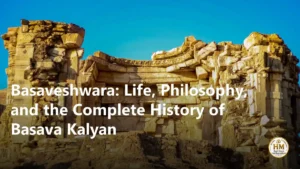
Basaveshwara was a 12th-century philosopher, statesman, and mystic who pioneered radical social equality and spiritual reform in medieval India. Rejecting caste divisions and ritualistic orthodoxy, he established the Anubhava Mantapa—the world’s first spiritual parliament—composed profound Kannada Vachana poetry, and introduced the egalitarian practice of wearing the Ishtalinga.
When modern travelers journey along National Highway 65 from Hyderabad toward Solapur or Pune, passing the bustling borderlands of Zaheerabad into Karnataka, a vivid green road sign flashes overhead near a flyover: ‘Basava Kalyan.’ To an ordinary commuter cruising at high speed, it appears as just another quiet semi-urban junction on the Deccan plateau. Yet, beneath the red soil and ancient fortifications of this town lies the memory of an extraordinary twelfth-century socio-spiritual revolution that permanently redefined the civilizational landscape of South India.
Long before modern concepts of human rights, constitutional democracy, and universal suffrage were debated in global forums, Basaveshwara transformed this historic capital into the vibrant epicentre of a mass movement. In an era dominated by rigid caste stratifications, ritualistic dogmatism, and dynastic feudalism, he mobilized working-class communities, asserting that spiritual liberation and human dignity are the birthrights of every human being, regardless of birth, occupation, or gender.
Basaveshwara served as both the visionary prime minister of the Kalachuri Empire and an uncompromising saint who walked among common laborers, cobblers, weavers, and farmers. His enduring contributions—ranging from democratic parliaments and vernacular philosophical poetry to an innovative theology of physical labor—remain astonishingly relevant. Understanding the life of Basaveshwara and the history of Basava Kalyan offers a profound look into one of India’s greatest egalitarian legacies.
Read the complete Telugu edition of this article.
The Early Defiance of Basaveshwara
In the year 1131 CE, the village of Bagevadi in present-day northern Karnataka witnessed the birth of a child whose vision would eventually alter the course of Indian religious history. Born into an orthodox Saivite Brahmin family to Madiraja, the town chief, and his devout wife Madalambika, the boy was named Basava, invoking the sacred presence of Nandi. From his earliest childhood, Basaveshwara exhibited a profound sensitivity toward the world around him. While his peers engaged in conventional play and rote memorization of Sanskrit liturgies, young Basaveshwara questioned why social barriers prevented certain human beings from walking down specific village streets or accessing the same divine presence.
The defining turning point of his youth occurred around the age of eight during his Upanayanam, the formal sacred thread ceremony intended to induct him into Brahminical orthodoxy. As priests chanted Vedic mantras and his father prepared to place the Yajnopavita across his shoulder, Basaveshwara held his father’s hand and halted the ritual. He asked how a woven thread could purify an immortal soul, why his elder sister Nagalambika was denied this rite based purely on gender, and how a ceremony that excluded the vast majority of human beings could truly represent divine righteousness. Refusing to accept an identity rooted in birth-based hierarchy, Basaveshwara cast aside the sacred thread, departed from his ancestral home, and set out into the unknown in search of timeless spiritual truth.
Basaveshwara and the Epiphany at Koodala Sangama
Traveling along forested footpaths, the young seeker arrived at Koodala Sangama, the sacred confluence of the Krishna and Malaprabha rivers. There, under the spiritual guidance of Guru Jataveda Muni (Ishanya Guru), Basaveshwara spent twelve rigorous years mastering classical philosophy, Sanskrit literature, and spiritual meditation. However, rather than accepting scholastic dogma at face value, he scrutinized philosophical texts through the lens of lived compassion and rational inquiry, constantly contemplating why divine nature distributes air, water, and sunlight without prejudice while human society invents caste boundaries.
During this period of intense sadhana, Jataveda Muni initiated him into the worship of the Ishtalinga—a miniature personal emblem of Lord Shiva held in the palm of the hand or worn upon the chest. This profound symbol eliminated the need for monumental stone temples, institutionalized intermediaries, and priestly gatekeeping. It was at Koodala Sangama that Basaveshwara composed his immortal Vachana: ‘The rich will build temples for Shiva; what can I, a poor man, do? My legs are pillars, the body is the temple, and the head is the golden tower.’ With this spiritual breakthrough, the temple was no longer an external stone structure owned by the wealthy; the living human body became the dwelling place of the divine.
Armed with profound realization and blessedly instructed by his master to implement his vision in society, Basaveshwara journeyed to the imperial capital of Kalyani (now Basava Kalyan), where his maternal uncle Baladeva held a high ministerial post under King Bijjala II of the Kalachuri dynasty. Basaveshwara entered the capital not as a conqueror seeking personal glory, but as a dedicated servant of humanity determined to apply spiritual equality to the real-world affairs of statecraft, governance, and public administration.
RECOMMENDED BOOK

The Maya Simulation: Quantum Physics and the Science of Consciousness
by A. Ravinder
A guide that bridges the ancient wisdom of the Yoga Vasistha with quantum physics and modern consciousness science — for readers ready to question the nature of reality and calm the mind with practical tools like the Zero Voice Technique.
As an Amazon Associate, RamthaMedia can earn from qualifying purchases.
Basaveshwara as the Prime Minister in Kalyani
Basaveshwara began his administrative career as an ordinary royal accountant (Karanam). His honesty, encyclopedic knowledge, and sharp intellect quickly drew imperial attention. When decades of convoluted state financial records were untangled in a single night by his meticulous accounting, King Bijjala II recognized his extraordinary brilliance and elevated him to the rank of Maha Bhandari (Prime Minister and Grand Treasurer). Entrusted with the keys to the imperial treasury, Basaveshwara maintained absolute integrity, demonstrating that public funds belong exclusively to the people and the divine, rather than the whimsical pleasures of the ruling elite.
From this position of imperial influence, Basaveshwara instituted revolutionary socio-economic paradigms centered on two fundamental pillars: ‘Kayakave Kailasa’ (Work is Worship) and ‘Dasoha’ (Selfless Sharing). He declared that every citizen, from the monarch on the throne to the sanitation worker cleaning the streets, must engage in honest, productive manual labor. Labor was elevated from a degrading social obligation to a sacred act of worship, obliterating the traditional contempt shown toward manual trades. Income earned through legitimate effort was to be shared freely with the community through Dasoha, providing nutritious food, shelter, and educational support to all seekers and laborers without discrimination.
Naturally, his growing popularity and egalitarian policies infuriated entrenched feudal elites. Corrupt courtiers conspired against him, falsely alleging to King Bijjala that the prime minister was misusing royal coffers to fund the welfare of low-caste devotees. When the king ordered the royal treasuries inspected under armed guard, the accounts were found completely balanced to the exact coin, with excess contributions generated by the voluntary donations of grateful working citizens. Although cleared of all suspicion, Basaveshwara recognized that lasting societal transformation could never occur through imperial power alone; it required a grassroots cultural awakening.
Basaveshwara and the Anubhava Mantapa
To institutionalize this cultural transformation, Basaveshwara founded the **Anubhava Mantapa** (Hall of Spiritual Experience) in the heart of Kalyani, creating what modern historians recognize as the world’s first democratic spiritual parliament. Presided over by the celebrated mystic saint Allama Prabhu, the Anubhava Mantapa opened its doors unconditionally to every human being regardless of birth, caste, occupation, or gender. For the first time in Indian history, cobblers like Haralayya, washermen like Madivala Machideva, woodcutters like Molige Marayya, and spiritual women like Akka Mahadevi sat side-by-side with reformed scholars, debating metaphysics, social justice, and personal ethics on completely equal terms.
The Anubhava Mantapa democratized knowledge through the medium of **Vachana literature**—direct, rhythmic, and accessible aphorisms composed in the spoken Kannada language. Rejecting esoteric Sanskrit that remained inaccessible to the working masses, the Sharanas articulated timeless wisdom in everyday metaphors. Akka Mahadevi, shedding worldly attachments and royal comfort, arrived at the assembly as a towering symbol of feminine spiritual autonomy, declaring that the immortal soul possesses neither male nor female gender. In this dynamic space, every working professional became a philosopher, and collective discourse governed community norms.
The social momentum reached its dramatic climax when Basaveshwara and the Sharanas sanctioned a pathbreaking matrimonial alliance between the daughter of Madhuvarasa, an enlightened Brahmin courtier, and the son of Haralayya, a devoted leather artisan. In the conservative atmosphere of twelfth-century India, this inter-caste marriage was an unprecedented cultural shockwave that directly challenged the foundational hierarchy of the feudal social order. Traditionalist factions rallied their forces, demanding harsh royal intervention to crush the burgeoning egalitarian movement.
The Kalyana Revolution and Basaveshwara
Bowing to intense pressure from orthodox courtiers and fearful of losing imperial authority, King Bijjala II ordered the immediate arrest and public execution of Madhuvarasa and Haralayya. The two revered elders were subjected to horrific torture: blinded and dragged along city streets by royal elephants. When news of this gruesome injustice reached the Sharanas, widespread grief and indignation erupted across Kalyani. Despite Basaveshwara’s steadfast commitment to non-violence and moral endurance, civil unrest swept through the capital, leading to intense clashes and the assassination of King Bijjala by radicalized elements.
Seeing the peaceful city descending into chaos and the physical structure of the Anubhava Mantapa being dismantled by imperial troops, Basaveshwara experienced deep spiritual sorrow. Realizing that his active role in the political sphere had reached its natural conclusion, he relinquished his ministerial attire and returned to his spiritual sanctuary at Koodala Sangama. Standing at the sacred river confluence where his transformative journey began, Basaveshwara merged into the infinite presence of Koodala Sangamadeva, leaving behind a spiritual flame that violence could never extinguish.
In the aftermath of the Kalyana Kranti (Revolution of Kalyana), loyal disciples led by Madivala Machideva and Chennabasavanna undertook perilous journeys to preserve the sacred Vachana manuscripts. Fleeing into dense forests and rocky plateaus while pursued by imperial cavalry, they shielded the palm-leaf texts with their lives. Their heroic sacrifice ensured that the profound philosophical teachings of the Sharanas survived across generations, remaining an eternal beacon of egalitarianism and divine love.
📖 Basava Puranam — The Revolutionary Epic of Mahatma Basaveshwara
The Telugu Literary Legacy of Basaveshwara
The revolutionary message of Basaveshwara did not remain confined within the borders of Karnataka; by the thirteenth century, its philosophical radiance spread across neighboring Andhra and Telangana. The primary architect of this cultural transmission was the celebrated rebel poet **Palkuriki Somanatha**, born in the village of Palakurthi in the modern Jangaon district of Telangana. Somanatha, an ardent disciple of the Veerashaiva ethos, recognized that high Sanskrit literature served only the elite and chose instead to compose the magnificent **Basava Puranam** in accessible *Janu Tenugu* (pure, native Telugu).
By employing the indigenous *Dwipada* (couplet) meter, Palkuriki Somanatha produced the first major biographical and devotional epic in Telugu dedicated to a historical social reformer rather than a mythological king. His verses vividly recounted the life, spiritual miracles, and moral dialogues of Basaveshwara alongside the inspiring stories of working-class saints like Haralayya and Machideva. Through his courageous linguistic and spiritual rebellion, Somanatha established a vibrant Shaivite devotional culture across Telugu-speaking regions that flourishes to this day.
Exploring Basava Kalyan: Fort, Caves, and Heritage
Today, the historical city of Basava Kalyan in the Bidar district of Karnataka stands as a monumental testament to its glorious past. As the legendary capital of the Western Chalukyas (Kalyani Chalukyas) from 1050 to 1189 CE and later the Kalachuris, the town features remarkable architectural and archaeological treasures. The imposing **Basava Kalyan Fort**, originally founded in the tenth century and reinforced with seven formidable defensive gateways, houses historical structures like the Akhand Darwaza, the Rani Mahal, and ancient water reservoirs.
Adjacent to the fort, the **Archaeological Museum** preserves exquisite black stone sculptures of Jain Tirthankaras, Chalukyan decorative lintels, and ancient Kannada inscriptions that provide rich historical insights into the medieval era. Pilgrims and tourists also visit the sacred **Sharanara Caves** carved out of laterite stone—most notably the meditation caves of Akka Mahadevi and Basaveshwara—as well as the newly constructed **108-foot Basaveshwara Statue**, which stands proudly as one of the tallest monumental statues dedicated to the visionary philosopher in the world.
Travel Guide to Basava Kalyan from Hyderabad
For residents and visitors in Hyderabad, Basava Kalyan serves as an ideal and historically enriching weekend excursion. Located approximately **160 kilometers** west of the city along National Highway 65 (Hyderabad–Pune Highway), the journey offers smooth, wide, four-lane driving conditions through scenic rural landscapes. Traveling by private car or taxi via Patancheru, Sangareddy, Zaheerabad, and Humnabad generally takes between 3 and 3.5 hours, with numerous roadside eateries and fuel stations available throughout the corridor.
Public transport connectivity is equally convenient, as interstate KSRTC and TSRTC buses operating between Hyderabad (MGBS or Jubilee Bus Station) and destinations such as Solapur, Gulbarga, and Pune pass directly through Basava Kalyan at 30-minute intervals. Visitors planning a one-day trip are advised to start early around 6:00 AM, explore the historic fort and archaeological museum during morning hours, visit the Anubhava Mantapa and Sharanara Caves in the afternoon, and witness the monumental 108-foot Basaveshwara statue at sunset before heading back to Hyderabad by evening.
Spiritual Meaning of Basaveshwara and His Reform
The spiritual philosophy introduced by Basaveshwara represents a fundamental shift from external ritualism to internalized, embodied divinity. Central to this path is the concept of the **Ishtalinga**, a personal emblem of the formless supreme consciousness worn directly over the heart. By wearing the divine upon one’s body, the worshiper dispenses with the psychological need for physical temples, hereditary priesthoods, and astrological superstitions. The Ishtalinga affirms that every individual soul (Anga) is inextricably united with the ultimate reality (Linga), establishing an absolute inner democracy of the spirit.
Furthermore, the doctrine of **Kayakave Kailasa** elevates human labor to the realm of high spiritual sadhana. Work is not viewed as a punishment or a mundane necessity for survival, but as the very gateway to spiritual liberation (Kailasa). When an individual performs their daily profession with purity of intent, dedication, and honesty, the labor itself becomes a form of continuous meditation. By eliminating the false dichotomy between the sacred and the secular, Basaveshwara sanctified ordinary working life.
Complementing Kayaka is the principle of **Dasoha**, which requires seekers to dedicate their surplus earnings and physical energy to the service of society. Unlike conventional charity, which often feeds the pride of the donor, Dasoha is approached with profound humility as an act of returning what belongs to the divine back to the community. Through this selfless cycle of honest labor and unconditional sharing, Basaveshwara dissolved socio-economic greed and built a harmonious communal fellowship based on universal love.
In our contemporary world, where professional identity is frequently linked to social prestige, stress, and consumerism, Basaveshwara’s teaching of Kayakave Kailasa reminds us that all honest labor possesses inherent dignity and spiritual value. By approaching our daily work with mindfulness, integrity, and a spirit of service (Dasoha), we can transform our modern workplaces into vibrant centers of self-realization, empathy, and social harmony.
👉 premium AI smartphones – Mastering Battery Life on Today
Chapter Summary
This comprehensive study explores the life, philosophy, and enduring historical impact of Mahatma Basaveshwara alongside the heritage of Basava Kalyan. Starting with his early rejection of caste orthodoxy in Bagevadi, the narrative details his spiritual realization at Koodala Sangama, his rise to prime minister under King Bijjala II, and the founding of the democratic Anubhava Mantapa. It examines his core doctrines of Ishtalinga, Kayakave Kailasa, and Dasoha, as well as the revolutionary composition of Vachana literature in spoken Kannada. The chronicle also covers the turbulent events of the Kalyana Kranti, the literary contributions of Telugu poet Palkuriki Somanatha in the Basava Puranam, and provides an actionable travel guide for exploring the historic fort, museums, and monuments of Basava Kalyan from Hyderabad.
Scripture Notes
- Main Message: The central message of Basaveshwara’s Vachana philosophy is that authentic religion is defined solely by active compassion, ethical conduct, and universal brotherhood. As articulated in his timeless maxim, ‘Daya illada dharmavavudayya?’ (What religion is there without compassion?), spiritual realization cannot exist alongside social discrimination, ritual hypocrisy, or violence against living beings.
- Philosophical Teaching: Basaveshwara and the Sharana tradition established a dynamic monism known as Shakti Vishishtadvaita. In this vision, the divine is not an unreachable distant entity confined to stone sanctums, but a living reality intimately realized within the human heart through the Ishtalinga. The path to union with God requires moral living (Shatsthala), truthful labor (Kayaka), and selfless contribution to society (Dasoha).
Frequently Asked Questions
Who was Basaveshwara?
Basaveshwara (1131–1167 CE) was a legendary 12th-century philosopher, statesman, Kannada poet, and socio-spiritual reformer. He served as the prime minister of the Kalachuri Empire in Kalyani and founded the Lingayat tradition, advocating for complete caste, class, and gender equality.
What is the historical significance of Basava Kalyan?
Formerly known as Kalyani, Basava Kalyan was the imperial capital of the Western Chalukyas and Kalachuris. It became the epicenter of the 12th-century Sharana revolution and the site of the Anubhava Mantapa, often recognized as the world’s first democratic spiritual parliament.
What does ‘Kayakave Kailasa’ mean?
‘Kayakave Kailasa’ translates to ‘Work is Worship’ or ‘Labor is Heaven.’ It asserts that every honest profession is sacred and that performing one’s daily work with sincerity and dedication is the true path to spiritual liberation, regardless of social status.
📖 Tirumala Srivari Salakatla Brahmotsavams — A Complete Guide to the Sacred Nine-Day Festival
What is the Anubhava Mantapa?
The Anubhava Mantapa was an open spiritual and social assembly established by Basaveshwara in Kalyani. Presided over by Allama Prabhu, it allowed men and women from all castes and professions to debate metaphysics, ethics, and social reforms on equal terms.
What is an Ishtalinga?
The Ishtalinga is a small, personal emblem of Lord Shiva worn directly on the body over the heart. Given to every initiate regardless of caste or gender, it symbolizes the direct, personal connection between the individual soul and the divine without priestly intermediaries.
Who wrote the Basava Puranam in Telugu?
The celebrated 13th-century poet Palkuriki Somanatha composed the Basava Puranam in pure, native Telugu (Janu Tenugu) using the Dwipada meter, introducing the life and egalitarian teachings of Basaveshwara to the Telugu-speaking world.
How far is Basava Kalyan from Hyderabad, and how can one reach it?
Basava Kalyan is approximately 160 km from Hyderabad on National Highway 65. It is easily accessible by private car in about 3.5 hours or via regular interstate TSRTC and KSRTC buses traveling toward Solapur, Pune, or Gulbarga.
What are the major tourist attractions in Basava Kalyan?
Major attractions include the 10th-century Basava Kalyan Fort, the Archaeological Museum, the 108-foot Basaveshwara statue, the modern Anubhava Mantapa, and the ancient laterite meditation caves of Akka Mahadevi and Basaveshwara.