
According to visionary thinker Philip K. Dick, unexplained phenomena like déjà vu are subtle glitches within the cosmic Maya simulation. He argued that these fleeting moments of experiencing an event previously indicate software anomalies in the fabricated reality governing human perception, demonstrating that consciousness transcends the physical construct.
The concept of Maya represents one of humanity’s most ancient and profound philosophical frameworks, anticipating modern simulation hypotheses by thousands of years. From the enlightened sages of the Vedic era to contemporary theoretical physicists, insightful thinkers have consistently realized that the tangible world is not an absolute material reality, but an intricate multidimensional projection. In recent decades, discoveries in quantum mechanics, information theory, and cognitive neuroscience have begun to validate this timeless truth, suggesting that the cosmos operates remarkably like an interactive, data-driven program.
In 1977, celebrated science fiction visionary Philip K. Dick shocked the academic world by openly declaring that human beings inhabit a computer-programmed simulation. His groundbreaking insights laid the philosophical foundation for modern cultural milestones such as The Matrix and Inception. Dick recognized that our daily sensory experiences are essentially a holographic interface concealing a deeper computational matrix. Rather than treating this realization as mere speculative fantasy, he demonstrated how recognizing the artificial architecture of reality allows human consciousness to awaken to higher dimensional awareness.
Unraveling the mysteries of the Maya simulation is far more than a theoretical exercise; it is an empowering pathway toward self-mastery and conscious living. When we comprehend that our outer physical circumstances are dynamic reflections of consciousness rather than rigid obstacles, we stop living as helpless avatars and step into our true role as conscious co-creators. By bridging ancient spiritual wisdom with cutting-edge science, we discover the keys to breaking free from limiting programs, reclaiming sovereign awareness, and designing a purposeful destiny.
Read the complete Telugu edition of this article.
Philip K. Dick and the Maya Simulation Breakthrough
Philip K. Dick remains one of the most influential visionaries to articulate the computational nature of worldly reality. During a famous 1977 address in Metz, France, he astonished audiences by asserting that our perceived reality is a programmed simulation running on an invisible foundation of cosmic data. He described the physical realm as an elaborate holographic screen where human beings interact with artificial constructs, much like player characters within a complex video game environment. An avatar inside a virtual simulation accepts digital trees, rivers, and architecture as solid objects because its sensory boundaries are defined by the game’s code. Only when a software glitch occurs does the artificial nature of that environment become apparent.
Dick identified peculiar phenomena such as déjà vu as observable glitches within the machinery of the Maya construct. He argued that when an individual experiences an uncanny certainty that an unfolding moment has already occurred, consciousness is catching a glimpse of a real-time software revision or timeline alteration. The surrounding institutional structures often discourage people from questioning these perceptual anomalies, keeping society confined within conventional material assumptions. However, when we expand our inner awareness, we realize that ordinary physical senses perceive less than one percent of actual reality, while the remaining ninety-nine percent consists of an unmanifest informational field.
Quantum Physics and the Observer Effect in Maya
Modern quantum mechanics provides compelling empirical evidence supporting the concept of an informational universe. The celebrated double-slit experiment demonstrated that subatomic particles exist purely as wave functions of potential until an act of measurement or conscious observation takes place. The moment an observer focuses attention on a particle, the probability wave collapses into physical matter. This foundational quantum principle closely mirrors computational rendering in modern video games, where graphics load exclusively in the direction the player looks, while unobserved areas remain stored as raw data in computer memory.
This observer effect reveals the core operating principle of Maya, proving that physical reality does not exist independently of conscious awareness. Consciousness is not an accidental biological side effect generated by the brain; rather, consciousness is the fundamental ground from which all physical forms arise. By directing our thoughts, intentions, and focused observation, we actively influence how the universal matrix renders our life circumstances. Exploring the profound philosophy of <a href=”https://ramthamedia.in/non-duality-truth-vs-myth-telugu/”>non-duality and spiritual truth</a> demonstrates that our inner state of being continuously writes the experiential code of our outer world.
RECOMMENDED BOOK
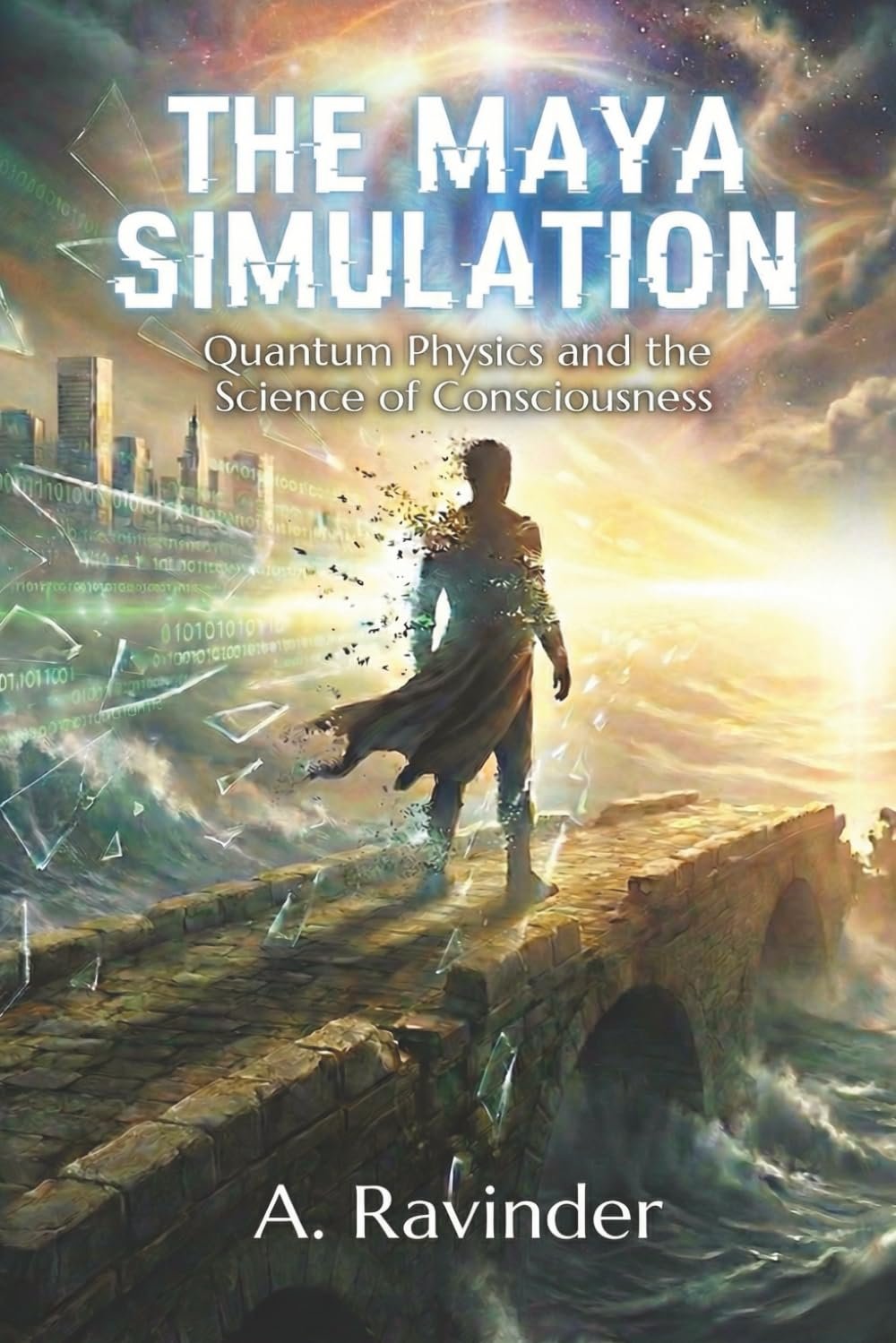
The Maya Simulation: Quantum Physics and the Science of Consciousness
by A. Ravinder
A guide that bridges the ancient wisdom of the Yoga Vasistha with quantum physics and modern consciousness science — for readers ready to question the nature of reality and calm the mind with practical tools like the Zero Voice Technique.
As an Amazon Associate, RamthaMedia can earn from qualifying purchases.
Timeline Shifts and the Pink Light Experience of Maya
In February 1974, Philip K. Dick experienced an extraordinary spiritual breakthrough when a beam of high-frequency pink light illuminated his consciousness. This incident transmitted immense informational downloads directly into his mind, allowing him to perceive historical memories dating back to the first century AD. From the perspective of modern theoretical physics, time is not an unyielding linear march from past to future, but a vast multidimensional continuum where all temporal coordinates coexist simultaneously. Dick’s conscious awareness temporarily decoupled from the default timeline, accessing parallel informational coordinates within the cosmic program.
This remarkable occurrence highlights the inherent flexibility of timelines within the architecture of Maya. Human beings frequently transition between subtle timeline variations without conscious realization, an anomaly commonly referred to as the Mandela effect. When large groups of people remember specific historical details differently than recorded history shows, they are observing the fluid nature of alternative timeline tracks. When an individual cultivates a heightened state of emotional and mental coherence, their awareness naturally resonates with harmonious timeline trajectories, proving that our present consciousness shapes both our future and our perceived past.
The Evolutionary Interface and Ancient Teachings on Maya
Cognitive scientist Donald Hoffman has developed the interface theory of perception, demonstrating through mathematical evolutionary models that our physical senses did not evolve to reveal objective reality. Instead, human perception functions like a computer desktop interface, where intuitive icons symbolize complex underlying computational processes. A desktop icon representing a text file is neither a physical document nor the electronic transistors generating it; it is merely a user-friendly graphical interface that facilitates navigation. In identical fashion, the colors, sounds, textures, and solid shapes we perceive are mental translations constructed by our neural biology.
This modern scientific breakthrough aligns flawlessly with ancient Indian philosophy, which described the visible cosmos as Maya—an intricate sensory veil masking transcendent ultimate reality. Classical masters taught thousands of years ago in the <a href=”https://ramthamedia.in/youth-illusions-yoga-vasistha-rama-teachings/”>teachings of Yoga Vasistha</a> that the material world is a mental construct rather than an absolute physical reality. Contemporary physics confirms that physical atoms consist of more than ninety-nine point nine percent empty space. This apparent vacuum is not barren emptiness, but an infinite energetic field of quantum information waiting to be shaped by consciousness.
Reprogramming the Mind to Transcend Maya
If our experienced reality functions as an interactive cosmic program, human beings possess the inherent capacity to reprogram their experiential parameters. Spiritual masters and quantum theorists affirm that the human mind acts as a conscious console. When an individual remains locked in repetitive thought cycles, emotional trauma, and habitual fears, the surrounding simulation faithfully renders identical circumstances. Conversely, when we elevate our inner frequency and cultivate clear mental intent, the structural coding of our daily experience shifts accordingly, unlocking new opportunities and elevated states of being.
The subconscious mind operates as the backend processor within the architecture of Maya, handling the deep routines that project our outer reality. During states of meditation, deep contemplation, or hypnagogic rest, we gain direct access to this subconscious control panel, enabling us to input constructive affirmations and clear intentions. Entering profound inner states through practices like <a href=”https://ramthamedia.in/astral-projection-sensational-facts-telugu/”>astral projection and expanded awareness</a> allows seekers to transcend localized temporal restrictions, operating from orthogonal dimensions of awareness to create profound shifts in their physical lives.
Recognizing Real-Time Glitches in the Fabric of Maya
Careful observation reveals frequent algorithmic anomalies or real-time glitches that confirm the responsive nature of Maya. One of the most common manifestations is synchronicity, where deeply held thoughts or private contemplations are suddenly mirrored by external events, unexpected encounters, or precise information appearing in the physical environment. In addition, frequently noticing repeating numerical sequences like 11:11, 22:22, or 333 serves as an intuitive signal from the universal matrix, reminding the observer of the hidden mathematical coherence governing existence.
Another striking phenomenon involves unexpected encounters with unfamiliar individuals who enter our lives at critical crossroads, deliver indispensable guidance or assistance, and subsequently disappear without a trace. Far from being random coincidences, these occurrences represent programmed interventions designed to nudge human awareness toward purposeful growth. Philip K. Dick observed that as our conscious presence expands, our capacity to recognize these structural signposts increases, awakening us to the reality that we are multidimensional spiritual beings rather than mechanical organisms.
📖 What Is the Nature of the World? Is Reality an Illusion? | Yoga Vasistha S3 EP-34
The Three Ascending Levels of Consciousness in Maya
To navigate the simulated framework of existence effectively, an individual must understand the three ascending stages of consciousness: The first stage is the Unconscious State (Level 1), wherein a person completely identifies with the physical body and believes that external conditions dictate their destiny. In this entry-level stage, the individual functions entirely as an automated avatar immersed in sensory reactions. The second stage is the Aware State (Level 2), where the seeker recognizes that personal thoughts and internal states actively shape external outcomes, prompting them to consciously analyze the patterns of reality.
The third and highest level is Lucid Living (Level 3), where the individual realizes their true identity as the sovereign player rather than the temporary avatar. In this enlightened state, a person navigates physical life with the same clarity and calm authority as an awakened dreamer consciously directing a lucid dream. Philip K. Dick detailed these transformative stages across his monumental eight-thousand-page journal, The Exegesis, concluding that while human beings appear confined within an artificial labyrinth of sensory illusion, the exit door has always remained wide open to anyone possessing true discernment.
Practical Principles to Master the Reality of Maya
To consciously reprogram personal reality and align with higher spiritual dimensions, practitioners can apply eight practical disciplines: First, reframe every obstacle as a temporary code anomaly rather than a permanent disaster. Second, cultivate sincere daily gratitude, which prompts the cosmic matrix to render abundant blessings. Third, practice thirty minutes of daily silence to eliminate accumulated mental static. Fourth, use vivid visualization to impress desired outcomes directly onto the subconscious processor, knowing the brain processes vivid imagination as tangible reality.
Fifth, regularly question perceived limitations by asking, ‘Is this circumstance truly absolute?’ Sixth, embody unconditional love, which represents the highest vibrational frequency capable of dissolving dense algorithmic blocks. Seventh, practice complete forgiveness to permanently decouple awareness from obsolete timeline trajectories. Eighth, anchor attention in the present moment, eradicating past regrets and future anxieties to commune directly with the eternal now. These practical habits empower every dedicated seeker to transcend sensory confinement and experience true liberation.
Spiritual Meaning
The esoteric understanding of Maya simulation reveals that our physical universe is neither a cosmic accident nor an inescapable trap, but a sacred educational arena designed for the evolution of consciousness. Ancient Vedic wisdom has always maintained that the cosmos is Lila—a divine play manifested by the Supreme Consciousness to experience its own infinite possibilities. When we realize that external challenges are simply interactive scenarios crafted to build spiritual strength, fear dissolves, allowing us to participate in existence with joyful confidence and profound reverence.
Within the spiritual framework of Maya, physical death is not an absolute annihilation of identity, but a natural graduation or software transition to higher levels of conscious awareness. Just as a user completes a stage in a virtual environment and steps into a higher realm of experience, the immortal soul sheds its physical avatar to assimilate wisdom and continue its eternal pilgrimage. Recognizing the indestructible nature of consciousness dispels existential dread, granting us the freedom to live authentically and fearlessly.
True spiritual liberation (Moksha) within the grand simulation of Maya is attained through the cultivation of the witness state (Sakshi Bhava). By learning to observe fleeting thoughts, emotional currents, and external events without reactive attachment, the seeker disidentifies from the programmed drama of worldly life. This unshakeable inner gnosis awakens the soul to its eternal unity with the ultimate reality, transcending all artificial boundaries and unveiling the limitless peace of pure awareness.
In our contemporary world characterized by relentless information overload, social comparison, and widespread anxiety, the teachings of Maya simulation offer indispensable practical grounding. Rather than feeling overwhelmed by fluctuating economic, social, or personal circumstances, we can recognize these outer events as impermanent projections. By establishing a daily routine of silent meditation, maintaining unshakeable gratitude, and approaching each challenge as an opportunity to upgrade our character, we consciously rewrite our life’s script, discovering that lasting peace and true freedom are always found within our sovereign awareness.
👉 Sony BRAVIA 3 65″ Review: Picture vs. Reality
Chapter Summary
This comprehensive analysis of Maya simulation bridges ancient Vedantic philosophy, modern quantum physics, and the visionary insights of Philip K. Dick to illuminate the true nature of human reality. By comparing physical matter to a rendered computational environment, both ancient sages and modern scientists demonstrate that the cosmos is an informational construct responsive to conscious observation. Quantum mechanics confirms through the observer effect that subatomic reality remains an open field of probabilities until measured, while cognitive neuroscience shows that our senses serve as an evolutionary user interface rather than a mirror of objective truth. Recognizing real-time glitches such as déjà vu, synchronicities, and timeline shifts helps seekers awaken from passive sensory immersion into conscious self-mastery. By ascending through the three levels of consciousness and applying eight practical principles of reality recalibration, individuals can liberate their minds from fear, transform their daily life, and joyfully fulfill their spiritual purpose.
Scripture Notes
- Main Message: The primary spiritual message of Maya philosophy is that the perceptible material world is a transient projection resting upon the unchangeable foundation of eternal consciousness (Brahman). Sacred scriptures urge human beings not to mistake the temporary interface for absolute reality. Recognizing the simulated nature of sensory appearances does not encourage passive withdrawal or world-negation; rather, it inspires selfless compassion, noble conduct, and fearless action grounded in the awareness of our shared divine essence.
- Philosophical Teaching: Classical philosophical treatises, notably the Yoga Vasistha and Advaita Vedanta classics, establish that the cosmos (Jagat) is an externalization of internal mental impressions (Samskaras). The perceived world is inextricably intertwined with the mind that beholds it. When the individual mind is purified through steady discernment, selfless service, and sustained meditation, the illusory veil of Maya becomes transparent, revealing the supreme truth of non-duality where the individual self realizes its timeless unity with the cosmic whole.
Frequently Asked Questions
What is the core concept of the Maya simulation?
The concept of Maya simulation explains that our physical universe functions as an advanced informational construct or artificial reality rather than an absolute material solid. Ancient Indian philosophers referred to this as Maya, the cosmic veil projecting the physical realm. Modern quantum physics and computational theories echo this realization, demonstrating that matter, energy, and spacetime emerge from an underlying informational field governed by consciousness.
How does modern quantum physics support the simulation theory?
Quantum physics supports simulation principles primarily through the observer effect and wave-particle duality. Foundational experiments reveal that subatomic particles remain in indeterminate wave states of potential until observed by consciousness, which causes them to collapse into tangible physical form. This directly resembles how video game engines render visual graphics only where the player is actively looking, preserving processing memory.
What did Philip K. Dick reveal about déjà vu and reality glitches?
Visionary author Philip K. Dick proposed that experiences of déjà vu are subtle perceptual glitches indicating real-time adjustments in the underlying simulation code. He argued that whenever the cosmic program alters a timeline or implements a variable update, human consciousness perceives an uncanny sense of repetition. These moments serve as intuitive clues revealing the artificial and malleable structure of linear time.
Can an individual consciously reprogram their personal experience in Maya?
Yes, an individual can reprogram their life experience by elevating their conscious focus and retraining their subconscious mind. Because physical reality acts as an interactive feedback loop reflecting internal states, cultivating high vibrational emotions like gratitude, practicing regular meditation, releasing limiting beliefs, and maintaining lucid witness awareness directly transforms the outer circumstances rendered by the cosmic matrix.