

Seth teachings present the philosophy that individual consciousness creates its own physical reality through thoughts and beliefs. While offering psychological motivation, a critical comparison with Indian philosophy and empirical science shows that Seth lacks the comprehensive depth of Karma, ignores collective external conditions, and relies on subjective channeling rather than verifiable proof.
The modern spiritual landscape underwent a massive transformation during the late twentieth century when Jane Roberts began delivering trance-channeled discourses attributed to an entity named Seth. This phenomenon quickly turned into a worldwide movement, popularized by the captivating maxim, ‘You create your own reality.’ Millions of contemporary seekers, disenchanted with dogmatic religious structures yet eager for personal empowerment, found an intoxicating sense of agency in these ideas. The Seth material became the philosophical bedrock for the modern New Age movement, giving birth to widespread concepts like the Law of Attraction, manifestation techniques, and subjective reality frameworks.
However, a sincere seeker of truth must look beyond magnetic slogans and evaluate the underlying substance. How much empirical and philosophical truth actually resides within the Seth discourses? Are these ideas genuinely original and practically workable across all strata of human life, or do they merely represent a simplified, poetic repackaging of ancient philosophical concepts blended with psychological projection? When scrutinized under the lens of rigorous logic, empirical physics, and the timeless wisdom of Sanatana Dharma, several fundamental vulnerabilities and limitations come to the surface.
This in-depth inquiry explores the core tenets of the Seth teachings from multiple disciplines. By comparing Seth’s assertions with the classical Indian doctrine of Karma, the scientific models of quantum physics and general relativity, and the psychological realities of human suffering, this analysis provides discerning readers with a grounded, clear, and critical perspective. Understanding these distinctions is vital for anyone who wishes to pursue authentic spiritual evolution without falling prey to ungrounded escapism or modern metaphysical illusions.
Read the complete Telugu edition of this article.
Seth and the Nature of Channeled Repetition
The discourses delivered by Seth through the mediumship of Jane Roberts have undoubtedly captivated readers with their poetic flow and imaginative grandeur. The core message that consciousness is the primary builder of physical form provided many modern seekers with a refreshing departure from materialistic reductionism. However, a meticulous study of the transcripts reveals peculiar structural patterns. Rather than presenting a coherent, stepwise, and logically progressing philosophical treatise, the material relies heavily on extensive repetition. The same foundational premise is rephrased across numerous chapters using varied metaphors, circular explanations, and ornate phrasing, creating an impression of vast depth while frequently covering the same narrow conceptual ground.
While this repetitive, rhythmic cadence can induce a soothing, meditative trance in casual readers, critical analysis suggests it often functions as a substitute for analytical precision. When an idea is reiterated constantly without systematic proof or progression, the reader is left with very little new operational wisdom. This stands in sharp contrast to the ancient Indian literary tradition found in the Upanishads and Brahma Sutras, where profound, multi-layered cosmic truths are distilled into concise, mathematically precise aphorisms that withstand centuries of logical debate. In the Seth material, the absence of concise clarity creates an elusive, abstract atmosphere where specific mechanisms of reality-creation remain vague.
Furthermore, this perpetual circularity restricts the expansion of actionable knowledge. Although hearing that thought forms dictate external circumstances can momentarily elevate personal morale, it leaves critical questions unanswered regarding the operational boundary between personal desire and universal law. When a philosophical framework cannot clearly define its limitations or explain the precise mechanics of its operation, it remains trapped in the realm of subjective abstraction. Readers seeking rigorous spiritual mechanics find that the Seth teachings offer immense poetic comfort but very little systematic, verifiable methodology.
Seth Versus the Indian Doctrine of Karma
At the core of the Seth philosophy lies the celebrated declaration, ‘You create your own reality.’ While modern Western metaphysics celebrates this as an empowering revelation, a comparative study with the classical Indian doctrine of Karma reveals stark differences in philosophical depth. The law of Karma is not a simplistic transaction of positive thoughts attracting pleasant rewards; it is an intricate, multi-dimensional framework explaining the cosmic laws of cause and effect spanning across multiple lifetimes.
Sanatana Dharma classifies karmic mechanics into four distinct dimensions that provide a complete explanation of human experience. Sanchita Karma represents the vast reservoir of accumulated impressions and actions from past incarnations that determine a person’s innate tendencies and baseline tendencies. Prarabdha Karma is the specific portion of this accumulated momentum allotted to the current lifetime, manifesting as one’s biological lineage, physical constitution, unavoidable circumstances, and unalterable life crises. The Seth material almost entirely ignores the reality of Sanchita and Prarabdha Karma, operating under the naive assumption that the present conscious mind operates upon a completely clean slate free from past cosmic momentum.
Where Seth’s philosophy partially aligns with traditional thought is in the realm of Kriyamana Karma, which denotes the actions, intentions, and thoughts generated in the present moment where individual free will is actively exercised. Seth correctly emphasizes the power of current mental orientation, yet it divorces this present action from the causal tapestry of past momentum and Agami Karma, which represents future actions planned or set into motion. By reducing the entire cosmos to immediate mental affirmations, Seth creates a superficial framework that struggles to explain why different individuals born under radically different circumstances experience wildly disparate outcomes despite maintaining similar mental attitudes.
This oversimplification becomes particularly problematic in the popular Law of Attraction, which directly inherited Seth’s premises. In real-world application, asserting that thought alone generates external circumstance creates serious ethical dilemmas. When applied to collective human tragedies such as generational poverty, severe congenital disease, and natural disasters, this philosophy degenerates into toxic victim-blaming, suggesting that sufferers somehow consciously attracted their catastrophic misfortunes. In contrast, the classical law of Karma offers a compassionate, comprehensive framework that explains present suffering without cruelty, encouraging righteous action (Dharma) alongside humble acceptance of cosmic law.
RECOMMENDED BOOK
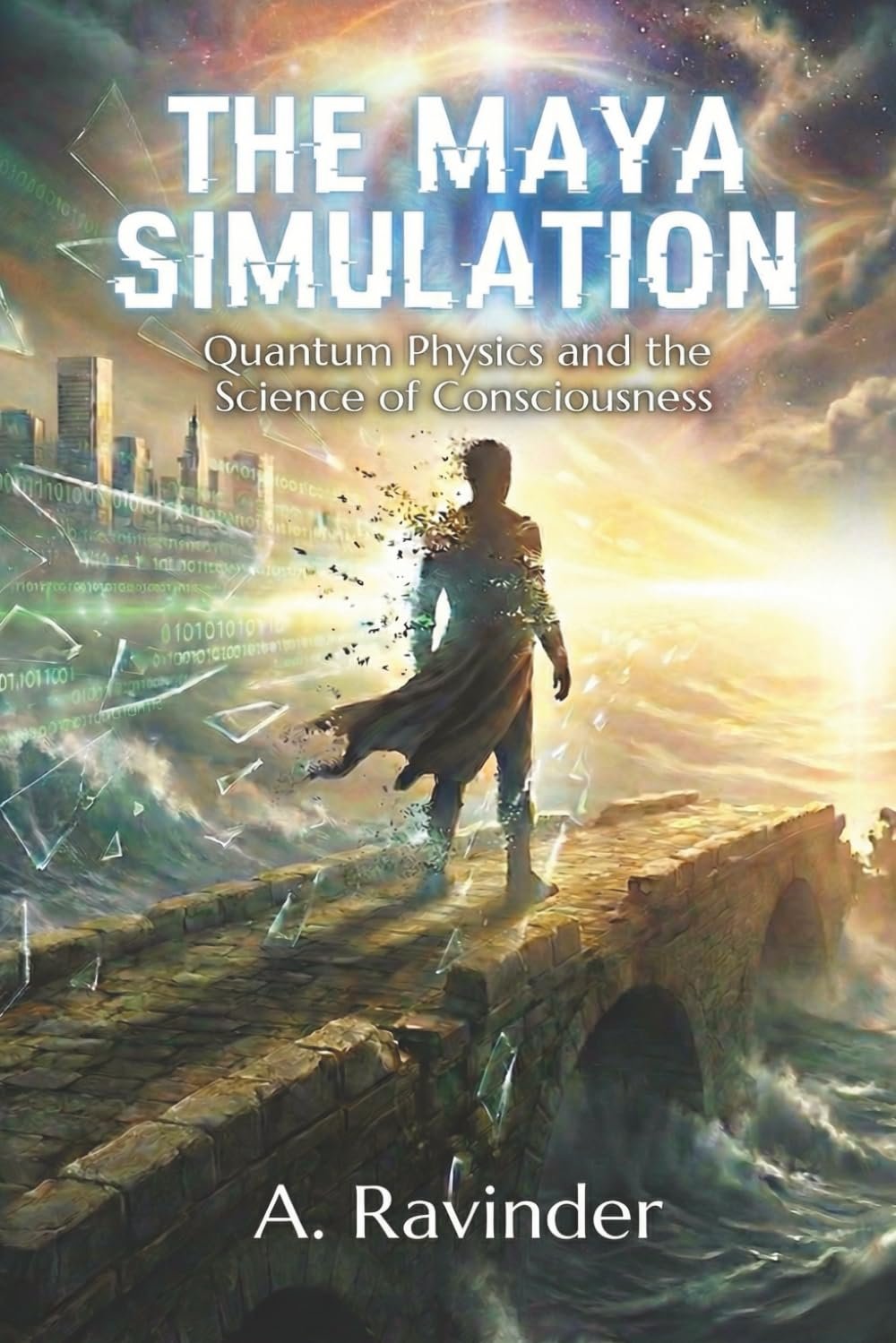
The Maya Simulation: Quantum Physics and the Science of Consciousness
by A. Ravinder
A guide that bridges the ancient wisdom of the Yoga Vasistha with quantum physics and modern consciousness science — for readers ready to question the nature of reality and calm the mind with practical tools like the Zero Voice Technique.
As an Amazon Associate, RamthaMedia can earn from qualifying purchases.
Seth on Multiverses and Cosmic Lifeforms
A fascinating aspect of the Seth material is its elaborate depiction of infinite dimensions, parallel realities, and myriad extraterrestrial beings inhabiting the cosmos. While these descriptions ignite human imagination, responsible inquiry requires that they be examined against modern scientific developments in astrophysics and theoretical physics. In contemporary physics, particularly within quantum mechanics and string theory, the concept of a multiverse is indeed a subject of rigorous exploration, supported by sophisticated mathematical frameworks.
For instance, the Many-Worlds Interpretation (MWI) in quantum mechanics suggests that every quantum measurement causes the universe to branch into multiple alternate realities. Similarly, cosmic inflation theory posits the existence of self-contained ‘bubble universes,’ while M-theory describes our universe as a three-dimensional membrane floating in a higher-dimensional realm alongside other ‘brane worlds.’ Although these theoretical physics models superficially resemble Seth’s claims of infinite parallel possibilities, the crucial difference lies in methodology. Scientific multiverse models are derived from rigorous mathematics and falsifiable hypotheses, whereas Seth’s claims are delivered solely through unverified subjective channeling.
In the observational realm, modern astronomy has discovered thousands of exoplanets orbiting distant stars, confirming that planetary systems are abundant throughout the galaxy. Many of these exoplanets reside within habitable zones, supporting the scientific plausibility of extraterrestrial life. However, while modern astronomy demonstrates the statistical possibility of life beyond Earth through telescopic data and spectroscopic analysis, Seth provides elaborate, unprovable assertions without verifiable data. Channeled descriptions of cosmic realms may serve as compelling metaphysical fiction, but they cannot be equated with empirical scientific discovery.
Seth and Einstein on the Illusion of Time
One of the recurring themes within the Seth discourses is the assertion that time is merely a psychological illusion and that past, present, and future exist simultaneously. Although this premise sounds modern and appears to align with Albert Einstein’s theory of relativity, a closer philosophical examination reveals that Seth’s conceptualization diverges significantly from the scientific meaning of spacetime.
Albert Einstein revolutionized our understanding of reality by demonstrating that time is not an absolute, universal constant, but a relative metric dependent upon the observer’s velocity and the surrounding gravitational field. In the vicinity of immense gravitational forces, such as black holes, or at speeds approaching the speed of light, time slows down relative to a stationary observer. This is not a vague mystical speculation; it is an empirically proven reality integrated into modern technologies such as global positioning satellites (GPS). Einstein synthesized space and time into a single four-dimensional continuum known as spacetime.
A major philosophical development arising from general relativity is the ‘Block Universe’ model, which proposes that all temporal events—past, present, and future—are permanently fixed within a four-dimensional framework. In this scientific perspective, the flow of time is a perceptual artifact of human consciousness traveling along a worldline. However, this scientific insight implies strict physical determinism, posing serious challenges to conventional notions of free will. By contrast, Seth attempts to hold two contradictory positions: asserting on one hand that time is an illusion where all events coexist, while insisting on the other hand that individual conscious intention possesses absolute, unconstrained free will to alter reality at any moment.
While Einstein established the relativity of time through rigorous tensor calculus and verified experimental observations, Seth presents a purely speculative assertion. Equating poetic channeling with relativistic physics creates a false equivalence that misleads seekers into assuming New Age channeling is scientifically grounded.
Seth Channeling Through Jane Roberts and Questions of Authenticity
In evaluating the validity of the Seth teachings, the channeling process of Jane Roberts and the subsequent history of post-Roberts transmissions require transparent scrutiny. Rather than blindly accepting Seth as an enlightened, discarnate entity from higher dimensions, one must examine the psychological, neurological, and historical factors surrounding the medium herself.
Jane Roberts was an accomplished writer and poet possessing exceptional literary flair, imaginative sensitivity, and deep familiarity with metaphysical literature. Throughout her personal journals and reflective writings, Roberts herself frequently expressed genuine self-doubt regarding the true source of the communications. She openly questioned whether Seth was a genuinely distinct external entity or an articulate manifestation of her own subconscious mind, literary talent, and cryptomnesia—a psychological phenomenon where stored memories, books read, and latent thoughts resurface without conscious recognition.
Scientific and psychological investigations into mediumship suggest that deep trance states can unlock extraordinary subconscious creative faculties. During such altered states of consciousness, the human mind is capable of organizing complex philosophical narratives by synthesizing previously absorbed knowledge. The articulate, authoritative voice of Seth closely mirrored Roberts’ own literary inclinations, suggesting that the channeled material was likely an exquisite product of deep subconscious creativity rather than an otherworldly revelation.
The vulnerability of the discarnate entity hypothesis became even more apparent following the death of Jane Roberts in 1984. Several other individuals claimed to channel the same Seth entity, yet none of these subsequent communications matched the literary depth, intellectual coherence, or poetic eloquence of the original Roberts transcripts. If Seth were truly an independent, immortal teacher existing beyond physical form, the quality and profound nature of the teaching would remain consistent regardless of the human instrument. The stark drop in quality following Roberts’ passing strongly indicates that the phenomenon was inextricably tied to her unique intellect and creative subconscious.
📖 Maya Simulation: Is Our Physical Reality a Cosmic Computer Program?
Seth on Mind Power — Psychological Hazards of Reality Creation
The appealing premise that one becomes whatever one thinks carries significant psychological hazards when embraced without discernment. While cultivating an optimistic mindset is psychologically beneficial, elevating ‘thought creation’ to an absolute cosmic law creates unrealistic expectations and severe emotional distress.
Individuals who fully adopt the belief that every fleeting thought directly shapes external reality often develop an unhealthy fear of their own normal emotions. They attempt to violently suppress natural feelings of sorrow, anger, anxiety, or grief, terrified that acknowledging negative emotions will instantly manifest catastrophic consequences in their lives. This continuous mental surveillance and emotional suppression leads to severe chronic stress, neurosis, and spiritual exhaustion, disconnecting seekers from authentic emotional health.
Furthermore, when adverse life events inevitably occur—such as systemic economic failure, terminal medical diagnoses, accidents, or grief—this philosophy fosters acute self-blame and debilitating guilt. Instead of addressing the situation with practical resilience and seeking medical or communal support, believers torment themselves with the agonizing conviction that some hidden mental failure or negative thought pattern caused their disaster. In the real world, human life is embedded within complex biological, environmental, sociological, and economic networks that operate far beyond the sovereign control of an individual’s personal imagination.
The commercialized Law of Attraction amplifies these destructive patterns by encouraging spiritual passivity. Promising that visualization and mental affirmations alone can overcome life’s tribulations discourages seekers from taking concrete, disciplined, and strategic action. Replacing diligent effort and pragmatic skill with passive positive thinking leaves individuals unequipped to face genuine worldly adversity.
Seth and Advaita Vedanta — Scientific Rigor Versus Spiritual Escapism
When channeled teachings face rigorous criticism, proponents frequently resort to defensive spiritual platitudes, asserting that skeptics ‘lack sufficient spiritual frequency’ or are ‘not yet spiritually evolved enough to comprehend.’ Such defensive reasoning constitutes spiritual escapism, serving solely to shield unexamined dogmas from healthy intellectual scrutiny and intellectual accountability.
True spiritual wisdom has never feared rigorous debate. In the Indian tradition of Advaita Vedanta, illuminated by Adi Shankaracharya, the nature of consciousness and reality is explored with uncompromising logical precision. Advaita Vedanta asserts that Brahman (pure, non-dual consciousness) is the ultimate reality, while the manifest world (Jagat) is an experiential projection governed by Maya (the cosmic principle of appearance). However, unlike the subjective solipsism found in Seth’s teachings, Advaita does not claim that an individual ego-mind arbitrarily manufactures the physical universe through private daydreams.
Advaita Vedanta rigorously distinguishes between practical reality (Vyavaharika Satya) and absolute reality (Paramarthika Satya). As long as one operates within the physical body, the laws of nature, societal duties, and the momentum of Karma must be honored with complete humility and pragmatic diligence. Escapist claims of personally creating objective reality dissolve when confronted with Vedanta’s structured metaphysics, which developed over millennia through intense contemplation, scriptural inquiry, and dialectical debate.
Ultimately, genuine spiritual advancement requires an unwavering commitment to truth, grounded discernment (Viveka), and intellectual honesty. While the Seth material offers fascinating literary and psychological insights into the power of belief, it must not be mistaken for empirical science or an infallible cosmic revelation. A discerning seeker must integrate positive psychological attitudes with the grounded wisdom of Dharma, recognizing that while the mind influences one’s personal attitude, it operates within an immense, interconnected cosmic order.
👉 Sony BRAVIA 3 65″ Review: Picture vs. Reality
Spiritual Meaning
The deeper spiritual lesson emerging from an examination of the Seth material is the fundamental necessity of Viveka, or spiritual discrimination. In an age overflowing with channelers, self-proclaimed gurus, and metaphysical marketing, the seeker must distinguish between transient psychological stimulation and authentic Self-realization. True spirituality does not inflate the personal ego by claiming godlike control over physical circumstances; rather, it dissolves the illusions of the ego to reveal the eternal, unattached consciousness underlying all existence.
Consciousness is indeed the fundamental ground of reality, as declared by the Vedic sages, but individual human thoughts are mere ripples on the surface of that vast ocean. Confusing an individual’s personal desires with the cosmic intelligence that governs the universe leads to delusion and suffering. The ancient masters taught that while our mental attitude determines our subjective experience of events, the objective unfoldment of nature occurs in accordance with cosmic law (Rta and Dharma), requiring surrender and aligned action rather than arrogant mental manipulation.
By understanding the profound difference between New Age reality-creation and the traditional doctrine of Karma, the seeker learns to respect the cosmic order. Realizing that the soul evolves through meeting both adversity and prosperity with equanimity frees the mind from the exhausting pursuit of micro-managing external outcomes. Spiritual maturity lies not in bending the universe to personal whims, but in harmonizing one’s individual will with the universal divine order.
To live this truth in modern daily life, one must cultivate balanced mental discipline without falling into metaphysical superstition. When facing difficulties, practice constructive, positive thinking alongside rigorous practical effort, medical care, and ethical responsibility. Reject the guilt-inducing trap of believing that every hardship is a personal mental failure, and instead embrace life’s challenges as opportunities to cultivate resilience, humility, and deeper compassion for the suffering of others.
Chapter Summary
This comprehensive analysis critically evaluates the channeled Seth teachings popularized by Jane Roberts, comparing their core assertion—that individuals create their own reality—against the classical Indian doctrine of Karma, Advaita Vedanta, and empirical physics. While acknowledging Seth’s role in inspiring modern positive mindset movements, the study demonstrates that the material suffers from repetitive circularity, lacks structural precision, and severely oversimplifies cosmic mechanics by ignoring accumulated past Karma (Sanchita and Prarabdha). Channeled assertions regarding multiverses and the illusion of time are contrasted with empirical quantum mechanics and Einstein’s relativity, revealing a profound methodological divide. Furthermore, psychological hazards such as toxic guilt, emotional suppression, and victim-blaming are highlighted alongside an examination of Jane Roberts’ own subconscious creativity. The article concludes that genuine spiritual maturity demands Viveka—clear discernment—balancing positive mental focus with grounded action and alignment with universal cosmic law.
📖 What Is the Nature of the World? Is Reality an Illusion? | Yoga Vasistha S3 EP-34
Scripture Notes
- Main Message: Sanatana Dharma teaches that while the human mind wields immense power over personal perception and current action (Kriyamana Karma), individual existence is simultaneously governed by inexorable cosmic laws (Dharma and Prarabdha Karma). True spiritual liberation arises not from attempting to manipulate the universe to satisfy personal cravings, but from transcending the ego and realizing one’s true identity as pure, non-dual consciousness (Brahman).
- Philosophical Teaching: Advaita Vedanta resolves the paradox of free will and destiny by categorizing reality into empirical (Vyavaharika) and absolute (Paramarthika) levels. In the empirical realm of everyday existence, the universe operates through structured cause, effect, and moral responsibility; claiming to arbitrarily create external physical conditions through personal thought alone is an error of Maya. Only at the absolute level of Self-realization does one discover that consciousness alone exists without a second.
Frequently Asked Questions
What is the core philosophy of the Seth teachings?
The central premise of the Seth teachings, channeled by Jane Roberts, is that consciousness forms physical reality. It asserts that individuals create their personal life experiences, environment, and physical circumstances entirely through their conscious beliefs, expectations, and habitual thought patterns.
How does Seth’s reality creation differ from the law of Karma?
Seth focuses almost exclusively on present conscious thoughts, ignoring past-life accumulated impressions (Sanchita Karma) and predetermined life circumstances (Prarabdha Karma). In contrast, the Indian law of Karma provides a comprehensive multi-lifetime framework of cause and effect, explaining suffering and circumstance without resorting to immediate victim-blaming.
Did Albert Einstein’s theory of relativity validate Seth’s views on time?
No. While Einstein demonstrated that time is relative to speed and gravity within the spacetime continuum, his conclusions were established through mathematical formulas and verifiable empirical tests. Seth’s assertion that time is an illusion is a subjective, metaphysical speculation that lacks empirical proof and mathematical structure.
What are the psychological dangers of the belief that you create your own reality?
Uncritical belief in absolute reality-creation can lead to severe emotional suppression, anxiety over natural negative thoughts, and profound self-blame during unavoidable tragedies like illness or loss. It can also encourage passive day-dreaming instead of taking disciplined, practical actions to resolve real-world problems.