
Parabrahman is the supreme, formless consciousness that serves as the ultimate source and foundation of all cosmic existence. In the Kena Upanishad, Parabrahman is defined as the foundational reality enabling the mind to think, eyes to see, and breath to flow, accessible only through direct intuitive self-inquiry rather than sensory perception.
In the whirlwind of modern lifestyle, human beings remain intensely occupied with the external world and the relentless pursuit of material comforts, frequently overlooking the deeper truth of their own inner consciousness. Driven by sensory desires, people often chase after worldly objects despite recognizing that everything experienced in the physical realm is transient, fragile, and fleeting. However, uncovering the underlying mystery of creation, the purpose of individual existence, and the eternal fountain of genuine happiness requires an inward journey that transcends the conditioned mind and the physical senses.
Guiding humanity along this inward pilgrimage are the ancient <a href=”https://www.britannica.com/topic/Upanishad”>canonical philosophical treatises known as Upanishads</a>, which constitute the philosophical crown of Vedic wisdom. Among these profound texts, the Kena Upanishad holds a preeminent place by offering an uncompromising, luminous exploration of the infinite Self and the true nature of ultimate reality. By redirecting human inquiry from outward perception to the foundational witness behind perception, this ancient scripture serves as an indispensable guide for seekers aspiring toward timeless liberation.
Studying the Kena Upanishad provides modern seekers with a clear intellectual framework and a practical contemplative path to awaken from spiritual forgetfulness. It systematically deconstructs our dependence on finite objects and intellectual concepts, inviting us to discover the uncreated light shining within our own hearts. As we examine the insights of this venerable scripture, we uncover the eternal bridge connecting human awareness with the boundless, unconditioned supreme consciousness.
Read the complete Telugu edition of this article.
Introduction to Parabrahman — Concept and Meaning
The sacred term Parabrahman is derived from two profound Sanskrit roots: ‘Param’, signifying the supreme, transcendent, and unsurpassable, and ‘Brahman’, representing the infinite, ever-expanding cosmic reality that forms the bedrock of all creation. Therefore, Parabrahman denotes the supreme reality that permeates everything, gives rise to everything, sustains everything, and yet transcends all temporal and spatial boundaries. It is the uncaused cause of all manifestations, the ultimate goal of spiritual seeking, and the primary essence of pure consciousness itself. Across classical Indian philosophical systems, and especially within the Vedas and Upanishads, the multifaceted dimensions of this supreme reality are expounded with extraordinary clarity and depth.
While the Samhita and Brahmana portions of the Vedas emphasize the performance of sacred rituals and duties known as Karmakanda, the Upanishads shift the focus entirely toward Jnanakanda, the domain of direct philosophical illumination and self-knowledge. In these sacred texts, seekers explore foundational inquiries regarding the individual soul, the supreme cosmic consciousness, the cosmic mystery of creation, and the precise path leading to final liberation. Within this sacred canon, the Kena Upanishad occupies a distinctive and revered position. It bridges the conceptual understanding of the divine with form, name, and attributes known as Saguna Brahman with the absolute, formless, attribute-free reality known as Nirguna Brahman. Thus, it functions not merely as an intellectual treatise, but as a practical guide for self-discovery and a pristine mirror reflecting the absolute truth of existence.
Kena Upanishad — The Vedic Origin of Parabrahman
The Kena Upanishad belongs to the ancient tradition of the Samaveda, emerging from the Talavakara or Jaiminiya Shakha at a historical pinnacle when the Vedic inquiry into spiritual truth reached its highest maturity. This celebrated text derives its name from its opening Sanskrit word, ‘Kenesitam’, commencing with the fundamental inquiry: ‘By whose will does the directed mind fly toward its objects? By whose command does the vital life force move first?’ The interrogative root ‘Kena’ signifies ‘by whom’ or ‘by what supreme power’. Through this initial query, the Upanishad immediately establishes its central objective: to discover the transcendent power and consciousness that animates the human mind, the sensory instruments, and the life-sustaining breath.
In keeping with the venerable tradition of Vedic instruction documented in the <a href=”https://en.wikipedia.org/wiki/Kena_Upanishad”>foundational texts of the Samaveda tradition</a>, the Kena Upanishad unfolds as an intimate dialogue between an enlightened preceptor and an earnest disciple. As the student presents penetrating questions regarding the unseen driver of human experience, the master delivers profound explanations that unveil the genuine nature of supreme consciousness. This dynamic question-and-answer format actively draws the reader into the contemplative process, transforming abstract philosophy into immediate personal reflection. It does not simply convey theoretical knowledge; rather, it provides a direct map for translating metaphysical understanding into living spiritual realization.
Fundamental Inquiries — Seeking Parabrahman Beyond the Mind
The opening section of the Kena Upanishad arrests our routine thought patterns by presenting a sequence of radical, primary questions. These inquiries challenge seekers to look past the surface activities of life and investigate the primary source that empowers all biological and psychological functions. By questioning the hidden origin of conscious experience, the scripture invites us into deep introspection to recognize the presence of Parabrahman:
1. By whose impulse does the mind think, process thoughts, formulate decisions, and acquire information? What is the hidden conscious light that operates the mental faculty?
2. By whose conscious power does the physical eye perceive shapes, colors, and forms? What is the foundational awareness that enables vision itself?
3. From what source does the organ of hearing derive its capacity to register sound vibrations and comprehend spoken language?
4. By whose divine command does the vital breath, the Prana, sustain biological functions and maintain the living organism?
These inquiries clearly demonstrate that the human mind, the sensory organs, and the physical body cannot function autonomously. They are inert instruments that depend entirely on an underlying conscious principle for their vitality and operation. The Upanishad identifies this primordial source as Brahman. By asking these questions, the seeker is guided to transition from spiritual ignorance to wisdom, from the ephemeral realm of matter to the eternal reality of spirit, and from the illusion of mortality toward immortal awareness. Exploring <a href=”https://ramthamedia.in/every-hindu-must-read-books/”>essential scriptures every spiritual seeker must read</a> reinforces how vital these ancient questions are for genuine spiritual growth.
RECOMMENDED BOOK
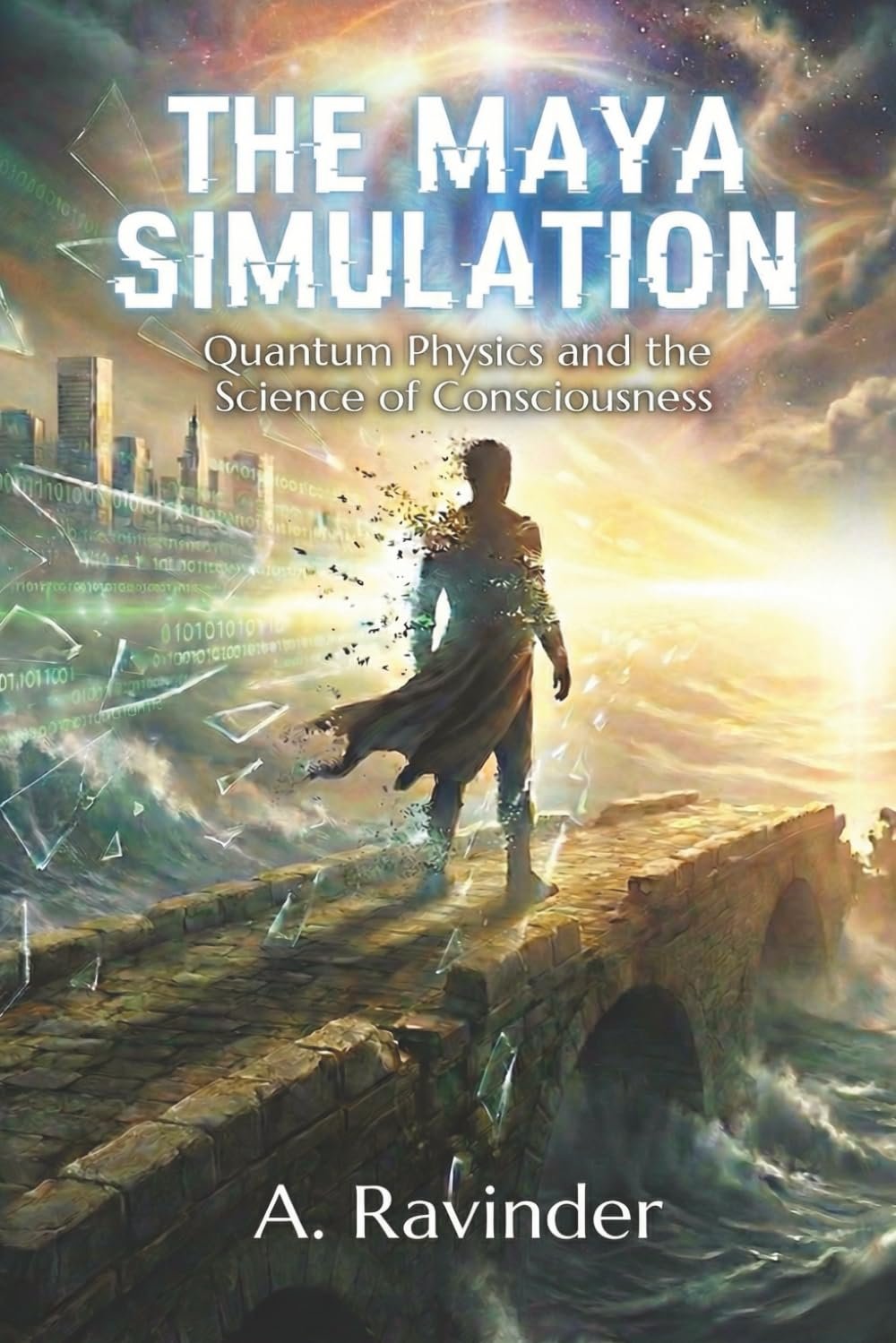
The Maya Simulation: Quantum Physics and the Science of Consciousness
by A. Ravinder
A guide that bridges the ancient wisdom of the Yoga Vasistha with quantum physics and modern consciousness science — for readers ready to question the nature of reality and calm the mind with practical tools like the Zero Voice Technique.
As an Amazon Associate, RamthaMedia can earn from qualifying purchases.
Beyond the Senses — Defining the Power of Parabrahman
In articulating the nature of Parabrahman, the Kena Upanishad explicitly declares that the ultimate reality cannot be grasped by the ordinary senses or comprehended by conceptual intellect. The text provides a classical definition in its famous verse:
‘Srotrasya Srotram Manaso Mano Yad Vaco Ha Vacam Sa U Pranasya Pranash Caksusash Caksuh Atimucya Dhirah Pretyasmallokadamrta Bhavanti.’
This translates to: ‘It is the Ear of the ear, the Mind of the mind, the Speech of speech, the Breath of breath, and the Eye of the eye. The wise, relinquishing identification with the senses and transcending this mortal plane, attain immortality.’
Through this sublime declaration, the Upanishad unveils three essential truths regarding the supreme reality. First, Brahman is not an object that can be perceived outwardly like a physical form, sound, or texture. Second, the ordinary mind cannot encapsulate Brahman within thoughts, images, or definitions, because the mind itself is illuminated by Brahman. Third, the physical senses are entirely incapable of reaching it: the eyes cannot see it, ears cannot hear it, the tongue cannot taste it, the nose cannot smell it, and the skin cannot touch it.
Parabrahman is therefore a transcendent reality that defies linguistic description and conceptual limitation. We can awaken to its presence through intuitive realization, yet we cannot define it in finite vocabulary. It functions as the unmanifest cosmic power without which no perception could ever take place. It is comparable to a luminous lamp hidden in darkness: though the lamp itself may not be the direct object of sight, its self-effulgent radiance illuminates every object in the room, making all vision possible.
The Timeless Nature of Nirguna Parabrahman
The Kena Upanishad firmly reveals Parabrahman as Nirguna—entirely free from material qualities, forms, and attributes. In the empirical universe, every manifest entity possesses a specific shape, color, dimension, and set of identifiable characteristics. In stark contrast, Parabrahman transcends all such qualifying conditions. It cannot be bound by categories of space, causality, or physical substance, remaining forever unconditioned and pure.
Consequently, Parabrahman is entirely timeless. It remains unaffected by the divisions of past, present, and future. It existed prior to the manifestation of the cosmos, persists continuously throughout the existence of the universe, and endures unchanged even after the cosmic dissolution. It is eternal, unchanging, and absolute. While physical eyes cannot perceive this formless reality, sincere practitioners can experience its presence directly through dedicated meditation, disciplined contemplation, and profound spiritual inquiry.
Furthermore, this supreme truth is realized only when the veil of spiritual ignorance, known as Avidya, is dismantled by the light of pure wisdom. This liberating wisdom is not acquired merely through academic study or intellectual accumulation; it is an innate, self-luminous realization that dawns within the quieted heart. Parabrahman is without beginning and without end—it is Nitya (eternal), Satya (truth), Shuddha (pure), Buddha (all-aware), and Mukta (ever-free). It is not merely an anthropomorphic deity, but the infinite, all-pervading substratum of the entire cosmos.
True Knowledge and Experiencing Parabrahman Directly
A cornerstone of the Kena Upanishad is its radical exploration of the relationship between intellectual understanding and the actual realization of Parabrahman. The scripture states with resolute clarity: ‘Yadvaco Nivartante Aprapya Manasa Saha’—words return baffled, together with the mind, unable to reach that supreme state. This emphatic statement highlights the absolute transcendence of the divine, reminding seekers that finite thoughts cannot encompass the infinite.
The Upanishad cautions that merely reading about Brahman or debating philosophical concepts is fundamentally different from experiencing the truth directly. Theoretical knowledge, known as Paroksha Jnana, must transform into direct, unmediated intuitive realization, termed Aparoksha Anubhuti. Intellectual learning serves only as a preparatory guide; actual realization requires removing the mental constructs that obscure our true nature.
This ultimate realization occurs when the seeker understands the true relationship between individual consciousness and supreme cosmic awareness. The Jivatma, or individual soul, is a reflection of the all-pervading Paramatma. When the individual consciousness sheds its mistaken identification with limited physical and mental sheaths, it recognizes its true origin in Parabrahman. This realization is likened to a sudden flash of lightning: the veil of ignorance drops instantly, dissolving egoic identity into the boundless peace of universal consciousness.
Experiencing Parabrahman — The Core Upanishadic Vision
Rather than treating spirituality as an abstract intellectual doctrine, the Kena Upanishad presents the realization of Parabrahman as an immediate, practical experience. The earnest pursuit of self-knowledge and inward inquiry is presented as the singular path capable of bestowing authentic peace, lasting contentment, and ultimate liberation.
The scripture teaches seekers to perceive the divine not merely as a localized personal deity confined to a specific shrine or image, but as the universal cosmic principle residing equally in every atom of creation. While traditional worship of divine forms possesses great devotional value, the Upanishad urges aspirants to expand their vision and behold the supreme power pulsating within every living creature, every natural law, and every moment of conscious experience.
Attaining this direct experience represents the supreme fulfillment of human life. When a person realizes Parabrahman, they gain an inner completeness that no external circumstance can diminish. Material gains and worldly losses cease to disturb their equanimity. As taught in the higher branches of Vedanta, attaining this Self-knowledge fulfills the ultimate human purpose, known as Purushartha, freeing the soul from the cyclic bondage of repeated birth and death.
The Path of Knowledge in Seeking Parabrahman
The inquiry into the nature of Parabrahman detailed in the Kena Upanishad forms the very heart of the path of knowledge, or Jnana Marga. In normal everyday existence, human attention remains perpetually captured by sensory stimuli. We see sights, hear sounds, and process thoughts without ever asking what enables these experiences to occur. The Upanishad cuts through this unexamined lifestyle with the declaration: ‘Na Tatra Cakshur Gacchati Na Vag Gacchati No Manah’—the eye does not reach there, nor does speech, nor the mind.
Because Parabrahman is the ultimate subject that makes all objective experience possible, it cannot be turned into an object of knowledge. To know the knower of all things, the seeker must turn awareness back upon itself. This contemplative journey requires intellectual humility, purification of character, and the systematic surrender of personal ego. Engaging in <a href=”https://ramthamedia.in/atma-sakshatkaram-consciousness-waves-science/”>profound states of self-realization and consciousness</a> illustrates how inward meditation allows the practitioner to transcend ordinary limitations and align with this transcendental truth.
This sacred pursuit relies on three pillars: continuous self-inquiry into one’s true identity, harmonious integration of logical reflection with inner experience, and the guidance of an enlightened preceptor. The teacher acts as a spiritual beacon, assisting the seeker in dismantling false identifications with the transient body and restless mind until the unchanging reality of Parabrahman shines forth effortlessly.
📖 Is Time Merely an Illusion? The Ultimate Essence of Leela’s Story | Yoga Vasistha S3 EP-33
The Non-Dual and All-Pervasive Nature of Parabrahman
The Kena Upanishad characterizes the nature of Parabrahman as Nirbheda—completely devoid of internal distinctions, divisions, or limitations. There are no borders, gradations, or separations in the supreme reality. Although the cosmos presents a bewildering variety of names and forms, one indivisible, homogeneous consciousness underlies the entire cosmic panorama.
This singular reality sustains and permeates all natural laws and cosmic forces. Whether we observe gravitational pull, electromagnetic energy, or the radiant brilliance of light, every cosmic manifestation is an expression of the one primordial energy of Parabrahman. It is the solitary power operating behind all physical phenomena and spiritual faculties alike.
Furthermore, Parabrahman remains equally present everywhere and accessible to all beings without partiality. It is not restricted by geographic location, social background, gender, or intellectual capacity. The supreme presence exists identically within the sage and the simple seeker, within the rich and the poor, and within every life form. It witnesses all experiences while remaining untainted by the dualities of pleasure and pain, joy and sorrow, or gain and loss.
Manifest and Unmanifest Dimensions of Parabrahman
Vedantic philosophy approaches Parabrahman through two complementary perspectives: the manifest aspect (Saguna or Vishvaroopa) and the unmanifest aspect (Nirguna). In its manifest dimension, Parabrahman expresses itself as the wondrous variety of the visible universe. Every celestial body, mountain, ocean, animal, and human being is a sacred manifestation of this boundless reality. Devotees who express their love through sacred forms, including dedicated worship and <a href=”https://ramthamedia.in/lord-ganesha/”>devotional focus on Lord Ganesha</a> or other revered deities, are venerating this divine reality through its accessible, personal manifestations.
In its unmanifest dimension, Parabrahman remains entirely formless, infinite, and transcendent. It is neither bound by any name nor circumscribed by any physical representation. While philosophers and contemplative mystics emphasize this Nirguna aspect through silent meditation and discrimination, the two perspectives are fundamentally unified. They are simply two ways of apprehending the one supreme truth, much like water and ice or the ocean and its waves.
Within the human being, this supreme reality dwells as the Atman, the inner witness of thoughts and sensations. When the individual soul realizes that its inner Self is non-different from the universal reality, all notions of separation dissolve. This conscious union between the individual and the infinite is the very definition of Moksha, or eternal spiritual freedom.
The Oneness of Jivatma and Parabrahman
The profound relationship between the Jivatma (individual soul) and Paramatma (supreme soul) represents the central revelation of the Upanishads. The individual soul is not a separate entity created out of nothing; rather, it is the divine consciousness reflected within the adjuncts of the human mind and body, analogous to the sun reflecting in countless vessels of water. Due to spiritual ignorance, the individual soul identifies with the limitations of the body-mind vessel and experiences itself as isolated, anxious, and mortal.
By embarking on the inward inquiry prescribed in the Kena Upanishad, the individual soul begins to investigate its true origin. As false identifications are discarded through discernment, the soul discovers that its fundamental identity has always been one with the supreme reality. Great Upanishadic declarations such as ‘Aham Brahmasmi’ (I am Brahman) and ‘Tat Tvam Asi’ (You are That) give voice to this sublime realization of inherent oneness.
This realization cannot be achieved through intellectual gymnastics alone; it requires consistent, earnest spiritual practice. Through regular meditation, mindful dispassion, and contemplative inquiry, the practitioner gradually quiets the agitations of the ego. In that stillness, the individual soul recognizes its boundless heritage, tasting unconditioned peace and infinite love.
Realizing Parabrahman — Awakening Supreme Peace and Bliss
According to the Kena Upanishad, the direct realization of Parabrahman culminates in the attainment of supreme, unshakable peace and transcendental bliss. This state is not an ephemeral emotional high or a temporary mental calm; it is an enduring spiritual awakening that transforms one’s entire existence. To attain this exalted state, the scripture emphasizes three vital disciplines:
First, the restless mind must be stilled. The human mind is typically flooded with endless desires, anxieties, regrets, and discursive chatter. Through the regular practice of meditation, this mental turbulence is quieted, allowing the underlying stillness of pure consciousness to reveal itself. Second, the sensory organs must be brought under serene self-mastery. When sensory desires no longer drag attention outward, inner vision becomes pristine and clear.
Third, the seeker must harmonize spiritual knowledge (Jnana), meditative concentration (Dhyana), and heartfelt devotion (Bhakti). Jnana clarifies the intellect, Dhyana stabilizes attention, and Bhakti purifies the emotions. As the celebrated Upanishadic maxim declares, ‘Brahmavid Brahmaiva Bhavati’—the knower of Brahman becomes Brahman indeed. Upon realizing this truth, all illusions of separateness vanish, and the enlightened seeker abides in timeless freedom.
👉 Home Temple Pooja Stand with Door, LED Light and Storage
Four Disciplines to Realize Parabrahman
To help seekers translate sublime metaphysical philosophy into everyday living, the Vedic tradition outlines four interconnected disciplines for realizing Parabrahman:
1. Jnana (Cultivation of Wisdom): This involves studying the sacred scriptures with reverence, contemplating their inner significance, and practicing continuous self-inquiry by asking ‘Who am I?’. It encompasses the classical threefold discipline of Shravana (attentive listening to sacred teachings), Manana (deep logical reflection to remove doubts), and Nididhyasana (deep contemplative absorption in the truth).
2. Dhyana (Meditation): Meditation requires withdrawing awareness from external distractions and fixing attention steadfastly upon the divine presence within. Consistent daily practice stills mental agitations and reveals profound inner tranquility.
3. Bhakti (Devotion and Surrender): Bhakti is the cultivation of selfless love and reverent devotion toward the Supreme. True devotion extends beyond outer rituals, inspiring the practitioner to behold the divine presence in every living being and engage in dedicated, selfless service with complete inner surrender.
4. Vairagya (Dispassion and Non-Attachment): Dispassion does not imply abandoning one’s duties or escaping into seclusion; rather, it represents the mature capacity to live in the world without being enslaved by material desires or emotional dependencies. Acting with unselfish dedication and releasing anxious attachment to outcomes bestows true inner freedom.
These four disciplines function in harmonious synergy: wisdom fosters dispassion, dispassion deepens meditation, meditation enriches devotion, and devotion crowns wisdom, carrying the seeker toward self-realization.
Living the Dharmic Message of Parabrahman
The Kena Upanishad does not advocate an escape from the realities of everyday life; rather, it offers a radiant vision for sanctifying daily existence. It teaches humanity to align sensory experiences with spiritual awareness, recognizing that every faculty of perception is energized by the supreme consciousness.
Rather than suppressing the senses, the scripture instructs us to recognize their divine source. Because our eyes see and our ears hear by the grace of Parabrahman, our actions and perceptions should be guided by truth, compassion, and noble ideals. When spiritual ignorance is dispelled by wisdom, the sorrows born of egoic delusion naturally dissolve.
The Taittiriya Upanishad echoes this sublime truth in the declaration ‘Anando Brahmeti Vyajanat’—know that Brahman is pure bliss. When an individual aligns their life with this awareness, their existence becomes joyful and purposeful. Regardless of external challenges, their inner sanctuary remains serene, fearless, and whole.
How Realizing Parabrahman Illuminates Human Existence
The Kena Upanishad presents the wisdom of Parabrahman not as a dry theological hypothesis, but as a living, transformative experience. It stands as an empowering guide that reveals our inherent spiritual grandeur, providing the keys to a deeply meaningful, ethical, and illuminated life.
By mastering the senses, calming the intellect, and awakening to our identity with the supreme consciousness, we fulfill the highest purpose of human existence. Realizing Parabrahman is the ultimate summit of spiritual striving and the wellspring of immortal peace. As the ancient message affirms: ‘Life shines with supreme radiance through the realization of Parabrahman!’
A person who attains this realization becomes a luminous presence in society. Beholding the sacred reality within every heart, their thoughts and actions flow with natural compassion, equanimity, and love. They walk the earth as a beacon of light, inspiring and uplifting everyone around them. Are you ready to embark on this noble journey of self-inquiry and welcome the timeless light of the Kena Upanishad into your life?
Spiritual Meaning
The esoteric core of the Kena Upanishad centers on the radical deconstruction of the subject-object relationship. In ordinary awareness, the individual presumes that the ego is the conscious observer perceiving an external world of objects. The Upanishad reverses this fundamental assumption by demonstrating that the ego, the mind, and the sensory faculties are themselves passive objects illuminated by a deeper, uncreated Subject—the supreme Parabrahman.
By defining Brahman as the ‘Ear of the ear’ and the ‘Mind of the mind’, the scripture guides the practitioner to trace the stream of perception back to its unmanifest source. The spiritual teaching reveals that consciousness is not a byproduct of biological organs, but the primary, self-luminous reality that makes biological life possible. Recognizing this truth liberates the seeker from the illusion of being a vulnerable, mortal body-mind complex.
Furthermore, the text reveals that spiritual enlightenment is not the acquisition of something novel or external, but the intuitive rediscovery of that which has always been present. When the mental agitation of desire and fear subsides, the self-effulgent nature of the divine presence shines forth effortlessly as one’s own authentic Self.
In our contemporary world characterized by digital overstimulation, chronic stress, and constant external validation, the teachings of the Kena Upanishad provide an urgent and grounding sanctuary. When we pause amidst daily responsibilities to observe our own breathing and recognize the silent witness behind our running thoughts, we immediately disconnect from anxiety. Practicing this mindful self-inquiry in everyday situations allows us to respond to life’s challenges with poise, clarity, and boundless kindness.
📖 AI and Spiritual Consciousness: Can We Communicate with the Divine?
Chapter Summary
This comprehensive exposition of the Kena Upanishad unfolds the profound nature of Parabrahman, the transcendent and all-pervading reality behind the cosmos. Commencing with fundamental questions regarding the unseen driver of human cognition, speech, and perception, the scripture reveals that the mind and senses are dependent instruments illuminated by supreme consciousness. Parabrahman is expounded as Nirguna—attributeless, timeless, and beyond the grasp of sensory organs and intellectual definitions. The text emphasizes that theoretical knowledge must mature into direct, intuitive experience (Aparoksha Anubhuti), which dissolves the illusion of separation between the individual soul (Jivatma) and the universal reality (Paramatma). Through the balanced integration of four essential spiritual disciplines—Jnana (wisdom), Dhyana (meditation), Bhakti (devotion), and Vairagya (dispassion)—seekers quiet the restless mind and transcend egoic limitations. Realizing Parabrahman culminates in supreme peace, unconditioned bliss, and spiritual liberation, transforming one’s daily life into an illuminated expression of universal love, compassion, and divine purpose.
Scripture Notes
- Main Message: The central message of the Kena Upanishad is that the supreme reality, Parabrahman, cannot be perceived as an objective entity through the senses or intellect, because it is the very consciousness that empowers all thinking, speaking, seeing, and living. Immortality and authentic peace are realized not by pursuing external objects, but by turning awareness inward to recognize the foundational divine presence illuminating every experience.
- Philosophical Teaching: Philosophically, the text expounds the non-dual (Advaita) essence of Vedic wisdom. It establishes that while the manifest universe displays infinite diversity (Saguna), its foundational substratum is unconditioned, formless, and non-dual (Nirguna). The individual soul is fundamentally identical to this supreme reality. When spiritual ignorance is removed through systematic self-inquiry and contemplation of Upanishadic truths under preceptor guidance, the seeker awakens to their true identity as pure, eternal consciousness.
Frequently Asked Questions
What is the central question asked in the Kena Upanishad?
The Kena Upanishad begins with the fundamental inquiry: ‘By whose will does the mind think, by whose command does the vital life force move, and by whose power do the eyes and ears perceive?’ It seeks to identify the supreme conscious power operating behind human existence.
Why is Parabrahman described as beyond the senses?
Parabrahman is described as beyond the senses because physical senses can only perceive finite objects possessing form, color, or sound. Brahman is the uncreated, formless subject that enables the senses to operate; therefore, it cannot be converted into an external object of perception.
What is the difference between Saguna and Nirguna Brahman?
Saguna Brahman refers to the supreme reality manifesting with divine qualities, names, and forms as the cosmos and personal deities. Nirguna Brahman refers to the unmanifest, attribute-free, timeless, and formless absolute reality that transcends all qualifying conditions and material categories.
How can a seeker practically realize Parabrahman in daily life?
Seekers realize Parabrahman by harmonizing four spiritual disciplines: cultivating scriptural wisdom (Jnana), practicing daily meditation (Dhyana), nurturing loving devotion and selfless service (Bhakti), and maintaining healthy non-attachment to worldly outcomes (Vairagya).
{“@context”: “https://schema.org”, “@graph”: [{“@type”: “BreadcrumbList”, “itemListElement”: [{“@type”: “ListItem”, “position”: 1, “name”: “Home”, “item”: “https://ramthamedia.in/”}, {“@type”: “ListItem”, “position”: 2, “name”: “Spirituality-English”, “item”: “https://ramthamedia.in/en/category/spirituality-english/”}, {“@type”: “ListItem”, “position”: 3, “name”: “Parabrahman: The Ultimate Truth of the Kena Upanishad”}]}, {“@type”: “FAQPage”, “mainEntity”: [{“@type”: “Question”, “name”: “What is the central question asked in the Kena Upanishad?”, “acceptedAnswer”: {“@type”: “Answer”, “text”: “The Kena Upanishad begins with the fundamental inquiry: ‘By whose will does the mind think, by whose command does the vital life force move, and by whose power do the eyes and ears perceive?’ It seeks to identify the supreme conscious power operating behind human existence.”}}, {“@type”: “Question”, “name”: “Why is Parabrahman described as beyond the senses?”, “acceptedAnswer”: {“@type”: “Answer”, “text”: “Parabrahman is described as beyond the senses because physical senses can only perceive finite objects possessing form, color, or sound. Brahman is the uncreated, formless subject that enables the senses to operate; therefore, it cannot be converted into an external object of perception.”}}, {“@type”: “Question”, “name”: “What is the difference between Saguna and Nirguna Brahman?”, “acceptedAnswer”: {“@type”: “Answer”, “text”: “Saguna Brahman refers to the supreme reality manifesting with divine qualities, names, and forms as the cosmos and personal deities. Nirguna Brahman refers to the unmanifest, attribute-free, timeless, and formless absolute reality that transcends all qualifying conditions and material categories.”}}, {“@type”: “Question”, “name”: “How can a seeker practically realize Parabrahman in daily life?”, “acceptedAnswer”: {“@type”: “Answer”, “text”: “Seekers realize Parabrahman by harmonizing four spiritual disciplines: cultivating scriptural wisdom (Jnana), practicing daily meditation (Dhyana), nurturing loving devotion and selfless service (Bhakti), and maintaining healthy non-attachment to worldly outcomes (Vairagya).”}}]}]}