
Katyayani is the Navadurga form connected in the Devi tradition with the power that gathers to defeat a destructive force. Her story is not a licence for aggression; it asks how courage can be disciplined by discernment and directed toward protecting life and justice.
Confronting unfairness requires something far deeper than anger; it demands courage steadily guided by knowledge, which forms the true heart of Katyayani’s presence. Grounded faithfully in the reviewed Telugu source, this exploration keeps the sacred lines clear, distinguishing what is taught in foundational scripture, what has evolved through local custom, and what serves as thoughtful reflection for our times. Keeping those distinctions in plain view protects the integrity of the living tradition while helping us understand its genuine spiritual purpose today.
Within the Devi tradition, Katyayani embodies the focused energy that gathers purposefully when an unruly, destructive force must be stopped. Her narrative never offers an excuse for private wrath or reckless aggression. Instead, it places a quiet, demanding question before the seeker: how can human courage be trained by clear discernment so that strength is spent solely on defending justice and safeguarding vulnerable lives? When strength answers to wisdom, action protects rather than harms.
Read the complete Telugu edition of this article.
How sacred tradition remembers Katyayani
Across the Devi tradition, Katyayani represents the collective spiritual force that gathers deliberately to overcome an overwhelming destructive power. Her sacred lore must never be misread as permission for personal vendettas or unchecked anger. Rather, it challenges us to discipline raw courage through careful discernment, directing every ounce of resolve toward preserving life and upholding justice. We approach her accounts with reverent devotion, recognizing that such stories can never replace consulting a primary sacred text or verifying an official temple announcement. Whenever a specific ritual practice belongs strictly to one family lineage or community, that boundary must be respected, ensuring that a beloved local custom is never mistaken for an absolute universal rule.
What the symbols of Katyayani reveal
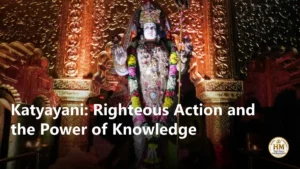
In her traditional imagery, the presence of the lion and the gathered weapons conveys fearless resolve and an unyielding readiness to act. Alongside this imagery, the comparative reflection on Mahasaraswati emphasizes pure clarity of mind, truthful speech, dedicated learning, and the inner refinement required to resolve a conflict without creating unnecessary harm. Sacred forms in worship serve as anchors, gently drawing our wandering attention into honest self-examination. Because different temple shrines and lineage teachers illuminate these symbols from distinct perspectives, this rich variety of understanding remains a treasured, living strength of the tradition.
The inner meaning that Katyayani awakens
Standing against unfairness with courage guided by genuine knowledge only holds true value when it reshapes our day-to-day behavior. In the rush of daily friction, sincere devotion steps in to check a hasty reaction, holding us accountable to our promises and carving out a quiet pause where clear discernment can breathe. The spiritual path is not a chase after dramatic inward sensations or impressive titles; its real work is helping us become steadily more truthful in our words, patient with others, and responsible in every commitment we carry.
This inner discipline naturally carries over into how we treat the world around us. Lighting a brass lamp, repeating a sacred mantra, or offering flowers before a decorated image finds its true fulfillment only when it inspires tender care for our family, fair respect for working hands, honesty in our conversation, and a willing hand extended to someone facing hardship. These reflections show how the teaching applies to daily life, rather than promising automatic or guaranteed material rewards from performing a ceremony.
Simple ways to honor Katyayani at home
At home, honoring this presence can begin quite simply: sit quietly with a short sacred passage, resolve to speak truth without bitterness, and take one constructive step toward resolving an unfair situation at hand. For household worship, lighting an oil lamp, offering fresh white flowers, and softly repeating the sacred name are more than sufficient. Prayers, however, cannot replace professional guidance when legal challenges, health conditions, or safety concerns arise; those always require qualified expert care. Keep your prayer corner tidy, prepare sacred offerings strictly according to your household budget and physical health, and never adopt specialized initiation rites picked up from unverified sources. You can warmly involve young children by sharing a gentle story, letting them place a blossom, or pausing together in a brief moment of family gratitude.
The northern tradition and its southern reflection
Across different regions, Mahasaraswati is revered through distinctive worship customs and should never be viewed as an identical or interchangeable name for Katyayani. Considering the two forms together allows a meaningful dialogue between steadfast courage and contemplative wisdom, even while honoring the unique boundaries of each sacred lineage. Bringing in the southern name serves solely as a thoughtful comparison, not as an assertion that every temple across South India follows an identical ten-day alankara sequence. Each regional sanctuary cherishes its own established calendar and traditional observances.
📖 Kushmanda: Creative Power and Mahachandi
Temple traditions across the Telugu lands
Throughout Telangana and Andhra Pradesh, the festive days of Dasara unfold through vibrant temple alankaras, the beloved tradition of household bommala koluvu doll displays, community chanting, and selfless volunteer service. However, specific schedules for the 2026 season remain entirely in the hands of individual temple administrations. Devotees planning a visit should always confirm darshan timings, special queue arrangements, and local ritual guidelines directly through official temple bulletins, ensuring that broad general overviews are never mistaken for an authoritative temple schedule.
Lessons from Katyayani for everyday life
Take this sacred contemplation into the working day by choosing one concrete act that reflects its deeper spirit: building a steady and honest habit, dedicating an uninterrupted hour to quiet study, sharing a wholesome meal without wasting food, navigating a difficult conversation with gentle respect, or using your work tools with integrity. A festival leaves an enduring blessing only when its quiet wisdom outlasts the temporary decorations taken down from the doorway.
Reading Katyayani with deeper attention
Approaching Katyayani with genuine depth means reading her sacred lore as a steady, contemplative study rather than treating it like a fleeting festive caption. Her stories, symbolic imagery, and ritual customs grew out of distinct historical layers of sacred tradition. One can offer full, heartfelt reverence while thoughtfully noticing which element stems directly from canonical texts, which belongs to a beloved local temple custom, and which represents a modern ethical reflection. Recognizing these separate threads keeps personal faith honest, mature, and deeply grounded, while granting every family the space to cherish their own inherited customs without anxiety.
The transformative power of Katyayani truly proves itself once we step away from the prayer room and re-enter ordinary life. Offering a quiet moment of attention to a troubled neighbor, lending a helping hand, choosing patience over an angry outburst, or standing up for what is fair carries this sacred current into our homes and workplaces. At the same time, keep safety in mind when handling oil lamps and sacred implements, prepare prasadam according to your family’s health and financial means, and steer clear of promises asserting miraculous material rewards. The lasting worth of any celebration is revealed in our conduct long after the ceremonial lamps have gone quiet.
Festival dates and special temple observances shift with each passing season. Before setting out on a journey or sharing a festival schedule with others, always check your local panchanga calculations and look for the temple’s current announcements. The timeless spiritual guidance behind the goddess endures across generations, but a single calendar note intended for 2026 must never be mistaken for a permanent fixture in future years.
Sources and further reading
The living tradition combines the Devi Mahatmya and related Puranic narratives with regional temple memory and family practice. Read the year-specific calendar alongside the local panchanga, and identify a temple custom by its actual source. The complete Devi Navaratri guide keeps the ten parts together.
| Focus | Story, symbol, worship, and lived application |
| Source levels | Scriptural narrative, regional custom, and editorial reflection |
| Practical outcome | One small dharmic action carried beyond the festival |
Frequently asked questions about Katyayani
What is the main theme of Katyayani?
Meeting injustice with courage guided by knowledge is the main theme explained through the story and symbols of the form.
How can I worship Katyayani at home?
Read a short sacred passage, speak truthfully without cruelty, and take one responsible step where an unfair situation requires attention. A home puja may use a lamp, white flowers, and a simple name remembrance. Legal, medical, or safety matters still require qualified professional help. A simple, safe observance is sufficient for a household devotee.
Is the southern comparison universal?
📖 Aligina Bathukamma: Rest and listening — Bathukamma 2026
No. Mahasaraswati appears in several regional worship patterns and is not an interchangeable name for Katyayani. The pairing in this series invites a dialogue between courage and knowledge while preserving the distinction between the traditions. It should be checked against the specific temple or family tradition.
Are the promised results guaranteed?
Claims about blessings belong to devotional faith. They are not medical, legal, financial, or scientific guarantees.
Where can I verify the 2026 dates?
Check a reliable local panchanga and official temple notices. The calendar details for 2026 should not be copied into future years without recalculation.
For the wider English series, visit the English devotion and temple category or continue with the Vijayadashami and Rajarajeshwari chapter.