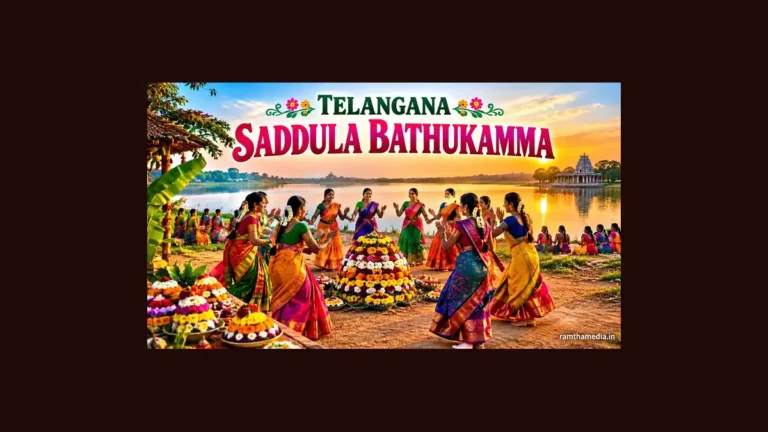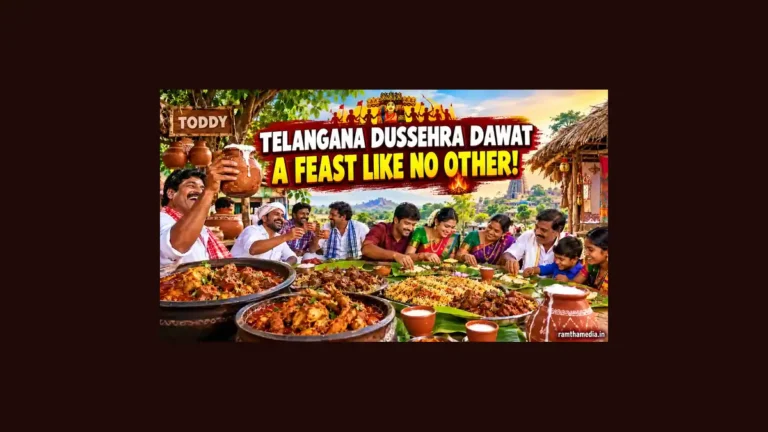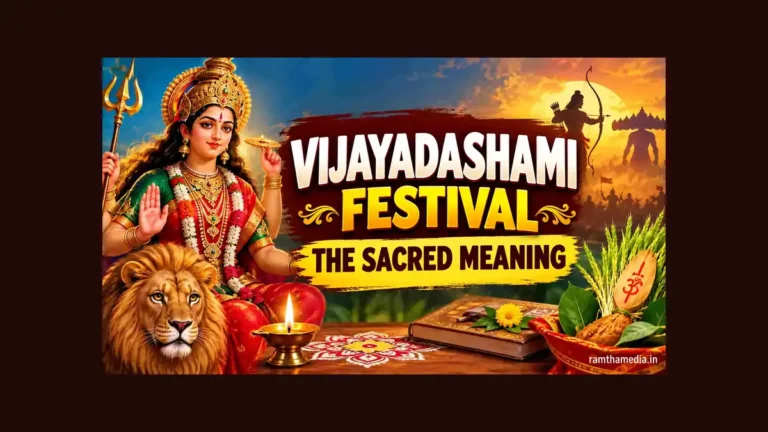

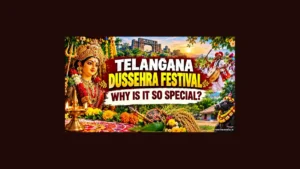
Dussehra in Telangana is a massive festival honoring labor culture, social equality, and nature worship. Communities unite through nine nights of devotion, worship of livelihood tools, Jammi leaf exchanges, Indian Roller sightings, and Ravana Dahan.
Across the soil of Telangana, numerous festivals grace the calendar throughout the year, yet the arrival of Dussehra brings an atmosphere that stands entirely apart. Whole villages take on a fresh radiance as sons and daughters who journeyed far in search of livelihood return to their ancestral homes. Joy overflows in every corner, echoing from village council platforms to vibrant town lanes. When we examine why Dussehra holds such profound preeminence in Telangana compared to other regions, remarkable social and spiritual truths come to light.
While the nine nights of Navratri resonate across streets with fervent devotion to the Divine Mother, the tenth day of Vijayadashami rises as a grand celebration that transcends barriers of caste and creed to unite every community. Here, Dussehra is never a mere recitation of ancient lore; it is a living celebration where the common laborer, sustained by drops of honest sweat, bows before the very tools of their trade. It is an observance of boundless hope, where people look to the azure flight of the Indian Roller across open autumn skies to foresee their upcoming success.
From the historic neighborhoods of Hyderabad to the forested landscapes of Adilabad, the festival resounds with celebrations of Ravana Dahan that declare the eternal victory of righteousness over wrongdoing. Rooted deeply in the fragrant red soil of Telangana and the dignity of its working people, this festival weaves devotion, ecology, and social justice into an unbroken tapestry. Examining these distinctive customs reveals how sacred traditions and daily human struggle merge into one magnificent cultural identity.
Read the complete Telugu edition of this article.
Dussehra Navratri Devotion and the Deep Emotions During the Goddess Farewell
In Telangana, the Sharad Navratri festivities immerse entire towns and villages in an ocean of spiritual fervor for nine continuous days. Starting from the first day of the bright fortnight of the Ashwayuja month, every shrine, village square, and street corner resonates with sacred chants praising the Mother Goddess. Durga Mata pandals erected at central junctions become centers of community fellowship, adorned with fragrant flowers, kumkum worship ceremonies, and generous community feeding programs. Drawing from the sacred Devi Saptashati in the Markandeya Purana, the people of Telangana revere the Primordial Energy—the cosmic source of creation, maintenance, and dissolution—not as a distant deity, but as their own loving mother.
When these nine days of intense prayer draw to a close, the moment arrives to bid farewell to the Mother Goddess and escort her clay form to the sacred waters of local lakes and rivers. The entire atmosphere becomes deeply charged with collective emotion. The thunderous cadence of traditional dappu drums, which represents the pulsing heartbeat of Telangana folk expression, fills the autumn sky. Accompanied by jubilant shouts of praise, dance, and colorful processions, the farewell journey of the Goddess unfolds as an unforgettable spectacle of heartfelt love.
As the consecrated clay idol gently dissolves into the cool depths of the river or village lake, tears well up in the eyes of countless devotees. Yet, beneath those tears rests an enduring peace, for everyone understands that while the external form dissolves, the spiritual presence of the Mother remains immovably enshrined within their consciousness. In the Devi Bhagavata, Maharshi Vyasa articulates this sacred bond between the devotee and the Universal Mother: Even if the external earthen image dissolves within water, the conscious energy consecrated in the lotus of the devotee’s heart never faces separation, continuing to protect and guide without end.
With folded hands, devotees whisper their prayer, asking the Divine Mother to return again next year and watch over their homes with peace, health, and bountiful rains. As this sacred wave of Navratri devotion concludes, it seamlessly makes way for the unique celebration of Ayudha Puja, where the everyday beauty of labor and human endeavor is elevated to the highest spiritual honor.
Explore this related festival tradition: Vijayadashami and the True Mystery of Shami Tree, Ayudha Puja, and Ravana Dahan.
Dussehra Ayudha Puja Honoring Labor Culture and the Message of Social Justice
The foundational philosophy of Dussehra celebrates the triumph of virtue over vice. In Telangana, Dalit and Bahujan philosophical perspectives illuminate this message with extraordinary social depth, declaring that the true meaning of Vijayadashami lies in eradicating centuries of caste discrimination, untouchability, and social inequality so that every human being receives equal dignity. In this land, conquering inner demons and mythological adversaries directly translates into dismantling societal prejudices that divide human beings, thereby establishing an order anchored in fairness and self-respect.
Community leaders and social thinkers, such as Dalit leader T. Bapanna, emphasize that the evils plaguing humanity are not merely mythical monsters of antiquity, but real-world injustices like social marginalization and denial of dignity. Therefore, vanquishing evil represents the triumph of social justice, where every person is guaranteed their rightful place under the sun. The majority of working communities across Telangana comprise honest manual laborers, rural artisans, and agrarian workers whose sustenance depends entirely on daily physical toil.
Because of this deep connection to physical labor, the Ayudha Puja conducted on Dussehra day becomes a supreme celebration of labor culture. In the rural courtyards of Telangana, farmers meticulously wash their ploughs, sickle blades, and bullock carts, marking them with auspicious turmeric and vermilion. Toddy tappers reverently sanctify their climbing ropes and tools; cobblers worship their sewing awl; potters offer prayers to their rotating wheel; washermen clean and honor their heavy iron boxes; and handloom weavers revere their wooden shuttle and loom.
This practice directly reflects the Karma Yoga teachings of the Bhagavad Gita, wherein Maharshi Vyasa explains that performing one’s rightful occupational duties and respecting the instruments that sustain life is the purest form of worship offered to the Divine. By sanctifying the machinery, implements, and humble tools that generate livelihood, Dussehra places honest human effort upon the highest altar. It is not an exclusive festival for the privileged, but a festival of the sweating worker, affirming the self-respect of every occupational community. Once this sacred worship of livelihood concludes within homes, entire villages gather to step out together into the open arms of nature.
Dussehra Sightings of the Indian Roller and the Sacred Jammi Leaves Tradition
On the afternoon of Vijayadashami, every village in Telangana comes alive with a unique pastoral excitement as people step out into green countryside pastures to catch sight of the Indian Roller bird, known locally as the Palapitta, and to exchange the leaves of the sacred Jammi tree as symbolic gold. Linked intimately to the triumphant conclusion of the Pandavas’ year of incognito exile, this timeless custom infuses individuals with renewed confidence that every enterprise undertaken will culminate in auspicious success, while reaffirming the unbreakable bond between humanity and the natural environment.
According to the Virata Parva of Vyasa’s Mahabharata, the Pandavas concealed their formidable divine weapons within the branches of a Shami tree before entering their covert exile in the kingdom of Virata. When the year ended, they retrieved their weapons, offered worship to the tree, and emerged victorious over the Kaurava forces. Folklore across the Deccan Plateau holds that as the Pandavas set out for battle, the auspicious sighting of the Indian Roller graced their path, signifying absolute triumph. Although local folklore includes varied regional retellings, the conviction that viewing this blue-winged bird brings victory remains etched into the soul of Telangana.
As dusk settles, elders, youth, and children assemble at the sacred Jammi tree standing at the edge of the village boundary. After performing the traditional Shami Puja, people gently pluck a few leaves, refer to them lovingly as gold, and distribute them to family, neighbors, and friends. Accompanied by the warm embrace of Alai Balai, past grievances and disputes are dissolved, demonstrating a marvelous picture of rural solidarity where community harmony reigns supreme.
📖 Telangana History in Bathukamma Songs: Oral Tradition and Living Memory
Beyond its mythological roots, the sighting of the Indian Roller carries immense ecological wisdom. Characterized by its brilliant turquoise wings, this majestic bird frequents Telangana’s open grasslands, scrub forests, and agricultural lands. Because it feeds extensively on destructive crop pests, grasshoppers, and beetles, the Indian Roller has served as the farmer’s natural protector for generations. Sighting this winged ally amid harvest-ready fields is an authentic omen of agricultural prosperity and environmental balance.
Ancient medical and botanical texts such as the Sushruta Samhita and traditional Vrikshayurveda remind us that birds and trees constitute the vital life-bearing pillars of nature, and that human prosperity thrives only when these creatures live in undisturbed safety. It is therefore vital to recognize that observing the Indian Roller must never involve capturing it, trapping it in cages, or causing it distress. Devotees honor this tradition truly by admiring the bird soaring freely against the open sky, letting its graceful flight awaken hope, ecological responsibility, and confidence in new beginnings.
Explore this related festival tradition: Vijayadashami: The Inner Meaning of Dharma’s Victory.
Dussehra Ravana Dahan Celebrations Across Hyderabad to Adilabad
In harmony with the timeless narrative of the Valmiki Ramayana, the conclusion of Dussehra across Telangana is marked by the grand staging of Ramlila and the fiery spectacle of Ravana Dahan, commemorating Lord Rama’s vanquishing of the demon king Ravana and the ultimate restoration of Dharma. Across major public grounds, towering effigies stuffed with fireworks are ignited at twilight, illuminating the evening sky and reminding every onlooker that untruth, pride, and exploitation inevitably crumble before the enduring power of truth.
The philosophical underpinnings of this event emphasize that no matter how intellectually brilliant or materially powerful an individual might be, an existence rooted in arrogance and transgression against moral order leads to inevitable ruin. As depicted in the Yuddha Kanda of the Ramayana, Lord Rama marshaled courage and righteousness to overcome overwhelming odds, proving that moral integrity is invincible. For citizens throughout Telangana, participating in this event provides a profound moment of introspection, encouraging everyone to discard selfish tendencies, pride, and anger in favor of a virtuous life.
In the historic city of Warangal, thousands assemble at the Ursugutta Rangaleela Maidan, as well as the neighborhoods of Karimabad and Kazipet, where traditional Ramlila performances and effigy burnings have drawn generations of families together. Similarly, vibrant observances take place at the Professor Jayashankar Mini Stadium in Nizamabad and the DIET Grounds in Adilabad, organized diligently by cultural committees, alongside packed gatherings in major municipal grounds throughout Jagtial and Karimnagar.
Within the state capital of Hyderabad, the Ravana Dahan celebrations carry rich historical significance. At the Nampally Exhibition Grounds, the Rajasthan Pragati Samaj has maintained an unbroken tradition of organizing magnificent Ravana Dahan celebrations for over five decades. At the expansive Secunderabad Parade Grounds, massive effigies of Ravana, Kumbhakarna, and Meghanada are set ablaze before tens of thousands of cheering citizens in an awe-inspiring display.
The sage Valmiki encapsulates the secret of Rama’s triumph through the immortal dictum that righteousness protects those who protect righteousness, illustrating that evil must inevitably reduce to ashes before truth. Similar celebrations unfold around the Falaknuma Mallikarjuna Temple in Old City, as well as in Golconda, Chintalbasti, Saroornagar Stadium, LB Nagar, Khairatabad, Borabanda, and Nagole. Near NTR Stadium by Lower Tank Bund, musical programs and dramatic enactments captivate audiences. Families, children, and elders stand side by side, witnessing the visual triumph of light over darkness and carrying home a renewed sense of ethical purpose.
Dussehra Scriptural Foundations and Regional Customs Synthesis
The multifaceted celebrations of Dussehra in Telangana can be understood through a harmonious synthesis of sacred classical scriptures, regional cultural expressions, and their underlying social messages. Each major phase of the festival carries both a scriptural authority and a direct, practical application for everyday community life.
The initial phase of Sharad Navratri and water immersion finds its textual authority in the Markandeya Purana and the Devi Bhagavata. In practice, this manifests across Telangana as nine nights of devotional worship, vibrant kumkum ceremonies, and the rhythmic immersion of clay idols accompanied by traditional dappu drum beats in village lakes. The inner spiritual message reminds us that even when the physical form dissolves into water, unbroken faith and inner strength remain alive within the human soul.
The worship of tools during Ayudha Puja aligns with the Karma Yoga teachings of the Bhagavad Gita. In towns and villages, Dalit, Bahujan, and working artisans cleanse and worship their livelihood tools and machinery. This observance proclaims the supreme dignity of labor and envisions a just society free from caste discrimination, prejudice, and economic humiliation.
The evening sighting of the Indian Roller bird and the exchange of Jammi leaves find their authority in the Virata and Shanti Parvas of the Mahabharata, alongside ancient Ayurvedic treatises. Communities view the free-flying bird across agricultural fields and perform Shami Puja, sharing leaves as symbolic gold with warm embraces. This tradition dissolves past animosities, builds collective harmony, and underscores compassionate ecological balance.
Finally, the enactment of Ramlila and the burning of Ravana effigies derive from the Yuddha Kanda of Valmiki’s Ramayana. Celebrated across iconic venues from Hyderabad’s Parade Grounds to Warangal’s Ursugutta, it delivers the timeless assurance that no matter how colossal an unjust force may appear, it must inevitably yield before steadfast righteousness and moral integrity.
Explore this related festival tradition: Telangana History in Bathukamma Songs: Oral Tradition and Living Memory.
Spiritual Meaning of Dussehra in Daily Life
The paramount teaching of Telangana’s Dussehra celebrations is that true devotion cannot remain confined within temple walls or decorative ritual altars. Instead, genuine spirituality must reveal itself dynamically in the honest labor of our hands, the compassionate smile we extend to our fellow human beings, and our active reverence for the surrounding natural world. When labor is sanctified and human beings are treated with uncompromised dignity, ritual worship attains its ultimate fulfillment.
From an Ayurvedic and seasonal perspective, classical masters like Charaka and Vagbhata explain that the autumn season of Sharad Ritu naturally aggravates physical pitta dosha, which frequently mirrors as emotional restlessness, frustration, and irritability within the human mind. The communal rituals of Dussehra serve as a profound therapeutic remedy, bringing people together into outdoor spaces, reducing psychological friction through festive joy, and restoring mental equilibrium through community sharing.
Gathering beneath the branches of a single Jammi tree outside the village, where individuals from diverse professions and backgrounds exchange green leaves, touch each other’s hands, and share the sincere embrace of Alai Balai, represents an unmatched form of social and psychological therapy. It systematically dismantles the psychological barriers of ego, social isolation, and lingering resentments, substituting them with warmth, mutual acceptance, and shared goodwill.
We can honor the spirit of this festival each day by treating every working individual and artisan around us with deep respect, ensuring our actions dismantle discrimination. We should cultivate a genuine love for nature, ensuring we never support the caging or harming of wild birds like the Indian Roller, but instead teach children to appreciate wildlife living freely in nature. As we remember the burning effigies of Ravana, let us intentionally incinerate our personal arrogance, grudge-bearing habits, and petty rivalries. Each morning, take two minutes of quiet reflection before starting work to appreciate your tools of trade, resolving that your honest effort will uplift society while keeping your heart grounded in humility.
Chapter Summary
Dussehra in Telangana represents a unique cultural synthesis of fervent devotion, labor sanctification, environmental harmony, and social equality. The festival commences with nine sacred nights of Navratri, culminating in the poignant immersion of the Divine Mother’s clay form where outer ritual dissolves into inner faith. It transitions into Ayudha Puja, wherein Dalit, Bahujan, and working artisans revere their instruments of livelihood, sanctifying human toil and championing a society free from caste discrimination. The auspicious sighting of the Indian Roller bird and the exchange of Jammi leaves as symbolic gold reawaken an ancient covenant of non-violence, environmental protection, and community reconciliation through warm Alai Balai embraces. Finally, massive Ravana Dahan spectacles organized from Hyderabad to Adilabad reaffirm the eternal truth that arrogance and injustice will always fall before righteousness. Dussehra thus serves as a holistic spiritual celebration that ennobles the working human being, unites society, and honors Mother Nature.
Scripture Notes
- Main Message: The sacred scriptural foundations drawn from the Markandeya Purana, Devi Bhagavata, Valmiki Ramayana, Mahabharata, and the Bhagavad Gita converge upon a singular truth: righteousness and honest duty form the foundation of life. The Devi Bhagavata reminds us that the Divine Mother dwells continuously as living consciousness within the devotee’s heart, rendering external form secondary to inner faith. The Ramayana and Mahabharata demonstrate that arrogance and oppression can never endure against moral truth, while the Gita’s Karma Yoga sanctifies honest human labor as the supreme offering to the Divine.
- Philosophical Teaching: Philosophically, Dussehra teaches humanity that the divine presence is found not in idle contemplation, but in active harmony with one’s community, work, and ecosystem. Honoring one’s livelihood instruments transforms mundane labor into sacred Karma Yoga, dissolving artificial hierarchies of high and low birth. The reverence for the Shami tree and the wild Indian Roller illustrates that ecological sensitivity is an indispensable component of Dharma. To live the philosophy of Dussehra is to destroy the inner Ravana of egoism, embrace all people with fairness, and live in peaceful balance with creation.
📖 Bathukamma 2026: Nature, Songs and Telangana Cultural Life
Frequently Asked Questions
Why is the Dussehra festival considered so uniquely special in Telangana?
Dussehra in Telangana is extraordinarily special because it transcends regular ritualism to become a massive people’s festival. It uniquely combines the profound celebration of labor dignity through Ayudha Puja, the search for the sacred Indian Roller bird, the distribution of Jammi leaves as symbolic gold, and community-wide Alai Balai embraces that dissolve caste barriers and personal enmities across society.
Why do people look for the Indian Roller bird on Dussehra, and can it be kept in a cage?
According to the Mahabharata, the Pandavas sighted the Indian Roller bird upon retrieving their weapons from the Shami tree, resulting in their complete victory. People believe spotting it on Dussehra brings success in new ventures. However, capturing or caging the bird for good luck is completely contrary to Dharma; it must only be observed flying freely in its natural habitat.
What is the social and Bahujan significance of the Dussehra celebrations?
From a Dalit and Bahujan perspective, Dussehra symbolizes the dismantling of social discrimination, untouchability, and inequality, establishing true social justice. Because working communities rely on daily physical toil, worshiping their professional implements during Ayudha Puja serves as a powerful declaration of the supreme dignity of labor and the self-respect of working people.
Where are the major Ravana Dahan celebrations organized in Hyderabad?
Prominent Ravana Dahan events in Hyderabad take place at the Nampally Exhibition Grounds, Secunderabad Parade Grounds, Falaknuma Mallikarjuna Temple premises, Saroornagar Stadium, and NTR Stadium near Lower Tank Bund. In addition, large celebrations are held across Golconda, Chintalbasti, LB Nagar, Khairatabad, Borabanda, and Nagole.
What makes the celebrations at Nampally Exhibition Grounds and Secunderabad Parade Grounds unique?
At the Nampally Exhibition Grounds, the Rajasthan Pragati Samaj has maintained an uninterrupted tradition of conducting Ravana Dahan for over fifty years. At the Secunderabad Parade Grounds, the unique highlight is the simultaneous burning of colossal effigies of Ravana, Kumbhakarna, and Meghanada amidst grand public gatherings.
Which district centers in Telangana are famous for their Ravana Dahan and Ramlila events?
In regional Telangana, historic celebrations take place at Ursugutta Rangaleela Maidan, Karimabad, and Kazipet in Warangal. In addition, massive gatherings occur at the Professor Jayashankar Mini Stadium in Nizamabad and the DIET Grounds in Adilabad, as well as prominent public grounds throughout Jagtial and Karimnagar.