
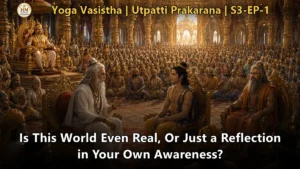
Bondage is nothing but the seer’s attachment to what he sees. Vasistha Maharshi tells Sri Rama that the self, pure consciousness, appears bound the moment it clings to the world it perceives. The world itself has no independent existence — it rises and falls like a reflection in a mirror, and only ignorance of one’s true nature makes that reflection feel permanent. The moment self-knowledge dawns, the bondage dissolves, because what never truly existed cannot hold anyone captive.
Most people spend their whole lives chasing freedom from something they cannot even name — a tightness in the chest, a restlessness that no achievement seems to loosen. They call it stress, or bad luck, or simply life, without ever asking the fundamental question that troubled Rama: what actually ties them down in the first place?
In the court of the Ikshvahu dynasty, young Sri Rama had already begun asking that very question. Having heard Vasistha Maharshi describe the nature of detachment, he now turned to a deeper puzzle — if the seer and the seen are truly separate, what exactly is this thing called bondage, and how does it ever end?
📚 Yoga Vasistha — full guide & all episodes
Rama Asks What Bondage Truly Means
Sri Rama sat before his teacher with a question that had been forming quietly in his mind for days.
He had listened to discourses on renunciation, on the fleeting nature of pleasure, on the wisdom of turning away from craving. But one word kept returning to him unresolved: bondage.
He asked Vasistha Maharshi directly — what is this bondage that scriptures speak of so often? Where does it come from, and where does it live?
Sri Rama: Revered Guru, everyone speaks of freeing oneself from bondage. But what exactly is this bondage? Show me its root, so I may understand what I am trying to escape.
The Seer’s Bond with the Seen Explained to Rama
Vasistha Maharshi answered with the calm precision of one who had examined this question many times before.
The witnessing consciousness, he explained to Rama, is the true seer — the silent awareness within every being that watches all experience without itself being touched by it.
Bondage, he said, is simply the relationship this seer forms with the world it observes. The witness clings to the seen, mistakes the seen for something solid and real, and in that clinging, feels itself trapped.
Vasistha Maharshi: The seer becomes bound only through its attachment to the world it perceives. When that perceived world dissolves, the bondage dissolves with it — for the two were never separate in the first place.
Rama Asks — What Is This World Made Of?
Rama pressed further, sensing that the answer opened onto something larger.
If bondage depends entirely on the world being perceived, then the world itself deserved scrutiny. What was this ‘seen’ that held such power over the seer?
Vasistha Maharshi did not hesitate. The world, he said, is nothing but a construction of imagined divisions — the idea of ‘I’ and ‘you,’ the idea of ‘this’ and ‘that,’ layered one upon another until they appear as solid reality.
As long as this imagined shape of the universe persists in the mind, liberation remains out of reach — not because freedom is difficult, but because the very believing in that shape is the obstacle.
A Verse That Cuts Through Confusion for Rama
Sensing that Rama needed something sharper than explanation, Vasistha Maharshi offered a verse he called a marvel of clear thought.
The world that is seen, he said, has never truly existed as a real, independent thing at any point in time. And where something never truly exists, calling it ‘unreal’ would also be meaningless — because unreality itself needs a background of “is-ness” to be spoken of at all.
In other words: if the world had ever been substantially real, someone would need to explain how it later became unreal. And if it had never been real, then debating its reality or unreality both become empty exercises, like arguing about the color of a shadow.
Vasistha Maharshi: Listen carefully, Rama — there is a marvel hidden here. The seen world, examined truly, has never at any time possessed existence of its own. So how can something have a ‘departure’ from a state it never actually occupied?
The Witness That Never Changes — Vasistha’s Lesson to Rama
Because the world lacks independent reality, Vasistha Maharshi continued, only the seer — the witnessing awareness — remains constantly and truly present.
This awareness is self-luminous; it knows all things by its own nature, which is why the sages call it the knowable. Yet it can never fully be grasped as an object, which is why it is equally called the unknowable.
Until a person recognizes this awareness as fully as it deserves to be recognized, the appearance of the world continues wherever that person happens to be — even within something as small as a single atom, a reflection of the same drama repeats itself.
A Call to the Struggling Soul — Guidance Given to Rama
Turning briefly to address every soul caught in this predicament, Vasistha Maharshi spoke with unusual warmth.
He said that birth as a human being is itself a rare opportunity — a chance that should not be wasted in idle drifting. Every person striving toward this understanding must ask sincerely: how can I stop this seen world from occupying my sight?
He compared it to giving up wine — someone who insists that drinking brings satisfaction will never manage to renounce it, no matter how hard they try, because the desire for it stays firm in the mind. In the same way, believing ‘this world is truly real’ is a delusion that keeps tightening its grip.
Only through disciplined practices — sustained effort, meditation, careful inner examination — does the mind gradually purify itself enough to recognize that the seen world has no independent existence at all. Once that purified understanding takes hold, the illusion no longer appears, not because it vanished somewhere else, but because the false seeing itself has ended.
Rama’s Doubt About Effort and Renunciation
Sri Rama, listening intently, raised an objection that had been building throughout the discourse.
If the world truly has no existence at all, he asked, then what is the purpose of striving toward anything? Should a person simply abandon every effort altogether? Perhaps stillness, or samadhi — deep meditative absorption — alone protects a person from this so-called bondage of the seen world?
Sri Rama: Great sage, if you conclude that this seen world does not exist, then why should we participate in it at all? Should everything simply be abandoned? Is samadhi alone the refuge that saves us from this world, which after all still feels like a bondage to us?
📖 Crystal, Dream, Gold — If This World Is False, Why Does It Feel So Real? | Yoga Vasistha S3 EP-23
The Trouble with Forced Stillness Explained to Rama
Vasistha Maharshi acknowledged the truth in Rama’s concern, then gently exposed its flaw.
Even during deep meditative absorption, he explained, a subtle impression remains: ‘I am not seeing the world now — I am suppressing it.’ That very impression becomes a seed capable of sprouting the same worldly perception again later, endlessly, life after life.
He distinguished between two kinds of absorption. One is a forced, willful blankness, where a person tells himself the world does not exist while the underlying belief in its reality stays firmly planted. This kind cannot destroy the root cause of seeing the world as real.
The other is a thoughtless, natural stillness — the true meditative state that can indeed carry a soul toward liberation. But Vasistha Maharshi pointed out the deeper problem: as long as the perceived world persists in someone’s understanding, this second, truer state of stillness itself is difficult to achieve.
What Sleep Reveals to Rama About False Freedom
To make his point vivid, Vasistha Maharshi turned to the ordinary experience of deep sleep.
A person sleeping soundly has no waking awareness of the world at all during that state — no worries, no relationships, no possessions troubling the mind. Yet the moment that person wakes, the entire familiar world of endless concerns returns exactly as before.
If temporary absence of world-awareness were true liberation, deep sleep itself would have already freed every human being who has ever lived. Since it clearly has not, Vasistha Maharshi asked Rama what real benefit a brief, forced stillness could offer if the underlying belief in the world’s reality survives untouched beneath it.
Neither Escape Nor Blind Indulgence — Vasistha’s Advice to Rama
Vasistha Maharshi then dismantled two tempting but mistaken paths a seeker might choose.
The first mistaken path says: ‘I will attain thoughtless stillness so completely that it never breaks, and thereby reach the pure state free of all disturbance — after that, I have nothing more to do with this world, so let me simply become indifferent right now.’ Rama himself had voiced something like this earlier, during an earlier discussion on dispassion.
But Vasistha Maharshi cautioned that as long as the root perception of an external world remains lodged in the heart, even the greatest yogis fail to fully transcend what they outwardly see. The mind still carries attachments toward whatever objects it desires, and wherever that clinging exists, the illusion of a separate, solid world persists alongside it.
The second mistaken path is the opposite extreme — a person telling himself, ‘I am nothing but a lifeless stone; nothing matters,’ and then living carelessly, indulging every impulse without discipline. Vasistha Maharshi asked what benefit such reckless living could possibly bring. Without genuine inner transformation, that borrowed carelessness merely lets the same old worldly perception stand before the person, as solid and unquestioned as ever — and even sustained meditative practice, approached this way, ends up no more useful than the indifference of a stone.
The Mirror of Consciousness Revealed to Rama
To close this stage of the teaching, Vasistha Maharshi offered an image meant to steady Rama’s understanding for what would follow.
Pure consciousness, he said, resembles a vast mirror capable of reflecting an unbroken chain of impressions — one world appearing within another, endlessly. Just as a single mirror can hold reflections of a mountain, a river, the earth, the sky, and countless other forms all within its own surface without dividing itself, so too does this same conscious reality display many worlds within itself.
Because pure awareness constantly reflects experience in this manner, embodied beings encounter, again and again, the sorrows of old age and death, and the shifting states of waking, dreaming, and deep sleep. Sri Rama, hearing this, could not stay silent.
Sri Rama: Wise one, you have established that this seen world does not exist — then what use do we have for anything at all? Should we not simply give everything up? Is samadhi the only shelter that can save us from a world we still feel bound to?
Two Paths Compared for Rama — Forced Stillness vs. True Understanding
| Aspect | Forced Meditative Blankness | True Self-Knowledge |
|---|---|---|
| Underlying belief | World is still felt as real, only suppressed | World is recognized as having no independent existence |
| Result of the practice | Leaves a seed for the world to reappear later | Uproots the very cause of false seeing |
| Comparison offered | Like deep sleep — world returns on waking | Like recognizing a mirage as mere heat and sand |
| Vasistha’s verdict | Cannot by itself grant liberation | Alone leads to lasting freedom from bondage |
The Inner Meaning of This Teaching to Rama
What Vasistha Maharshi offers Rama here is not a call to abandon the world outwardly, nor a license to live carelessly. He is pointing at something quieter and more demanding — the discovery that the sense of being trapped comes entirely from mistaking a passing reflection for something permanent.
Renunciation, in this teaching, is not about running from responsibilities or forcing the mind into artificial silence. It is about steadily loosening the grip of belief that says ‘this world I see is solid, separate, and eternally real.’ That belief, patiently examined through practices like sustained reflection and meditation, weakens on its own, the way a fear of shadows fades once a lamp is lit.
The comparison with deep sleep is especially pointed. A temporary absence of trouble is not the same as freedom from trouble’s root cause. Real peace does not depend on shutting one’s eyes to the world, but on seeing it so clearly that its power to bind quietly disappears.
Notice one belief you treat as permanently solid — a worry, a possession, a role you play. Ask quietly: has this ever truly had an existence of its own, or has your mind simply agreed to see it that way?
Chapter Summary
Sri Rama asks Vasistha Maharshi to define bondage. The sage explains that bondage is the seer’s attachment to the world it perceives, a world that has never possessed real, independent existence. Only the witnessing awareness is truly constant. Rama, doubting whether all effort should then be abandoned, is shown that forced stillness or reckless indifference cannot grant freedom — only sustained self-inquiry can dissolve the false belief in the world’s solidity, the way waking from sleep does not truly end its returning cares, but genuine understanding does.
Scripture Notes
- Main Message: Bondage is not imposed by the world itself but created by the seer’s attachment to it; since the world has no independent existence, that bondage dissolves entirely through clear self-knowledge, not through suppression or indifference.
- Philosophical Teaching: Yoga Vasistha here distinguishes true renunciation, born of understanding, from artificial withdrawal or careless living, insisting that only steady inner inquiry can uproot the belief that the perceived world is real and separate from the perceiver.
- Connection to the Next Chapter: Having questioned whether stillness alone can save him, Sri Rama now waits for Vasistha Maharshi to explain what true, lasting freedom actually requires — a teaching the next chapter continues to unfold.
The seer becomes bound only through attachment to what it sees.
Something that never truly existed cannot be said to have departed from existence.
A brief silence of the mind is not the same as freedom from what caused the noise.
Frequently Asked Questions
What does bondage mean in Yoga Vasistha’s teaching?
Bondage means the attachment the witnessing awareness forms with the world it perceives. Vasistha Maharshi explains that the seer feels trapped only because it clings to the seen as though it were solid and permanent, when in truth the seen has no independent existence at all.
Is meditation alone enough to end bondage, according to this teaching?
No, forced or willful stillness alone is not enough. Vasistha Maharshi warns that suppressing the world without dissolving the underlying belief in its reality simply plants a seed for that belief to return, much like the world reappears the moment a person wakes from deep sleep.
Does this teaching mean the world should be abandoned entirely?
No, Vasistha Maharshi rejects both extremes — neither forced withdrawal nor careless indifference frees a person. He teaches that only clear understanding of the world’s lack of independent existence, gained through sustained inner inquiry, brings real freedom.
Why does Vasistha Maharshi compare the world to a reflection in a mirror?
He uses this comparison to show that consciousness can display countless worlds within itself without ever being divided or affected by them, just as a single mirror reflects mountains, rivers, and skies without holding any of them as solid substance.
What is the difference between forced stillness and true self-knowledge in this chapter?
Forced stillness suppresses the perception of the world while the belief in its reality remains intact, whereas true self-knowledge removes that belief altogether, so the false perception of a separate world does not return.
Why does deep sleep not count as liberation in this teaching?
Because a person in deep sleep briefly loses awareness of the world but returns to the same worldly concerns on waking, proving that mere absence of perception, without removing its root cause, cannot be true liberation.
Conclusion
Sri Rama sits with a question that reaches further than he first expected — if the world has no true existence, what should a striving soul actually do with the years still left to live? Vasistha Maharshi’s answer, quiet and unhurried, waits just beyond this teaching, ready to show what freedom demands when neither escape nor indulgence will do.
👉 Click this link to read the next episode: Can Death Really Destroy a Man Who Has No Karma Left? | S3 EP-2 | Yoga Vasistha
👉 Click this link to read the next episode: Can Death Really Destroy a Man Who Has No Karma Left? | S3 EP-2 | Yoga Vasistha