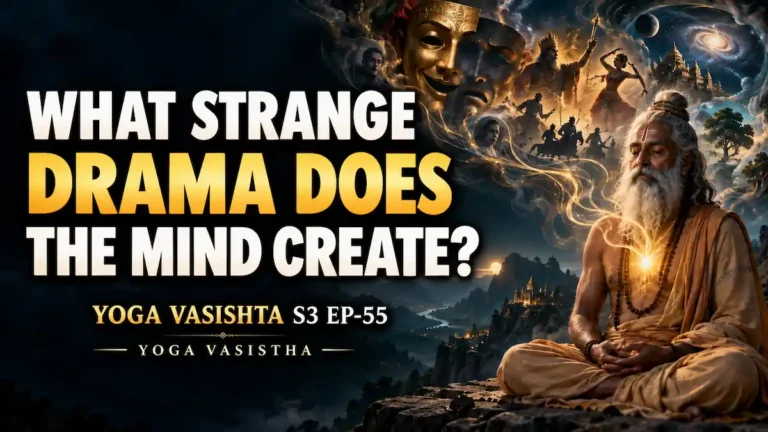

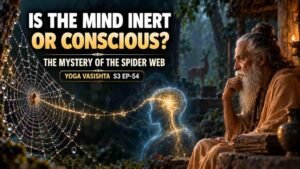
The mind is fundamentally a stream of thoughts and a cluster of intentions. When pure Consciousness turns outward toward external objects, latent impressions shape it into the mind, projecting the world. By severing these latent tendencies, the mind dissolves back into its true nature as the Supreme Self.
The human mind constantly races from one thought to another. Every seeker eventually confronts this quiet mystery: what is this internal force that sparks boundless joy one moment and acute anxiety the next? Does this invisible impulse govern human action, or can one master it?
A serene stillness settled over the royal assembly as Sri Rama gave voice to the profound inquiry stirring within his heart. Guided by a sacred thirst for truth, an illuminating dialogue on the true nature of the mind unfolded before the revered sage Vasistha.
📚 Yoga Vasistha — full guide & all episodes
Read the complete Telugu edition of this article.
An Invisible World Born from Pure Intention
The royal assembly sat in breathless silence. Sri Rama, the jewel of the Raghu dynasty, joined his palms in deep reverence. Recalling the wisdom from previous discourses, his bright eyes reflected an urgent longing to uncover the true origin of this intention-driven mind.
Vasistha turned a compassionate gaze upon the young prince, a gentle smile gracing his serene countenance.
Sri Rama: O revered Master! You have unveiled many wonders regarding the mind. I perceive that this mind possesses a form sculpted by resolute intention, swaying perpetually between inert matter and living consciousness. Pray, reveal to me its true, unvarnished nature.
Vasistha: O Rama! The mind is nothing other than imagination and perception. To possess a mind simply means to engage in continuous ideation. Movement is the inherent nature of thought. All actions in this world are driven solely by the mind. When these actions dissolve into subtle, invisible impressions, they remain stored within as latent tendencies. These very impressions determine the future births, actions, and fruits experienced by living beings.
Severing the Tree of Latent Tendencies
A wave of profound contemplation swept through the court. The sage’s words parted the mysterious veil shrouding the human cycle of existence. Gazing upward in quiet reflection, Sri Rama felt the truth settle deep into his being: the mind alone projects this perceived universe.
Vasistha’s steady voice filled the hall, majestic and clear.
Vasistha: The infinite, all-powerful Supreme Self first assumes an active state characterized by the initial urge of intention. That primary intention is the mind itself. Standing between the real and the unreal, the mind operates as an imaginative memory. In the all-knowing Self, an illusion arises: ‘I know nothing.’ That very notion is the mind. In the unattached expanse of pure Consciousness, this mind fabricates the delusion: ‘I am the doer.’
Vasistha: O Raghava! Can an attribute ever exist without the substance that holds it? Likewise, without dynamic motion, the mind cannot exist. Can anyone separate heat from fire? Never! In the same way, the action-oriented mind and the living soul are not distinct entities. Whatever form an individual imagines, into that very fruit they transform. If latent tendency is a colossal tree, action is its seed. This physical body is merely the mind’s vehicle of motion. Diverse actions are its branching limbs, and fleeting joys and sorrows are its fruits. The wise chop down this tree of latent tendencies at its very roots with the sharp axe of non-attachment.
👉 Previous Episode: Does Karma Really Exist? The Seed and Tree Riddle | Yoga Vasistha S3 EP-53
Sixteen Names for One Consciousness
The assembled scholars nodded in wonder as they listened to how undivided Consciousness appears as the cosmos. Philosophical clarity illuminated Sri Rama’s face as the inquiry deepened.
A soft breeze rustled the silk drapes of the hall while every listener remained transfixed.
Vasistha: Rama! The indivisible supreme Brahman, appearing to overlook its innate nature by sheer coincidence, turns outward toward external objects. The ancient seers designated this outwardly inclined conscious power by diverse names. Based on recollection, it is called ‘the mind’; by its capacity to deliberate and discern, it is named ‘intellect’; when it clings to the illusory body with notions of ‘I’ and ‘mine’, it becomes ‘ego’; and when it vacillates restlessly, accepting and discarding objects without deep inquiry, it is known as ‘chitta’.
Vasistha: Similarly, through movement it is termed ‘karma’; by projecting lack onto perfection, it becomes ‘imagination’; through the repetitive impulses of worldly existence, it is called ‘samsara’; and as the storehouse of subtle impressions, it is designated as ‘latent tendency’. When truth shines forth, it is called ‘knowledge’; its dynamic striving is ‘effort’; its veiling power is ‘impurity’; and its distraction is ‘forgetfulness’. When indulging in sensory pleasures, it is known as the ‘senses’; when assuming the role of doer, it becomes ‘nature’; when misperceiving truth and untruth, it is ‘maya’; and through causal relations, it is named ‘action’. All these are merely different functional aspects of a single Consciousness.
A Fresh Doubt in Rama’s Heart
Silence hung over the assembly, yet Sri Rama’s piercing intellect prepared to unravel an even deeper mystery. A vital dilemma stirred within his contemplation: was this foundational mind mere inert matter, or was it vibrant, living consciousness?
With innate humility, his lotus eyes radiant with inquiry, the prince addressed his preceptor.
Sri Rama: O revered Master! Supreme Sage! Is this mind essentially inert matter, or is it living consciousness? This crucial distinction still eludes my complete understanding. Please dissolve this doubt.
Vasistha: Sri Rama! The mind is of a dual nature—both conscious and inert. It is neither purely matter nor purely pure spirit. Consciousness itself, when tainted by limiting adjuncts during worldly existence, is termed the mind. Can an idea ever exist apart from the thinker? It cannot! The mind, distinct from both absolute reality and sheer non-existence, causes the perception of this objective world. Mind is simply Consciousness veiled by ignorance. When firm conviction in the Self is absent, that wavering state is called the mind.
Many Roles Played by a Single Actor
The scholars leaned forward, eager to grasp how diverse schools of philosophy examined this single underlying principle of the mind from distinct viewpoints.
Vasistha glanced across the assembly of learned thinkers before speaking.
Vasistha: When a single actor adorns various costumes on a stage, spectators address him by different character names. Likewise, this one mind acquires numerous designations due to its varied functions. Some ascribe atomic dimensions or physical substance to it. The Naiyayikas, following Sage Gautama, describe the ego as a distinct substance, the living soul as its master, and the mind as atomic in size. The Samkhyas view the intellect as an evolute of primordial nature. The Charvakas argue that intelligence is merely a property of the physical body, perishing entirely with death.
Vasistha: The followers of Pancharatra proclaim that Sankarshana, Pradyumna, and Aniruddha originated from Vasudeva. Philosophers of the Vaisheshika tradition determine five distinct states of the intellect: memory, direct perception, experiential knowledge, logical deduction, and misconception. Though thinkers employ varying terms according to their intellectual capacities, a person of true wisdom recognizes that all these represent the multifaceted play of one single Consciousness operating through the inner organ.
Different Paths Leading to One City
As the ultimate truth underlying competing doctrines came to light, sectarian differences dissolved across the court. A profound realization blossomed in every heart: though individual paths differ, the ultimate destination remains one and the same.
Vasistha’s tone carried the quiet weight of timeless authority.
Vasistha: Dear Rama! Travelers departing at different times describe the same magnificent city from their unique vantage points. Similarly, various masters formulated doctrines tailored to the receptive capacity of their disciples. Unfortunately, immature seekers fail to grasp the core intention of the masters and quarrel foolishly, claiming their doctrine alone is supreme and all others are false. The Self is truly beyond verbal description. Through sincere devotion and steadfast inquiry, the mind’s impurities vanish. In a pristine mind, the Supreme Self shines forth as the indwelling Lord.
Vasistha: When asserting individuality, it is termed ego; when making decisions, it is intellect; and when ruminating, it is called the mind. Just as rays of sunlight are never separate from the sun itself, none of these mental modifications are separate from Consciousness. Even when everything dissolves into nothingness, the enduring Self alone remains real.
A World Shaped by Inner Conviction
The royal assembly sat immersed in silence, absorbing the truth that purity of inner consciousness far outweighs external rituals. Sri Rama reflected upon the immense power wielded by mental conviction.
Vasistha’s eyes shone with penetrating clarity as he addressed the assembly.
Vasistha: Just as a single man is called an elephant trainer, a charioteer, a farmer, a master, or a servant depending on his current role, the mind is designated as the soul, latent tendency, or karma according to its diverse activities. Just as light is indispensable to perceive objects hidden in the darkness, the mind is the principal instrument through which the universe is experienced. A bound mind experiences bondage, while a liberated mind attains supreme freedom. When someone performs sacred ablutions or charitable deeds, the fruit reaped corresponds precisely to the inner intention of the mind. Whatever the mind earnestly conceives, that alone stands established as reality.
The Threshold Between Conscious and Inert
At this juncture, another subtle doubt surfaced in Sri Rama’s mind. He wondered whether the mind alone bore responsibility for human suffering, or if the senses and the physical body were equally culpable.
The prince folded his hands, seeking definitive clarification.
Sri Rama: O great Sage! The ego, the senses, and the physical body also torment the individual. How then is it justifiable to assert that the mind alone inflicts suffering? What is the true role of the mind in this regard?
Vasistha: Rama! Can the ego, the senses, or the physical body ever torment an individual without the active involvement of the mind? When the mind is absent, the body cannot register any agony whatsoever. None of these elements exist independently of the mind. The mind acts as a threshold. On one side lies the realm of consciousness, and on the other lies the realm of inert matter. If the mind were purely inert, it could never generate the appearance of the universe; if it were purely conscious, ignorance could never touch it. Thus, existing as a hybrid intersection of consciousness and matter, it projects this phenomenal world as tangible reality.
The Secret Behind the Spider’s Web
The foundational truths of existence now stood revealed before the assembly. Anticipation shone in the eyes of all present, eager to witness what transpires when a turbulent mind returns to purity.
Vasistha raised both hands, his resonant voice commanding the entire court.
Vasistha: Just as a conscious spider spins an inert web out of its own body, intention-driven nature springs forth from the ever-luminous supreme Brahman. Just as waves arise naturally upon water, the illusion of doership manifests within the Supreme Self. When turbid water settles, it regains its pristine clarity; in the same way, once delusion is eradicated, the mind is recognized as Brahman itself. Untainted Consciousness alone is celebrated in the world under the designations of soul, mind, intellect, and ego. It is called consciousness, and it is known as chitta. Let there be no doubt regarding this truth: Consciousness is non-dual, peerless, and eternally pure!
Functional Aspects of the Inner Organ and Their Operations
| Designation | Inherent Nature | Primary Function or Effect |
|---|---|---|
| Mind (Manas) | Recollection and ideation | Continuously generating thoughts, intentions, and counter-intentions |
| Intellect (Buddhi) | Deliberation and discernment | Evaluating pros and cons to arrive at firm decisions |
| Ego (Ahamkara) | Bodily identification (‘I’ and ‘mine’) | Binding the individual in worldly bondage through limited identity |
| Chitta | Restless fluctuation | Accepting and rejecting sensory objects without deep inquiry |
| Latent Tendency (Vasana) | Subtle impressions | Storing residue of past actions to generate future births |
| Maya | Inversion of truth and untruth | Veiling the true Self while projecting the world as absolute reality |
Spiritual Significance
The mind is not an independent entity existing outside; it is pure Consciousness imagining itself to be finite and limited. Just as a spider weaves a web out of its own essence and subsequently gets entangled within its own threads, human beings weave elaborate mental intentions and become trapped in the webs of their own thoughts.
Action serves as the seed for the expansive tree of latent tendencies, with the fluctuating mind branching out in every direction. While different philosophical schools analyze the mind under myriad labels, these are merely instructional terms for the singular divine Consciousness. True liberation consists in withdrawing the mind from external preoccupations and turning this threshold faculty inward toward the taintless Self.
Recognize that daily joys and sorrows do not stem from external circumstances, but from the interpretations fashioned by your own mind. When facing challenging events, pause before reacting, witness them as an unattached observer, and cultivate the steadfast inner stillness of non-attachment.
📖 Is the Mind Stronger Than the Body? The Tale of Indra and Ahalya | Yoga Vasistha S3 EP-48
Chapter Summary
In this discourse, Sage Vasistha elucidates the true nature of the mind to Sri Rama. The mind is fundamentally an imaginative perception shaped by memory, with latent tendencies arising from action driving worldly existence. Undivided Consciousness assumes sixteen functional designations, including mind, intellect, ego, and chitta. Operating on the threshold between consciousness and inert matter, the mind is neither purely physical nor purely spiritual. Just as a spider spins threads from its own body, intention-driven nature emanates from the Supreme Brahman. Once its impurities settle, the purified mind shines forth as non-dual Brahman.
Scripture Notes
- Main Message: The mind possesses no independent reality; it is simply the outward movement of Consciousness when it temporarily overlooks its own infinite nature.
- Philosophical Teaching: Operating at the threshold between the real and the unreal, the mind regains its pristine identity as the Supreme Brahman the moment its latent tendencies are severed.
- Connection to the Next Chapter: Having understood the dual nature of the mind and the metaphor of the spider’s web, the subsequent inquiry explores practical methods to dissolve this mental structure completely and attain supreme peace.
The mind is nothing other than imagination shaped by memory.
Just as heat cannot be separated from fire, the mind cannot be separated from Consciousness.
Consciousness is non-dual, peerless, and eternally pure.
Frequently Asked Questions
What is the true nature of the mind?
The mind is fundamentally a stream of thoughts, memories, and intentional impulses. It is not an independent physical entity, but pure Consciousness turned outward under the influence of latent impressions.
Is the mind inert or conscious?
The mind is neither purely inert nor purely conscious; it is a blend of both operating on a threshold. Because of its proximity to the Self, it appears conscious, while its veiling ignorance makes it function like inert, limited matter.
How can one cut down the tree of latent tendencies?
The tree of latent tendencies must be severed at its roots with the sharp axe of non-attachment. Performing actions without selfish craving prevents the accumulation of new latent impressions.
What does the metaphor of the spider signify in Yoga Vasistha?
The spider metaphor illustrates that just as a spider produces an inert web out of its own conscious body, the Supreme Brahman projects the intention-driven cosmos out of its own infinite Consciousness without external materials.
Why do different philosophical traditions describe the mind differently?
Different traditions describe the mind differently because teachers adapted their explanations to the varying capacities of their students, much like travelers describing the same city from diverse approaches; in ultimate reality, only one Consciousness exists.
Is the mind the cause of bondage or liberation?
The mind is the cause of both bondage and liberation. When laden with impure latent tendencies, it binds the individual to worldly existence, but when purified and anchored in the Self, it leads to absolute liberation.
Conclusion
A profound stillness settled across the royal hall like a calm ocean wave. Sage Vasistha’s declaration, proclaimed with upraised hands, flooded Sri Rama’s interior with the radiant light of undivided Consciousness. Having glimpsed the unblemished Self veiled beneath the mind’s illusory web, the entire assembly sat absorbed in wordless peace, poised for the sacred wisdom that would dissolve the mind forever.