
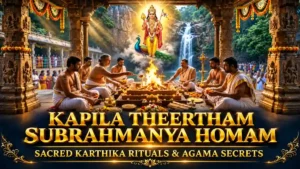
Sri Subrahmanya Swamy Homam is performed with immense grandeur at Sri Kapileswara Swamy Temple (Kapila Theertham) in Tirupati as part of the annual month-long Karthika Masam Homa Mahotsavams conducted by Tirumala Tirupati Devasthanams (TTD). Performed strictly according to Saivagama and Vedic traditions, this sacred fire ritual is revered for eradicating Kuja (Mars) Dosha, Naga Dosha, granting longevity, progeny, spiritual courage, and inner harmony.
For comprehensive spiritual rituals and daily observances, explore our Karthika Masam Master Guide.
🛕 Kapila Theertham Subrahmanya Swamy Homam — Key Highlights
- Sacred Shrine: Sri Kapileswara Swamy Temple (Kapila Theertham), Tirupati.
- Timings: Morning 9:00 AM – 12:00 PM & Evening 6:00 PM – 8:00 PM.
- Organised By: Tirumala Tirupati Devasthanams (TTD) — Saivagama Pundits.
- Seva Fee: Nominal Rs. 500/- per couple / two participants.
- Prasadam & Bahumanam: Sacred Uttariyam, blouse piece, Laddu prasadam, and special darshan.
- Spiritual Efficacy: Neutralises Kuja & Sarpa Doshas, bestows child boon, mental strength, and success.
The Sacred Splendour of Kapila Theertham at Seshachala Foothills
Nestled amidst the lush forest canopies and natural mountain cascades at the foot of the sacred Seshachala hills (Tirumala range), Sri Kapileswara Swamy Temple, popularly known as Kapila Theertham, stands as the solitary and ancient Shiva shrine in the temple city of Tirupati. It holds singular prominence in Hindu pilgrimage geography as a living confluence of Shaiva and Vaishnava spiritual traditions — with Lord Venkateswara reigning atop the sacred mountain and Lord Shiva guarding the foothills below.
Every year during the holiest lunar month of Karthika Masam, Tirumala Tirupati Devasthanams (TTD) organizes extensive Vedic homas in the temple yagashala. In this revered festival cycle, the Sri Subrahmanya Swamy Homam commenced with majestic grandeur amidst Vedic chantings, traditional Panchavadya instruments, and fragrant ritual oblations.
Sthala Purana & Mythological Origins of Kapila Theertham
Kapila Theertham is celebrated in the sacred pages of the Brahmanda Purana, Bhavishyottara Purana, and Skanda Purana as a sanctified tapasya ground of enlightened rishis and siddhas.
Penance of Sage Kapila and the Emergence of Linga
According to the sthala purana, Sage Kapila — revered as one of the twenty-four divine avataras of Lord Vishnu and the son of Prajapati Kardama and Devahuti — performed intense penance here dedicated to Lord Shiva. In Krita Yuga, King Sagara undertook an Ashwamedha Yajna. Indra secretly took away the sacrificial horse and tied it near Sage Kapila’s ashram in Patala. When the sixty thousand sons of Sagara arrived and disrupted the sage’s contemplation, they were reduced to ashes by his yogic fire. Overwhelmed with profound remorse, Sage Kapila came to the sacred falls at the foot of Venkatadri, installed a Shivalinga, and engaged in deep penance. Pleased with his devotion, Lord Shiva pierced through Patala and manifested as a self-born (Swayambhu) Jyotirlinga, conferring eternal bliss upon the sage. Hence, the deity was revered as Sri Kapileswara Swamy.
The Sacred Shrine Across Three Yugas
Scriptures record three distinct sacred names for this holy theertham across cosmic ages:
- Krita Yuga: Kapila Theertham (the holy seat of Sage Kapila’s tapasya).
- Treta Yuga: Chakra Theertham (sanctified by the Sudarshana Chakra of Lord Vishnu).
- Kali Yuga: Sarva Theertham / Kapila Theertham (the supreme purifier of all sins).
Historical Inscriptions and Architectural Heritage
Beyond legendary antiquity, Kapila Theertham boasts documented epigraphical records spanning over a millennium:
- Chola Era: Inscriptions dating back to the 10th and 11th centuries under Rajendra Chola I demonstrate extensive royal grants and continuous liturgical patronage for daily temple worship.
- Vijayanagara Empire: Under Emperor Sri Krishnadevaraya and Achyutaraya, the temple’s magnificent granite Mukhamandapa, stepping ghats, and dedicated Yagashala were constructed.
- Discovery of the 15th-Century Inscription (May 2023): Archaeological studies conducted jointly by the Archaeological Survey of India and TTD in May 2023 unearthed a rare Telugu stone inscription from the 15th century within the temple complex, detailing historic village land endowments for the maintenance of perpetual temple rituals.
- Monolithic Stone Nandi: Guarding the entrance is a grand monolithic black granite Nandi, sculpted with exquisite realism and divine repose, measuring two feet in height and two-and-a-half feet in length.
TTD’s Karthika Homa Mahotsavam — A Democratic Spiritual Blessing
In Vedic tradition, performing fire rituals (Homas and Yajnas) during Karthika Masam yields immense merit. However, conducting an authentic Shrauta or Smartha homam at home entails considerable financial and logistical resources, placing it beyond the reach of many ordinary families. Recognizing this, TTD conceptualized the month-long Karthika Homa Mahotsavam at Kapila Theertham to allow everyday householders to participate directly in authentic Agama homas at a purely nominal token fee.
The month-long calendar features a sequence of daily homas dedicated to Lord Ganesha, Lord Subrahmanya, Lord Dakshinamoorthy, the Navagrahas, Goddess Kamakshi, and Ekadasa Rudra, culminating in the sacred Trishula Snanam and the famous Jwala Thoranam on Karthika Pournami.
Agama Methodology of Sri Subrahmanya Swamy Homam
Conducted strictly adhering to the tenets of Saivagama and Skanda Purana, the homam is executed in two elaborate sessions:
Morning Rituals (9:00 AM – 12:00 PM):
- Kalasha Sthapana & Vighneshwara Puja: The morning commences with Punyahavachanam, purification of the Yagashala, invocation of Lord Vigneshwara, and sanctification of sacred Kalashas infused with river waters, herbs, and mantras.
- Agni Pratishthapana & Vedic Oblations: Sacred sacrificial fire is consecrated in the Homa Kunda. Pundits offer dry mango samidhas, pure desi cow ghee, navadhanyas, silk vastras, and fragrant dravyas while chanting the powerful Subrahmanya Moola Mantra, the sacred six-syllabled Shadakshari Mantra (Om Sharavanabhavaya Namaha), and Vedic Gayatris.
- Laghu Purnahuti & Nivedana: The morning session concludes with Laghu Purnahuti, sacred naivedyam, and the waving of camphor harathi.
Evening Archana (6:00 PM – 8:00 PM):
The evening session witnesses the lighting of auspicious earthen oil lamps, deeparadhana, chanting of the Sri Subrahmanya Sahasranama (thousand divine names), special pushparchana, and divine blessings for all participating devotees.
Astrological and Esoteric Significance
Vedic astrologers and Agama scholars highlight multiple transformative benefits of participating in Sri Subrahmanya Swamy Homam:
- Neutralising Kuja (Manglik) Dosha: Lord Kartikeya is the supreme presiding deity of the planet Mars (Kuja / Angaraka). Those afflicted with delayed marriage, marital discord, property disputes, or blood-related ailments find profound relief through this sacred homam.
- Remedy for Naga & Sarpa Doshas: Lord Subrahmanya is venerated as the cosmic master of serpents and subtle kundalini energies. Worshiping Him neutralises Sarpa Dosha and Rahu-Ketu nodal afflictions.
- Boon of Progeny (Santana Bhagyam): Couples aspiring for children traditionally take the sacred sankalpam at this homam, praying for healthy and virtuous offspring.
- Courage and Triumph Over Inner Foes: As the divine commander-in-chief (Deva Senapati), Skanda instills fearless courage, sharp intellect, and victory over internal weaknesses (Arishadvargas: lust, anger, greed, delusion, pride, and jealousy).
The Divine Symbolism of the ‘Vel’ (Sacred Spear)
The sacred spear (Vel) held by Lord Murugan is not an instrument of mortal destruction, but the cosmic emblem of Jnana Shakti (transcendental wisdom). Deep and pointed, the Vel signifies how true spiritual discernment cuts through the dense knots of ignorance and worldly delusion, illuminating the human consciousness with non-dual peace.
Pilgrim Guidelines & Darshan Information
- Seva Registration: Seva tickets priced at Rs. 500/- for two devotees can be obtained directly at the temple booking counters or via the official TTD pilgrimage portal.
- Dress Code: Traditional Indian ethnic attire is strictly mandatory. Men must wear dhoti with uttariyam or kurta-pyjama; women must wear sarees, half-sarees, or modest churidars with dupatta.
- Temple Timings: The temple is open daily from 5:00 AM to 8:30 PM. Devotees visiting during homam hours can witness the sacred fire rites directly from the Yagashala enclosure.
- How to Reach: Located just 4 km from Tirupati Main Railway Station and Central Bus Stand (APSRTC), Kapila Theertham is situated adjacent to the Alipiri Toll Gate. City buses and autorickshaws ply continuously to the shrine.
Frequently Asked Questions (FAQ) — Kapila Theertham Subrahmanya Homam
1. When is Sri Subrahmanya Swamy Homam performed at Kapila Theertham?
It is performed on designated auspicious days during the month-long Karthika Homa Mahotsavams conducted by TTD, usually running in two sessions: 9:00 AM to 12:00 PM and 6:00 PM to 8:00 PM.
2. What is the ticket price for participating in this homam?
The seva ticket fee is Rs. 500/- for two participants (husband and wife, or two individuals). Ticket holders receive an Uttariyam, blouse piece, Laddu prasadam, and special darshan of Sri Kapileswara Swamy.
3. What are the key spiritual and astrological benefits of this homam?
It alleviates Kuja (Manglik) Dosha, Sarpa and Naga Doshas, and Rahu-Ketu transit afflictions. It is renowned for granting marital harmony, virtuous progeny, protection from enemies, and fearless mental fortitude.
4. How far is Kapila Theertham from Tirupati Railway Station?
Kapila Theertham is situated approximately 4 km north of Tirupati Main Railway Station and the Central Bus Stand, right at the foot of Tirumala hills near the Alipiri check-point.
5. Is there a dress code for attending the homam at Kapila Theertham?
Yes, TTD’s traditional dress code applies strictly. Men must wear dhoti and uttariyam or kurta-pyjama. Women must wear sarees, half-sarees, or churidars with dupatta. Western wear such as jeans and t-shirts is strictly prohibited.