
Brahman is neither emptiness, nor light and darkness, nor even pure consciousness — it is a truth that defies description, yet remains the source of everything. When Sri Rama questions what looks like a contradiction in Vasistha’s teaching, the sage uses the illustration of King Shila to make clear that Brahman lies beyond opposites like far and near, large and small — and that the world we see is never separate from it.
Sometimes, no matter how much we listen or read, a small knot of confusion stays lodged in the mind. Each thing the teacher says makes sense on its own, but when you try to hold it all together, something refuses to fit.
That is exactly the doubt Sri Rama now carries. Taken one at a time, Sage Vasistha’s words about Brahman all sound reasonable. But the moment Rama tries to weave them into a single understanding, his mind comes to a halt. And so the assembly now turns to face that very doubt, brought openly before the teacher himself.
📚 Yoga Vasistha — full guide & all episodes
The Doubt Twisting in Rama’s Mind
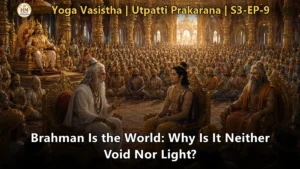
In that moment, a deep thoughtfulness moved across Rama’s eyes in the assembly hall. Sage Vasistha’s earlier words about the indescribable Brahman kept turning over in his mind. Rama had no doubt at all that what remains at the moment of great dissolution is that same true substance — beyond every name and form.
But the description Vasistha had given just before that left Rama pondering. ‘It is not emptiness. Not light. Not darkness. Not even pure consciousness. Not the individual soul. Not the intellect. Not even the mind’ — each of these statements, taken alone, made sense to him. Yet in the same breath, Vasistha had also said, ‘All of this is that very Brahman.’
Rama’s intellect could not quite reconcile those two statements. A trace of uncertainty lingered in his mind. Rather than let the doubt sit unspoken, he decided to bring it directly before his teacher, in search of real clarity.
Sri Rama: O Lord Vasistha! What you have said about the indescribable Brahman is entirely reasonable.
Sri Rama: You said it is not emptiness, not light, not darkness, not even pure consciousness, not the individual soul, not the intellect, not even the mind — that much I follow. But then you say, ‘All of this is that very Brahman.’ I cannot grasp how these statements fit together. Please explain this to me more clearly.
👉 Previous Episode: Is the Blue Sky Real, or an Illusion? How Do We Know the True Nature of the Supreme Self? | Yoga Vasistha S3 EP-7
Not Separate — And Therefore Without a Second — The Shila Analogy
A faint smile crossed Vasistha’s face as he heard Rama’s question. He knew this question came from a genuine hunger for awakening stirring within his disciple. Unhurried, peeling back one layer at a time, Vasistha began to speak.
Every eye in the assembly now turned to him. Everyone present knew that the answer to this question would open the door to the deepest truth of Brahman.
Sage Vasistha: Rama, your question is like a knotted thread. Let me loosen it with a single pull. Listen.
Sage Vasistha: Once there was a king named Shila. Suppose a father in his court calls a rock ‘shila,’ and also calls his own son ‘Shila’ — does that make the two the same? The name is one, but the two things are entirely different.
Sage Vasistha: In the same way, ‘the world’ is only a name. Ask what the real thing behind that name actually is, and you will find nothing there but Brahman itself.
The Mystery Unfolded Through the Tale of King Shila
Some in the assembly had not fully grasped the analogy. Noticing the uncertainty on their faces, Vasistha prepared to explain it in still greater depth. His voice carried the patience of a father teaching his child.
Vasistha emphasized that although this world passes through three states — creation, sustenance, and dissolution — the one ‘awareness that experiences it all’ remains the same throughout. Just as the ocean stays the ocean no matter how many waves rise and fall on it, the forms of the world may change, but the truth behind them never does.
Sage Vasistha: What is this world, after all? Nothing but a collection of names and forms, spinning through the cycle of birth and death.
Sage Vasistha: Strip away these names and forms — what remains? Not emptiness, but some form of ‘being’ remains. That very being is Brahman.
The Moment the Divide Between the Supreme and the Individual Dissolved
The silence in the hall grew deeper still. Vasistha now turned to another angle of the same truth — that even the division between the Supreme Self and the individual self is, in the end, an illusion. As he explained this, his voice grew graver, each word landing as clear as metal struck in a forge.
Vasistha made it plain that the distinction between ‘para’ — the far, the transcendent — and ‘apara’ — the near, the immanent — is a divide manufactured by our own intellect, and has no place in the reality of Brahman. As Rama heard these words, a new light stirred in his eyes, though he remained silent, listening still more closely.
Sage Vasistha: We speak of the Supreme Self and the individual self as though they were two. But understand this — the very distinction between ‘far’ and ‘near’ arises only within the experience we call the world.
📖 What Is the Secret Sorrow Hidden in Brahman’s Expansion Into the World? | Yoga Vasistha S3 EP-26
Sage Vasistha: Do you now see why I say consciousness is the world, and the world is consciousness? What we experience as the world is nothing but the very nature of the Supreme Self itself.
The Truth That the Seer and the Seen Are One
At this point, Vasistha offered words that dissolved even the distinction between seer and seen. He emphasized that although the one who sees (the seer) and what is seen (the seen) appear to be two different things, both arise from the same single source. This opened up a fresh dimension for everyone in the assembly.
Vasistha explained that the division between ‘seer’ and ‘seen,’ which the followers of Sankhya philosophy uphold, is only a distinction made for the sake of teaching — and that ultimate truth has no room for such a division. In his eyes there was the stillness of one who has gone deep into penance.
Sage Vasistha: The ‘seer’ is the one who watches, the ‘seen’ is what appears before him — the wise draw this distinction only as a device for teaching.
Sage Vasistha: In truth, the seer and the seen are not two separate things. Both are simply two faces of the very same consciousness.
Teaching Confirmed by the Word of the Vedanta
To give his words still greater weight, Vasistha recalled an ancient statement from the Vedanta. He told the assembly that this authoritative saying confirmed, in a sharper and more definitive form, the very truth he had just been unfolding.
The moment he spoke the line — ‘What the wise call Brahman, the ordinary person perceives as the world’ — a subtle ripple moved through the assembly. Satisfaction showed on the faces of those who had understood, and deep thought lingered on the faces of those still working their way toward it.
Sage Vasistha: There is an ancient saying: ‘What the wise call Brahman, that very thing appears to ordinary people as the world.’ There is nothing more to say beyond this.
Sage Vasistha: What is uncreated we call ‘the seer’; what is created we call ‘the seen.’ But these are not two separate things — they are two names for the very same reality.
👉 Click this link to read the next episode: Is There No Cause for This World at All? What Does It Have in Common with a Barren Woman’s Son? | Yoga Vasistha S3 EP-10
The Oneness Hidden Behind Names — The Shila Principle
After hearing this authoritative statement, the doubt that had earlier clouded Rama’s face began gradually to lift. But Vasistha had not yet finished his explanation. He offered one more example to lay this distinction out even more plainly.
Vasistha made clear that just as with the name Shila, although we use two different words — ‘Brahman’ and ‘the world’ — both words ultimately point to the very same reality. This, he said, is purely a matter of language; in truth, there are no two separate things at all.
Sage Vasistha: Just because two names are different does not mean the things they name must be different. We say ‘jalam’ and we say ‘water’ — two names, yet the substance is one.
Sage Vasistha: In the same way, we may use the words ‘Brahman’ and ‘the world,’ but both point to the very same single truth. It is precisely because that truth is no different from you or from me that we call it ‘the One without a second.’
The Deep Silence That Settled Over the Assembly
Vasistha’s final words filled the entire assembly with a distinctive kind of silence. Every person seemed to be quietly digesting this truth within themselves. Rama too bowed his head, sinking into deep reflection.
In that moment, the teaching seemed to stop being mere words and instead sink slowly into the hearts of those listening. Vasistha too spoke no further, letting that silence itself carry the teaching forward.
The Relationship Between Brahman and the World, as Vasistha Resolved It with Shila
| Term | Common Understanding | The Truth as Vasistha Explained It |
|---|---|---|
| Brahman | Some special entity, like emptiness or light | Neither emptiness, nor light, nor darkness — beyond all description |
| The World | Creation, separate from Brahman | The experience of Brahman itself through names and forms, not a separate thing |
| Seer and Seen | The one who watches and what is watched are two different things | A distinction made only for teaching — at the source, both are one |
| Para and Apara (Far and Near) | A real difference between the distant and the near | A division created by the intellect; no such difference exists in Brahman |
The Spiritual Essence of the Shila Teaching
The central lesson of this conversation, exemplified through the story of Shila, is this: truth is one, even though the words we use to describe it may differ. There is no contradiction in saying ‘it is not emptiness’ and then saying ‘all of this is that very truth’ — because Brahman submits to no single description the intellect can contain, and yet, at the very same time, pervades everything that exists.
The world we see, the life we live — none of it is separate from that one truth. Names and forms keep changing, but the ‘being’ behind them never changes. Holding onto this understanding slowly dissolves the divisions we carry within us — between far and near, between ‘I’ and ‘you.’
Today, take something around you that seems separate from everything else, and quietly notice the being behind it. Sit with the thought, even for a moment, that this same being also lives within you.
Chapter Summary — Brahman and the Shila Analogy
Sri Rama questions Sage Vasistha about an apparent contradiction in his teaching on Brahman — how can Brahman be described as neither emptiness nor light, and yet also be called ‘all of this’? Through the analogy of King Shila, Vasistha explains that the world is not something separate from Brahman, but is the very being behind all names and forms — Brahman itself. He shows that distinctions like seer and seen, far and near, exist only for the sake of teaching and have no place in ultimate reality, and he grounds this in an ancient Vedantic statement. He concludes that Brahman and the world are simply two names pointing to the very same truth — and it is precisely because that truth is no different from you or me that it is called ‘the One without a second.’
Scripture Notes on the Shila Teaching
- Main Message: Brahman and the world are not two separate things — they are two names for the very same truth. The indescribable Brahman itself comes into experience as the world of names and forms.
- Philosophical Teaching: Distinctions such as seer and seen, or far and near, exist only as devices for spiritual teaching. In ultimate truth, there is no room for such dualities — this is the very foundation of Advaita, the philosophy of non-duality.
- Connection to the Next Chapter: Now that the oneness of Brahman and the world has become clear, Vasistha will next explain how to bring this truth into lived, everyday experience.
It is precisely because it is no different from you or from me that we call it ‘the One without a second.’
Names and forms keep changing, but the being behind them never changes.
What the wise call Brahman, that very thing appears to ordinary people as the world.
Frequently Asked Questions on Brahman and the Shila Metaphor
Is Brahman the same as emptiness?
No. According to Sage Vasistha, Brahman is not emptiness, not light, not darkness — it is a truth that submits to no single description, yet remains the source of everything.
Are Brahman and the world two different things?
No. As demonstrated through the Shila analogy in the Yoga Vasistha, the world is not separate from Brahman — it is the very form of Brahman experienced through names and forms.
Why is a distinction made between seer and seen?
Purely for the sake of teaching. According to Vasistha, the one who watches and what is watched are, in truth, only two faces of the very same consciousness.
Are the Supreme Self and the individual self different?
No. The distinction between the far (para) and the near (apara) is only a division created by the intellect; Vasistha teaches that no such separation exists within Brahman.
Why is Brahman called ‘the One without a second’?
Because it is no different from you, from me, or from the world. Since there is no second truth alongside the one truth, it is called ‘the One without a second.’
What did Sri Rama question in this chapter?
Rama questioned the apparent contradiction in Vasistha calling Brahman ‘not emptiness’ and then immediately saying ‘all of this is that very Brahman’ — he asked for a clear reconciliation of the two.
Conclusion
The silence that settled over the assembly was not the silence of words simply running out — it was the moment a truth was sinking into the heart. Knowing that Brahman and the world are not two is one thing; turning that knowledge into lived experience is the real practice. So what will Vasistha teach next about bringing this oneness into everyday life?
👉 Click this link to read the next episode: Is There No Cause for This World at All? What Does It Have in Common with a Barren Woman’s Son? | Yoga Vasistha S3 EP-10