
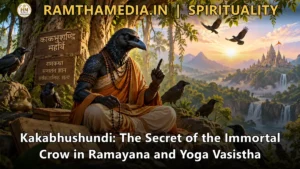
Kakabhushundi is an immortal sage and liberated soul (Jivanmukta) who voluntarily retains the physical form of a crow across cosmic cycles. Revered in both Goswami Tulsidas’s Ramcharitmanas and Sage Valmiki’s Yoga Vasistha, he acts as a timeless witness to creation, instructing Garuda on devotion and teaching Sage Vasistha the mastery of breath.
The narrative of Kakabhushundi stands as one of the most enigmatic and spiritually elevated accounts within Hindu literature. Unlike ordinary beings bound by the relentless cycle of birth, decay, and death, Kakabhushundi exists beyond the conventional limitations of chronological time. He is a Jivanmukta—a living liberated master—who willingly chose to dwell in the humble form of a crow, turning an apparent curse into an eternal vehicle for supreme spiritual realization and supreme devotion.
His presence bridges two colossal pillars of Indian sacred wisdom: the devotional path of devotion celebrated in Tulsidas’s epic masterpiece <a href=”https://www.britannica.com/topic/Ramcharitmanas”>Ramcharitmanas</a> and the non-dual philosophical inquiry embodied in Sage Valmiki’s Yoga Vasistha. In the Ramcharitmanas, he sits upon the tranquil peaks of Mount Nilgiri, dispelling the fundamental spiritual doubts of Garuda, the divine king of birds. In the Yoga Vasistha, under the name Bhushunda, he welcomes Sage Vasistha atop Mount Meru, revealing eye-witness accounts of multiple dissolutions and creations of the universe.
Throughout the ages, seekers have found in Kakabhushundi a profound model of steadfast equanimity and inner freedom. His existence proves that external physical forms and societal distinctions hold no ultimate reality before genuine spiritual illumination. By understanding his life, one uncovers the profound mechanics of cosmic time, the necessity of selfless devotion, and the yogic mastery over life-force energies that grants true immortality.
Read the complete Telugu edition of this article.
For a related perspective, read Prana Awakening: The Tibetan Monk 111 Breath Secret.
Recommended reading or puja accessory
This optional item may be useful for readers who wish to continue their study or home practice.
Vasishtha Rama Samvadam spiritual reading set →
As an Amazon Associate, Ramthamedia.in may earn from qualifying purchases.
Who Is Kakabhushundi in Sacred Hindu Texts?
Kakabhushundi translates literally to ‘Bhushundi in the form of a crow.’ Far from being an ordinary bird or a creature suffering under punitive bondage, he represents a great sage who willingly chose to retain his avian form because it was in this very body that he attained supreme spiritual enlightenment and unbroken devotion to Lord Rama. The <a href=”https://en.wikipedia.org/wiki/Kakabhushundi”>ancient narratives of Kakabhushundi</a> primarily illuminate two canonical works: the Uttara Kanda of Goswami Tulsidas’s Ramcharitmanas and the Nirvana Prakarana of Sage Valmiki’s Yoga Vasistha.
In the Ramcharitmanas, Kakabhushundi acts as the enlightened preceptor who narrates the holy acts of the divine incarnation to Garuda, clarifying the complex nature of divine play and dissolving all spiritual ignorance. In the Yoga Vasistha, he appears as an ancient yogic master residing upon a wish-fulfilling tree on Mount Meru, sharing unmatched esoteric knowledge regarding breath retention, self-mastery, and the cyclic dissolution of cosmic realms with Sage Vasistha himself.
For a related perspective, read Pineal Gland Secrets: Proven Paths to Awaken Inner Divinity.
RECOMMENDED PRODUCT
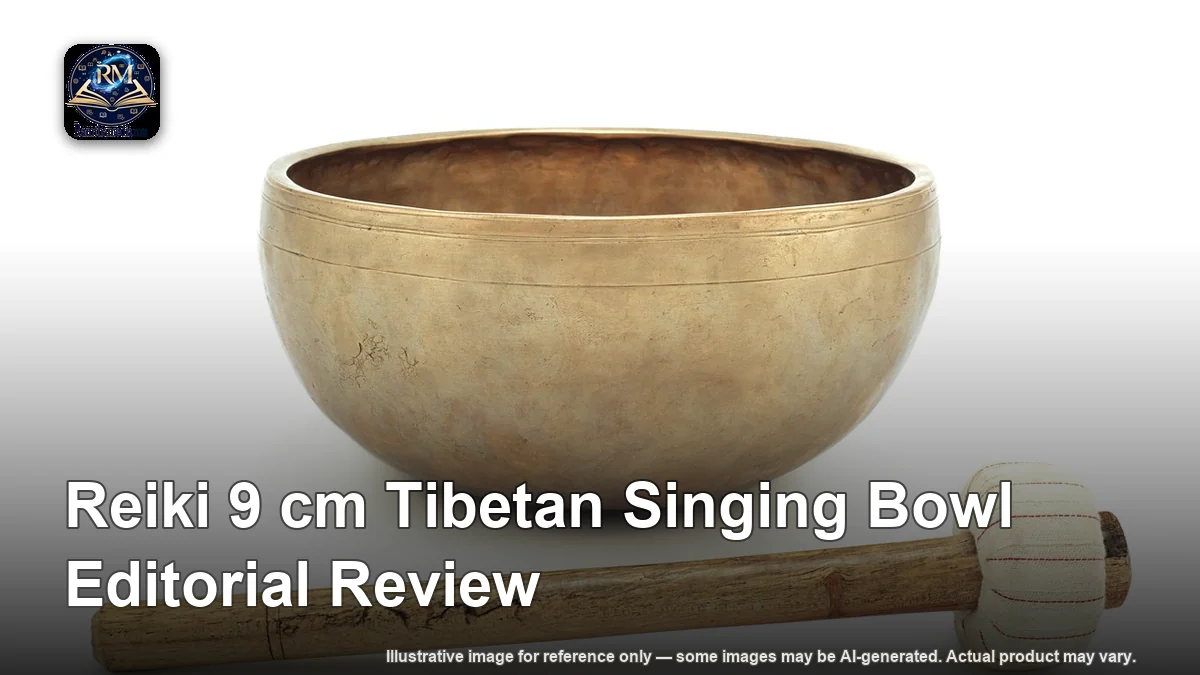
Reiki 9 cm Tibetan Singing Bowl Editorial Review : How can this product help you?
This review examines the Reiki using verified buyer feedback and the manufacturer’s listed specifications. Establishing a calm morning meditation ritual or dedicated prayer… The Reiki 9 cm Tibetan Singing Bowl meets this exact requirement by offering a dense 300 g cast metal alloy structure paired with a purpose-built wooden striker stick. Its… The Reiki 9 cm Tibetan Singing Bowl is a compact metal alloy meditation instrument engineered for personal sound therapy, mindfulness, and quiet prayer spaces. It produces a…
Read more about this productBuy on Amazon
As an Amazon Associate, RamthaMedia earns from qualifying purchases.
The Origin of Kakabhushundi in the Ramcharitmanas
In his past life during the Treta Yuga, Kakabhushundi was born in the holy city of Ayodhya as a member of the Shudra community. Although he was a fervent worshiper of Lord Shiva, his heart harbored grave pride, sectarian prejudice, and disdain toward other divine forms. One day, while meditating inside a Shiva temple, his spiritual preceptor entered the sacred space. Blown away by arrogance, Kakabhushundi failed to stand up or offer customary reverence to his guru. Angered by this blatant disrespect toward a spiritual teacher, Lord Shiva manifested an ethereal voice, cursing him to undergo a thousand wretched births, beginning in the form of a crawling serpent. Moved by compassion, his noble guru immediately chanted the celebrated Shiva Shadakshara Stotram, praying for the mitigation of the curse. Softened by the preceptor’s devotion, the <a href=”https://ramthamedia.in/shiva-parvati/”>divine grace of Lord Shiva</a> decreed that Kakabhushundi would endure these transmigrations without suffering and would ultimately awaken as an unmatched devotee of Lord Rama.
After passing through numerous transmigrations, Kakabhushundi took birth in a noble Brahmin family, completely dedicated to spiritual pursuit. Seeking ultimate knowledge, he approached Sage Lomasa to learn the distinction between the formless absolute and the divine with attributes. When Sage Lomasa emphasized the abstract, attributeless Brahman, Kakabhushundi repeatedly argued out of intellectual obstinacy, insisting upon the superior beauty of the personal form of Lord Rama. Frustrated by his argumentative stubbornness, Sage Lomasa cursed him to become a crow—a bird known for restless cawing and persistent debate. Kakabhushundi accepted this curse with deep reverence, humility, and prostrations. Astonished and delighted by his absolute lack of resentment, Sage Lomasa embraced him, initiated him into the supreme Rama Mantra, and bestowed the boon that death would never touch him without his own consent, leaving his devotion forever unbroken.
For a related perspective, read Siddheswarananda Bharati: The Renowned Doctor Who Embraced Sannyasa.
How Kakabhushundi Dispelled the Doubts of Garuda
The necessity of Kakabhushundi’s discourse arose during the ferocious battle of Lanka. When Indrajit, the son of Ravana, bound Lord Rama and Lakshmana using the mystic serpent weapon known as Nagapasha, celestial beings trembled in dismay. Narada Muni summoned Garuda, the natural predator of serpents, who swiftly arrived on the battlefield and devoured the mystical snakes, setting the divine brothers free. However, upon witnessing Lord Rama bound helplessly by a demon’s weapon, a paralyzing doubt arose in Garuda’s mind: how could the omnipotent Lord of the universe, whose mere name liberates souls from cosmic bondage, be constrained by an earthly weapon?
Tormented by this doubt, Garuda sought counsel from Sage Narada, Lord Brahma, and Lord Shiva. Shiva directed him to Mount Nilgiri, declaring that the crow sage alone possessed the experiential realization required to dispel the doubts of the king of birds. Kakabhushundi welcomed Garuda with immense warmth and narrated the entire Ramcharitmanas. He explained that divine incarnations perform leelas—cosmic plays—purely to delight devotees and validate natural laws. Kakabhushundi then shared his own childhood vision in Ayodhya, where, upon attempting to test the child Rama, he peered into the open mouth of the infant Lord and witnessed billions of universes, cosmic creators, and eons of cyclic time whirling within, only to return to find that not a split second had elapsed in the physical world.
Kakabhushundi in the Yoga Vasistha and the Visions of Cosmic Cycles
In the monumental philosophical treatise of the <a href=”https://ramthamedia.in/yoga-vasistha-telugu/”>profound teachings of Yoga Vasistha</a>, Sage Vasistha travels to the northeastern summit of Mount Meru to meet the ancient master Bhushunda. Sage Vasistha had heard from Sage Shatatapa in Indra’s assembly that an extraordinary sage lived in the form of a crow upon the southern bough of a celestial Kalpavriksha tree, residing inside a massive nest as an immovable witness to time. Upon meeting him, Vasistha discovered an embodiment of serene illumination surrounded by quietude, where even wild birds sat in meditative stillness.
Kakabhushundi revealed that he was born from the eggs laid by celestial swans—the vehicles of the divine Mother Shaktis—fertilized by the mighty crow Chanda, the vehicle of the goddess Alambusha. By the blessings of the Divine Mothers, the offspring achieved supreme awareness. Over vast stretches of cosmic epochs, all his siblings attained bodiless liberation (Videhamukti), while Kakabhushundi alone remained on Mount Meru as a living liberated being (Jivanmukta). He astonished Sage Vasistha by listing the staggering scale of cosmic events he had personally observed: he had witnessed eleven distinct incarnations of Lord Rama, twelve churnings of the primordial milk ocean, thirty destructions of Tripura by Lord Shiva, ten dethronements of Indra, two total annihilations of Daksha’s sacrifice, and twelve previous compositions of the Ramayana by different Sage Valmikis, alongside multiple Kurma and Varaha incarnations across endless cosmic dissolutions.
The Yogic Longevity of Kakabhushundi Through Prana-Apana Sadhana
When Sage Vasistha questioned how his physical form survived universal destructions (Mahapralaya) when the elements themselves dissolve, Kakabhushundi explained that his longevity was not a magical charm, but the outcome of unbroken internal equanimity and flawless mastery over the vital life currents: Prana and Apana. Kakabhushundi stated that when external cosmic fires rage, he absorbs his consciousness into the internal water element via Jala Dharana; when cosmic waters flood creation, he establishes his awareness in the unshakeable stillness of space via Akasha Dharana.
At the core of Kakabhushundi’s instruction lies the science of breath. In the space of the heart, two vital winds circulate perpetually: Prana moving upward and outward, and Apana drawing downward and inward. By observing the natural space where the outward inhalation ends twelve finger-widths outside the body, and where the inward exhalation settles into the silent chamber of the heart, the yogi enters the effortless pause known as Kumbhaka. When Prana merges into Apana, and Apana dissolves into Prana, the mind drops all conceptual projections of past and future. Existing entirely in the immediate present, free from egoism and attachment, the practitioner transcends physiological decay and realizes the immortal Self.
📖 Consciousness and Reality: Why Nothing We See Is Actually Real
The Difference Between Kakabhushundi and Kakasura
A frequent misconception among readers is confusing the revered sage Kakabhushundi with the demonic character Kakasura mentioned in the Aranya Kanda and Sundara Kanda of Valmiki’s Ramayana. These two figures share only the external appearance of a crow, but their spiritual standing, conduct, and destiny are entirely opposed. Kakabhushundi is an enlightened master, a Chiranjeevi, and an unblemished devotee who imparts supreme spiritual wisdom to celestial beings like Garuda and Vasistha.
In contrast, Kakasura was actually Jayanta, the arrogant son of Indra, who disguised himself as a crow during Lord Rama’s exile in Chitrakuta. Driven by wicked delusion, Jayanta attacked Mother Sita by pecking at her feet. In response, Lord Rama consecrated a blade of grass with the power of the Brahmastra weapon and released it. Terrified, Jayanta fled across the three worlds, but neither gods, demons, nor his own father could protect him from Rama’s arrow. Finally collapsing at Rama’s feet seeking asylum, Jayanta was spared his life, though the Brahmastra claimed his right eye as retribution. Kakabhushundi represents highest wisdom and surrender, whereas Kakasura symbolizes foolish insolence humbled by divine justice.
RECOMMENDED BOOK

The Maya Simulation: Quantum Physics and the Science of Consciousness by A. Ravinder
Is the world around us real? Or is it just a Maya Simulation?
A guide that bridges the ancient wisdom of the Yoga Vasistha with quantum physics and modern consciousness science — for readers ready to question the nature of reality and calm the mind with practical tools like the Zero Voice Technique. It explores mind, maya and consciousness in plain language, and offers a practical path for the seeker on the spiritual journey. Available in print and ebook instant-read versions.
Buy on AmazonBuy on Ramthamedia
As an Amazon Associate, RamthaMedia earns from qualifying purchases.
The Spiritual Meaning of Kakabhushundi and the Cosmic Witness
The choice of a crow’s form by Kakabhushundi holds profound allegorical and metaphysical significance. In traditional society, the crow is often overlooked, considered ordinary, or viewed as an undesirable scavenger. By choosing this very form, Kakabhushundi demonstrates that supreme spiritual truth does not depend upon exterior elegance, caste privilege, or physical beauty. True spiritual illumination purifies all appearances, revealing that the divine spark dwells uniformly in all living entities.
Furthermore, Kakabhushundi exemplifies the concept of Sakshi Bhava—the attitude of the unattached witness. Eons come into existence, flourish, and dissolve into cosmic dust, yet the immortal sage observes them from the perch of the wish-fulfilling tree without grief, expectation, or panic. His mind remains centered in the unchanging reality of Brahman, remaining entirely unaffected by the dramatic rise and fall of celestial dynasties and earthly civilizations.
His dialogue on Prana and Apana demystifies the path to spiritual immortality. Longevity in the yogic tradition is not an obsession with preserving physical matter indefinitely; rather, it is the natural consequence of harmonizing internal energies with the rhythm of universal consciousness. When a seeker renounces psychological craving and rests in the stillness between the breaths, the tyranny of time dissolves completely.
In contemporary daily life, modern individuals frequently suffer from acute anxiety rooted in regrets over the past and chronic fear regarding the future. Kakabhushundi’s teachings remind us that suffering originates within the agitated movements of the mind and unruly breath. By cultivating conscious awareness of our breathing, practicing equanimity in prosperity and adversity, and shedding egotistical arrogance, we can access an inner sanctuary of unshakeable peace amidst life’s chaotic transitions.
Chapter Summary
The sacred history of Kakabhushundi serves as a masterclass in devotion, humility, and non-dual wisdom across the Ramcharitmanas and Yoga Vasistha. Emerging from previous karmic falls and transformative curses, he transformed his humble crow form into a vehicle of eternal liberation. By dispelling the profound doubts of Garuda, he illuminated the mystery of divine play and the accessibility of God through unalloyed love. In the Yoga Vasistha, his dialogue with Sage Vasistha unveils a breathtaking perspective on cyclic time, detailing multiple dissolutions of the universe and establishing the definitive yogic methodology of Prana-Apana integration. Distinct from the insolent Kakasura, Kakabhushundi stands as an immortal teacher (Chiranjeevi) who proves that true liberation is not the fruit of outer circumstance, but the realization of the eternal, witnessing Self residing in the cave of the heart.
📖 Starseeds Activation: Massive Frequency Shift Detected Across America
Scripture Notes
- Main Message: True liberation and immortality are attained through the destruction of egotism, absolute surrender to the Supreme Divine, and the establishment of unbroken equanimity. Outward physical form, social status, and past karmic failures pose no barrier to enlightenment once the heart is cleansed of pride and established in genuine spiritual humility.
- Philosophical Teaching: According to the non-dual philosophy shared in both the Yoga Vasistha and Ramcharitmanas, the objective universe is cyclic and mind-projected. Time is an experiential construct tied to the movement of thought and breath. When the pranas are unified through internal kumbhaka and the mind rests in the witness consciousness, one transcends death and abides in eternal peace.
Frequently Asked Questions
Is Kakabhushundi still alive today according to Hindu tradition?
Yes, according to traditional scriptural accounts, Kakabhushundi is a Chiranjeevi—an immortal being who remains present on Earth until the culmination of the Kali Yuga, dwelling in an exalted state of spiritual meditation.
Where does Kakabhushundi reside?
In Goswami Tulsidas’s Ramcharitmanas, Kakabhushundi resides on the secluded slopes of Mount Nilgiri. In the Yoga Vasistha, he is described as living atop the northeastern peak of Mount Meru, nesting upon the branch of a sacred Kalpavriksha tree.
How many creations and Ramayanas did Kakabhushundi witness?
In the Yoga Vasistha, Kakabhushundi informs Sage Vasistha that he has personally observed eleven incarnations of Lord Rama, twelve compositions of the Ramayana by different Valmikis, and dozens of universal dissolutions and recreations.
Are Kakabhushundi and Kakasura the same character?
No, they are entirely distinct. Kakabhushundi is an enlightened sage and devotee of Lord Rama in crow form, whereas Kakasura was Jayanta, the son of Indra, who attacked Mother Sita at Chitrakuta and lost his right eye to Rama’s Brahmastra.
Which sacred scriptures contain the story of Kakabhushundi?
The primary accounts of Kakabhushundi appear in the Uttara Kanda of Goswami Tulsidas’s Ramcharitmanas and the Bhushunda Upakhyana within the Nirvana Prakarana of Sage Valmiki’s Yoga Vasistha.


