
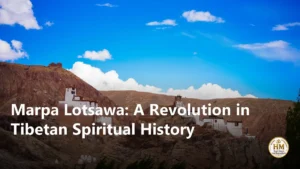
Marpa Lotsawa was a pioneering Tibetan master and translator who brought the Six Dharmas of Naropa and Mahamudra teachings directly from India to Tibet. By living as an enlightened householder yogi and farmer, he proved that supreme realization does not require monastic renunciation. His sacred lineage established direct, experiential transmission from guru to disciple.
During a tumultuous epoch in the high Himalayas, Tibetan Buddhism faced a devastating eclipse. Following the collapse of the imperial monarchy and the persecution under King Langdarma, centralized authority fractured into warring principalities, and authentic spiritual teachings began to fade into obscurity. Corrupted practices and fragmented lineages threatened to extinguish the sacred flame of Dharma across the plateau. In this profound darkness, the spiritual landscape desperately needed a transformative light to restore authentic wisdom and rekindle universal hope.
At this decisive historical juncture, an extraordinary figure emerged from a humble agrarian family in Lhodrak: Marpa Lotsawa. Blessed with an indomitable will and an unquenchable thirst for ultimate truth, he embarked on a journey that would forever alter the course of Himalayan spirituality. His life was far more than the chronicled career of a scholarly linguist; it ignited a spiritual revolution that fundamentally reshaped Tibetan culture and practice.
Marpa Lotsawa dismantled the prevailing assumption that full spiritual liberation belonged exclusively to celibate monastics residing in remote hermitages. He demonstrated through personal mastery that a householder, deeply engaged in farming, commerce, marriage, and family responsibilities, could attain the zenith of enlightened awareness. Driven by pure devotion, he converted his entire earthly inheritance into gold and braved life-threatening journeys across the Himalayas to receive authentic initiations from Indian Mahasiddhas.
Through his arduous apprenticeships under legendary masters Naropa and Maitripa, Marpa brought the living essence of the Tantras into Tibet. His legacy culminated in the birth of the Kagyu school, often celebrated as the Practice Lineage, which emphasizes direct experiential realization over dry intellectual scholarship. Today, his life remains a timeless testament that profound spiritual realization is accessible in the midst of everyday worldly responsibilities.
Read the complete Telugu edition of this article.
The Tibetan Dark Age and the Rise of Marpa Lotsawa
The historical emergence of Marpa Lotsawa occurred during one of Tibet’s most precarious eras, commonly remembered as the dark age of spiritual decline. Following the downfall of the Yarlung Dynasty, political chaos gripped the land, and the institutional support that had once sustained grand Buddhist monasteries dissolved. Authentic lineages of transmission grew frail, and scriptural interpretations were increasingly distorted without the guidance of realized Indian masters. The high mountain valleys stood at a critical crossroads, yearning for genuine teachers who could bridge the sacred sources of India with the spiritual aspirations of Tibet.
Born in the southern region of Lhodrak to an ordinary farming family, Marpa displayed an intensely fiery and defiant temperament from early childhood. Recognizing his uncontrollable energy and sharp intellect, his parents sent him to study under the renowned translator Drogmi Lotsawa. There, he mastered Sanskrit and classical literary arts, but his inner spirit demanded something far deeper than conventional grammar. His soul yearned for the living, untamed essence of the Dharma, prompting him to dedicate his entire existence to finding fully enlightened masters who held the unbroken oral transmission.
Perilous Journeys to India — Marpa Lotsawa and His Gurus
Undertaking a journey from the freezing heights of Tibet down to the sweltering plains of India in the eleventh century was an ordeal that few survived. Travelers faced perilous mountain precipices, lethal tropical fevers, venomous wildlife, and ruthless bands of highway bandits. Undaunted by the prospect of death, Marpa Lotsawa liquidated his entire family estate and converted all his worldly goods into gold dust to offer as traditional tribute to the Indian masters. He crossed the mighty Himalayan passes three separate times, driven solely by single-minded devotion to the Dharma.
In India, Marpa encountered his root guru, the celebrated Mahasiddha Naropa, residing at the monastic university of Nalanda and in sacred charnel grounds. Over years of rigorous discipleship, Naropa bestowed upon him the profound Six Dharmas of Naropa—a collection of advanced yogic practices comprising inner fire (Tummo), illusory body, dream yoga, clear light, the intermediate state (Bardo), and the transference of consciousness (Phowa). Marpa also sought out the great master Maitripa, who transmitted the luminous, non-dual realization of Mahamudra, illuminating the pristine nature of mind beyond conceptual limitation.
These esoteric transmissions were never meant for broad academic debate; they were confidential, experiential instructions whispered directly from master to disciple. During his return journey, an envious companion threw Marpa’s painstakingly copied Sanskrit manuscripts into the swirling waters of the Ganges. Rather than succumbing to despair, Marpa arrived at an illuminating realization: his knowledge did not depend on ink and paper, but was permanently awakened within his own heart. This moment epitomized the living, indestructible character of his realization.
The Householder Path — Marpa Lotsawa and Lady Dagmema
What distinguished Marpa Lotsawa from the vast majority of Tibetan luminaries was his unapologetic embrace of the householder lifestyle. Instead of taking monastic vows, he remained an active landowner, farmer, and trader in his native village of Drowolung. He demonstrated that domestic duties, financial management, and marital partnership are not obstacles to liberation, but rather the very soil in which enlightened awareness can blossom. He unified worldly action and transcendent realization into a single continuous stream of spiritual practice.
Central to this sacred dynamic was his devoted wife, Lady Dagmema, whose name translates as ‘Selfless One.’ Far from being an ordinary domestic companion, Dagmema was an accomplished practitioner in her own right, revered as a living embodiment of the wisdom dakini. She acted as an affectionate spiritual mother to Marpa’s disciples, providing nourishment, encouragement, and maternal protection during their most arduous spiritual trials. Her wisdom and compassionate diplomacy were vital in sustaining the community that formed around Marpa’s estate.
Tragedy struck Marpa’s household with the untimely, violent death of his beloved son and chosen heir, Darma Dode. While the grief of losing his son was deeply felt, Marpa transformed this profound personal loss into a cosmic teaching on impermanence. The tragedy marked a pivotal transition in his legacy, shifting the continuation of his lineage away from biological inheritance toward an unbroken spiritual succession of heart-disciples.
Trials of Milarepa — Marpa Lotsawa and Karmic Purification
The spiritual journey of Marpa Lotsawa reached its crowning fulfillment in his relationship with his primary disciple, Jetsun Milarepa. Having practiced sorcery and black magic in his youth to avenge the mistreatment of his family, Milarepa arrived at Marpa’s doorstep weighed down by immense negative karma. Recognizing the immense potential and deep-seated karmic debt of his new disciple, Marpa deliberately withheld formal Buddhist initiations and subjected Milarepa to years of brutal, exhausting physical labor.
Under Marpa’s unyielding commands, Milarepa was ordered to construct massive multi-story stone towers with his bare hands, only to be ordered to tear them down, return every single boulder to its original location, and begin anew. To external observers, these demands appeared ruthless and tyrannical, but they were in truth the fiercest manifestations of enlightened compassion. Marpa utilized these relentless physical trials as a spiritual crucible to completely exhaust and purify Milarepa’s destructive karma before bestowing the highest Tantric secrets.
The unshakeable bond forged between guru and disciple through these monumental trials became the gold standard of Vajrayana discipleship. Once Milarepa’s karmic obscurations were thoroughly purged, Marpa lovingly poured the entirety of Naropa’s Six Dharmas and the Mahamudra teachings into him like water from one pristine vase into another. Through this radical alchemical relationship, Milarepa was empowered to become Tibet’s most revered yogic saint and poet.
The Kagyu Legacy — Marpa Lotsawa and Gampopa’s Synthesis
The spiritual stream transmitted by Marpa Lotsawa achieved institutional permanence through the visionary work of Milarepa’s illustrious disciple, Gampopa. Known throughout Tibet as the ‘Physician of Dhagpo,’ Gampopa had initially trained as a doctor and attained deep mastery in the Kadampa monastic tradition founded by Atisha. When he encountered Milarepa, Gampopa absorbed the direct yogic transmissions and boundless Mahamudra instructions of the Kagyu tradition, recognizing the unique power of both systems.
Gampopa’s genius lay in his synthesis of these two great spiritual currents. He merged the systematic discipline, moral ethics, and graduated path of Kadampa monasticism with the raw, experiential yoga and direct insight of Marpa’s Kagyu heritage. This integration birthed the Dagpo Kagyu tradition and established the first major Kagyu monastic seat at Daglha Gampo. By creating a stable monastic framework, Gampopa ensured that Marpa’s esoteric teachings could be systematically preserved and transmitted across generations without losing their yogic vitality.
Following Gampopa’s passing, the Dagpo Kagyu lineage blossomed into four primary and eight secondary schools, each upholding Marpa’s foundational teachings. The primary branches included the Karma Kagyu, founded by the first Karmapa Dusum Khyenpa, which inaugurated Tibet’s revolutionary Tulku (reincarnate lama) system; the Tsalpa Kagyu, which played a major political role in Lhasa; the Barom Kagyu, which flourished in eastern Kham; and the Phagdru Kagyu, which governed central Tibet. Across all these diverse lineages, the living heart remained unchanged: unwavering devotion to the Six Dharmas of Naropa and Mahamudra as transmitted by Marpa Lotsawa.
📖 AI and Spiritual Consciousness: Can We Communicate with the Divine?
Spiritual Meaning — The Living Realization of Marpa Lotsawa
The esoteric core of Marpa Lotsawa’s life lies in the absolute non-duality of Samsara and Nirvana. Classical religious dogmas often enforce a rigid division between sacred renunciation and profane domesticity, claiming that true spiritual realization is impossible amidst family and farming. Marpa shattered this conceptual limitation by proving that the ordinary circumstances of daily life—plowing fields, raising children, facing loss, and managing an estate—are themselves the primordial mandala of awakening when embraced with non-clinging awareness and pure perception.
A profound truth embodied in Marpa’s legacy is the supremacy of direct experiential wisdom over dry intellectual dogma. When his sacred Sanskrit scrolls were lost in the river, his immediate recognition that the true Dharma resides within one’s own consciousness underscored the essence of the ‘whispered lineage.’ Realization cannot be captured in dead letters or intellectual philosophies; it is an awakened state of being that must be ignited directly from the living realization of an authentic master to the receptive heart of the disciple.
Furthermore, the intense dynamic between Marpa and Milarepa illustrates the esoteric alchemy of karmic purification in Vajrayana. Spiritual progress cannot occur merely through theoretical enthusiasm or gentle affirmation when heavy obscurations cloud the mind. By using radical physical labor and psychological pressure, Marpa dismantled the ego’s fortress, transmuting Milarepa’s dark past into the boundless light of liberation. This demonstrates that genuine compassion often manifests not as comforting indulgence, but as the fierce fire that burns away all illusion.
For contemporary practitioners navigating the relentless demands of modern professional and family life, Marpa Lotsawa offers an empowering archetype. His life assures us that spiritual liberation does not require retreating to an isolated Himalayan cave or abandoning our worldly duties. By approaching our daily work, relationships, challenges, and emotional trials as fields of spiritual practice, we can cultivate pristine mindfulness and compassionate presence right in the heart of modern existence.
Chapter Summary
The remarkable life of Marpa Lotsawa stands as a watershed moment in the spiritual history of Tibet. Rising during a period of dark spiritual decline, this extraordinary householder from Lhodrak undertook three perilous journeys to India, converting his wealth into gold to receive direct oral transmissions from Mahasiddhas Naropa and Maitripa. Marpa mastered and brought back the foundational practices of the Six Dharmas of Naropa and Mahamudra, establishing the practice-oriented Kagyu tradition. Living as a farmer, husband to Lady Dagmema, and father, he unified everyday existence with supreme yogic realization. Through his rigorous training and karmic purification of Milarepa, and the subsequent institutional synthesis by Gampopa, Marpa’s spiritual lineage expanded into vibrant monastic and yogic traditions that endure worldwide today.
Scripture Notes
- Main Message: The sacred spiritual biographies (Namthars) of Marpa Lotsawa convey that the highest spiritual liberation is fully attainable within the fabric of ordinary householder life. Sacred texts and rituals serve as pointers, but authentic realization is an awakened state of consciousness transmitted through an unbroken lineage of realized masters, demanding complete sincerity, perseverance, and profound devotion to the guru.
- Philosophical Teaching: Rooted in the pinnacle teachings of Mahamudra and the Tantric methods of the Six Dharmas of Naropa, Marpa’s philosophy affirms that the mind is primordially pure, luminous, and inseparable from ultimate reality. Rather than rejecting worldly phenomena, the practitioner utilizes every sensory experience, emotional challenge, and karmic obstacle as the raw fuel for immediate awakening and spontaneous wisdom.
Frequently Asked Questions
Who was Marpa Lotsawa?
Marpa Lotsawa (1012–1097) was an extraordinary Tibetan spiritual master, yogi, and translator born in Lhodrak. He made three perilous journeys to India, where he studied under Mahasiddhas like Naropa and Maitripa, bringing back esoteric Vajrayana teachings that founded the Kagyu school of Tibetan Buddhism.
Which spiritual teachings did Marpa Lotsawa bring from his Indian gurus?
Marpa Lotsawa brought the profound Six Dharmas of Naropa (including inner fire or Tummo, dream yoga, illusory body, clear light, bardo, and phowa) and the ultimate non-dual meditation system of Mahamudra from his revered gurus Naropa and Maitripa, establishing experiential Tantric practice across Tibet.
What makes the spiritual path of Marpa Lotsawa unique?
Marpa Lotsawa demonstrated that supreme spiritual enlightenment does not require monastic celibacy or worldly renunciation. He lived openly as a married householder, farmer, and landowner alongside his wife Lady Dagmema, proving that family life and daily work can serve as the direct foundation for ultimate realization.
📖 Jyotirlinga: The Twelve Sacred Pillars of Divine Light and Spiritual Liberation
Why did Marpa Lotsawa subject Milarepa to severe trials?
Marpa subjected Milarepa to severe physical and mental ordeals—such as building and dismantling massive stone towers—out of fierce compassion. These grueling tasks were designed to exhaust and purify the heavy negative karma Milarepa had accumulated through black magic, preparing him to receive the highest Vajrayana initiations safely.
Who established the Dagpo Kagyu lineage?
The Dagpo Kagyu lineage was established by Gampopa, the foremost disciple of Milarepa. Gampopa integrated the disciplined monastic stages of the Kadampa tradition with the direct yogic and Mahamudra teachings of Marpa’s lineage, creating the first Kagyu monastic institutions at Daglha Gampo.
Which Kagyu branch introduced the Tulku reincarnation system?
The Karma Kagyu branch, founded by the First Karmapa Dusum Khyenpa (a disciple of Gampopa), introduced the revolutionary Tulku system in Tibet, establishing a formal tradition of recognizing the successive conscious reincarnations of realized lineage masters.