
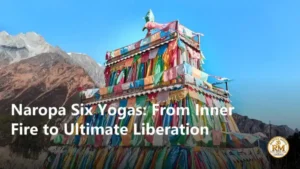
The Six Yogas of Naropa represent an advanced Tibetan Buddhist Tantric system designed to attain complete spiritual liberation within a single lifetime. Originating in ancient Indian esoteric traditions, Mahasiddha Naropa synthesized these completion-stage practices to transmute subtle winds, awaken dormant inner heat, navigate dream states, and merge personal consciousness directly into primordial luminosity.
The Six Yogas of Naropa stand as one of the most profound and secret systems of psychospiritual transformation in the Vajrayana Buddhist tradition. Rooted in the ancient Indian Tantric lineages of the Mahasiddhas, these completion-stage practices integrate the physical body, the subtle energetic network, and the luminous nature of mind. Rather than viewing the physical vehicle as an obstacle to spiritual realization, this system regards the body as an indispensable laboratory for awakening, utilizing physiological and energetic processes to dissolve mental obscurations and realize enlightenment in one lifetime.
Historically, this sacred knowledge was transmitted from the Indian adept Tilopa to his foremost disciple, the great scholar-yogi Naropa, who served as a gatekeeper of Nalanda Monastery before embarking on the rigorous path of experiential Tantra. Naropa synthesized these diverse Tantric instructions into an integrated sixfold curriculum. His Tibetan student, Marpa the Translator, undertook perilous journeys across the Himalayas to receive these teachings and transport them to Tibet. There, Marpa passed the lineage to the ascetic poet Milarepa, whose realization demonstrated that even intense karmic burdens could be purified through rigorous, devoted application.
In our contemporary era, where spiritual inquiry often collides with chronic mental restlessness and fragmented attention, the wisdom of Naropa provides an invaluable map of human consciousness. These methods demystify the subtle interactions between prana (vital wind), nadis (energy channels), and bindu (drops of consciousness), offering practical insights into how intentional breathing, visualization, and non-attached awareness can dismantle fear, overcome attachment, and unveil the pristine radiance that lies at the core of every sentient being.
Read the complete Telugu edition of this article.
The Sacred Lineage and Origin of Naropa
The historical genesis of the Six Yogas of Naropa lies deeply embedded in the rich soil of medieval Indian Tantric Buddhism. Naropa lived during the eleventh century as an accomplished master and chancellor at the famed Nalanda University. Despite mastering vast compendiums of philosophy, debate, and scriptural commentary, Naropa encountered a fierce dakini who pointed out that intellectual understanding alone could never bridge the gap to direct spiritual realization. Recognizing the truth of her assessment, Naropa abandoned academic prestige and searched tirelessly until he found his destined root guru, Tilopa. Under Tilopa’s unconventional and demanding guidance, Naropa underwent twelve major and twelve minor trials, each designed to eradicate subtle layers of pride, conceptuality, and dualistic grasping.
After attaining supreme siddhi, Naropa codified the most potent completion-stage practices drawn from major Tantric cycles, including the Guhyasamaja, Chakrasamvara, and Hevajra Tantras. This integrated system came to be known as the Six Dharmas or Six Yogas. When the Tibetan seeker Marpa Chokyi Lodro traveled south to India seeking authentic spiritual teachings, Naropa recognized him as the ideal recipient for the lineage. Marpa meticulously translated these profound Sanskrit texts and oral instructions into Tibetan. He subsequently bestowed them upon Milarepa, who famously practiced them in solitary mountain caves, demonstrating that unwavering devotion and diligent practice can dissolve negative karma and manifest full buddhahood within a single mortal frame. The transmission remains unbroken today, passed down through an uninterrupted succession of realized masters.
Subtle Energy Foundations Taught by Naropa
The philosophical and practical edifice of the teachings of Naropa rests upon the science of the subtle body, which comprises three fundamental elements: tsa (energy channels), lung (vital wind or prana), and thigle (subtle drops or energetic essences). According to this traditional anatomy, the human body contains tens of thousands of microscopic energy pathways, among which three primary channels govern spiritual dynamics: the central channel (uma or avadhuti), the left channel (ida or lalana), and the right channel (pingala or rasana). In ordinary states of consciousness, vital winds circulate erratically through the left and right channels, feeding discursive thoughts, emotional turbulence, and dualistic perceptions.
The objective of the system established by Naropa is to draw these wandering karmic winds out of the lateral channels and gather them firmly into the central channel. When the breath and consciousness enter, abide, and dissolve within the central channel, the conceptual mind ceases its erratic movement, unlocking transcendent bliss and primordial awareness. Energy nodes known as chakras—located at the crown, throat, heart, and navel—serve as focal junctions where subtle energies gather. By stabilizing the flows of prana and melting the energetic drops through dedicated contemplation, the practitioner harmonizes physical vitality with spiritual clarity, laying the energetic groundwork for radical psychological transformation.
RECOMMENDED PRODUCT

SLEEPEZEE Meditation Cushion Sloped Floor Seat Review : How can this product help you?
This review examines the SLEEPEZEE using verified buyer feedback and the manufacturer’s listed specifications. Sitting flat on a hard floor during extended mindfulness or… The SLEEPEZEE floor meditation seat directly addresses posture breakdown by using high-density polyurethane foam that maintains its elevation rather than flattening out. Its… The SLEEPEZEE Meditation Cushion provides firm polyurethane foam elevation designed to align the pelvis and ease knee pressure during cross-legged floor sitting. Measuring…
Read more about this productBuy on Amazon
As an Amazon Associate, RamthaMedia earns from qualifying purchases.
Essential Ngondro Preparations in Naropa Practice
Embarking upon the esoteric path articulated by Naropa without thorough foundational training is considered both futile and hazardous. Traditional lineages mandate that aspirants first complete the preparatory disciplines known collectively as Ngondro. These preliminary practices cleanse the practitioner’s psychophysical matrix through hundreds of thousands of prostrations, refuge prayers, bodhicitta cultivation, Vajrasattva purification mantras, and mandala offerings. This rigorous preparatory phase purges deep-seated karmic residues, cultivates mental humility, and fortifies the nervous system against the intense energetic currents generated during higher tantric sadhana.
Beyond liturgical recitations, the foundation of this training requires strict moral integrity, physical purification, and unshakeable devotion to a qualified spiritual preceptor. Because these advanced practices manipulate vital life energies and subconscious mental states, an aspiring yogi must possess an altruistic motivation centered entirely on the welfare of all living beings. Without a grounded moral foundation and the stabilizing anchor of guru devotion, premature attempts to force subtle energies into the central channel can cause physical distress, nervous strain, or severe psychological destabilization. The preparatory path guarantees that the student’s inner vessel is pure and resilient enough to contain the potent nectar of realization.
The Six Transformative Yogas of Naropa Explained
The Six Yogas of Naropa comprise an ordered sequence of interconnected disciplines that systematically dismantle the illusions of physical matter, psychological conditioning, and the fear of mortality. The first and foundational discipline is Tummo (Inner Fire Yoga). Through precise diaphragmatic breath retention (the vase breath) and visualization of a blazing syllable at the navel chakra, the yogi ignites an intense inner warmth. This spiritual fire ascends through the central channel, burning away emotional afflictions and melting the subtle drops at the crown, inundating the practitioner with non-dual bliss. Beyond conferring physical immunity to freezing Himalayan temperatures, Tummo serves as the energetic engine that empowers all subsequent yogas.
Building upon the energetic fluidity created by Tummo, the second discipline is Gyulu (Illusory Body Yoga). Here, the practitioner meditates upon all physical forms, including their own flesh, as empty reflections akin to a rainbow, a mirage, or an image in a polished mirror. By dissolving the instinctual reification of matter, the yogi transcends vanity, fear, and attachment. This directly informs the third practice, Milam (Dream Yoga), wherein the practitioner maintains lucidity during sleep. By recognizing that dream experiences possess the same illusory nature as waking life, the yogi gains control over the dream state, transforming mundane nightmares into visionary platforms for spiritual training and exploring multidimensional awareness.
The fourth discipline, Ösel (Clear Light Yoga), allows the yogi to access the pristine, luminous awareness that shines continuously beneath the surface of everyday waking consciousness and deep dreamless sleep. By dissolving mental grasping into this fundamental radiance, the yogi touches the unconditioned ground of reality. The fifth practice is Bardo Yoga, designed to guide the practitioner through the disorienting intermediate states that occur between bodily death and subsequent rebirth. Having mastered dream lucidity and clear light during life, the practitioner recognizes the terrifying visions of the post-mortem bardo as mere projections of their own mind, achieving liberation without taking an involuntary rebirth.
The final practice is Phowa (Consciousness Transference Yoga), a remarkable technique employed at the moment of death. When physical vitality wanes and death becomes unavoidable, the practitioner ejects their subtle consciousness through the crown aperture directly into a pure realm or into the heart of an enlightened Buddha. This safeguard ensures that even practitioners who have not attained complete mastery during their lifetime can avoid lower realms of suffering and secure a favorable rebirth conducive to final enlightenment.
Navigating Obstacles on the Path of Naropa
Treading the path mapped by Naropa presents significant internal and external challenges that test the disciple’s endurance and psychological stability. A primary obstacle is the lack of sustained discipline; many practitioners become fascinated by the exotic reputation of the practices but lack the patience required for daily, repetitive meditation. Without relentless perseverance and consistent application, the subtle channels remain congested, preventing prana from entering the central channel and leaving the practitioner frustrated.
Somatic and psychological imbalances also present major hurdles during these practices. Misapplied breath retentions or forced visualization can disrupt the natural equilibrium of lung (wind energy), leading to heart palpitations, dizziness, insomnia, and acute emotional distress. Furthermore, the experiential encounter with uninhibited dream states and energetic surges can feed spiritual vanity, causing the ego to co-opt sacred milestones for personal pride. To overcome these hazards, the practitioner must maintain absolute transparency with a qualified guru, practice moderation, and frequently cultivate the humble realization that all phenomena are empty of inherent selfhood.
Recognizing Signs of Mastery in Naropa Systems
As a dedicated seeker deepens their practice within the tradition of Naropa, distinct physiological, energetic, and mental signs of progress begin to manifest naturally. At the somatic level, the body displays balanced thermal regulation, vitality, and resilience. Practitioners of Tummo develop the capacity to generate radiant physiological warmth effortlessly, maintaining physical ease even in extreme cold without succumbing to feverish or agitating heat.
Mentally and spiritually, the signs of accomplishment include an unwavering emotional tranquility, spontaneous compassion, and freedom from neurotic attachments. In the realm of sleep, the yogi experiences unbroken lucidity, moving through dreams with complete awareness and converting nightmares into spiritual insights. During waking hours, brief flashes of the primordial clear light illuminate ordinary perceptions, stripping the external world of its dense, solid appearance and revealing the vibrant, luminous clarity underlying everyday reality.
Integrating Mahamudra with the Path of Naropa
The dynamic methodologies formulated by Naropa find their ultimate fulfillment when integrated with the practice of Mahamudra (The Great Seal). While the Six Yogas focus extensively on the energetic scaffolding—utilizing postures, breath retentions, and internal visualizations to manipulate prana—Mahamudra represents the direct, effortless resting in the pristine nature of awareness itself. The energetic purifications achieved through Tummo and Illusory Body yoga clear the channels, allowing the mind to rest effortlessly in its natural state without distraction.
When these two approaches are skillfully combined under the guidance of a master, they form a balanced path where method and wisdom become inseparable. The Six Yogas act as the active methods (upaya) that tame the wild currents of vital energy, while Mahamudra provides the ultimate transcendent wisdom (prajna) that recognizes the uncreated emptiness of both the energy and the observer. This synthesis ensures that the yogi avoids both the trap of dry intellectual abstraction and the pitfall of getting attached to transient energetic sensations.
Modern Applications and Reverence for Guru in Naropa Traditions
In modern times, scientific researchers, neuroscientists, and contemplative psychologists have shown immense interest in the physiology of the Six Yogas of Naropa. Laboratory studies examining advanced practitioners of Tummo have verified astonishing voluntary control over autonomic nervous functions, including substantial increases in peripheral body temperature and altered brainwave patterns. While these scientific inquiries validate the somatic efficacy of these practices, tradition cautions against reducing sacred yogic systems to mere biological biohacking or stress-management techniques.
The indispensable core of these teachings remains ethical purity, compassion, and profound reverence for the lineage master. The guru is not merely an instructor imparting technical steps, but a living embodiment of the awakened state who directly transmits the blessing and monitors the student’s inner alignment. Attempting to extract these sacred techniques from their devotional and ethical matrix deprives them of their liberating power and invites grave psychological peril. Practiced with proper guidance, genuine humility, and an altruistic heart, these timeless teachings illuminate a direct, transformative highway toward ultimate freedom.
Spiritual Meaning
The inner meaning of the Six Yogas formulated by Naropa centers on the complete transmutation of mundane human experience into enlightened wisdom. Rather than rejecting the human body as impure or viewing transient thoughts as enemies to be eradicated, this path teaches that every physical sensation, breath, dream, and mental projection is an expression of the same non-dual reality. By directing vital energy into the central channel, the practitioner burns away the dualistic illusion of a separate self, realizing that the observer and the observed are inherently unified in clear light.
Furthermore, this esoteric curriculum dismantles humanity’s most primal terror: the fear of death and dissolution. Through the systematic exploration of dream states, deep sleep, and the intermediate bardo, the yogi treats physical death not as an unknown abyss of destruction, but as the supreme opportunity for spiritual liberation. When the gross sensory faculties dissolve, the primordial ground of being reveals itself in its naked splendor, and the prepared mind recognizes this light as its own true face.
Ultimately, the teachings of Naropa establish that spiritual liberation is not a distant, post-mortem destination, but a timeless reality hidden beneath the noisy currents of ordinary thought. When breath, awareness, and subtle energy harmonize, the entire universe is recognized as an illusory play of light and emptiness, free from birth, decay, and suffering.
Even for modern seekers living outside monastic environments, the principles underlying the system of Naropa offer immediate practical guidance. By cultivating mindfulness during waking hours, one learns to view stressful situations as passing, illusory reflections rather than permanent crises. Practicing conscious breathing anchors the erratic nervous system, while reflecting on the dreamlike nature of life reduces grasping and emotional reactivity. When approached with ethical integrity and humility, these ancient insights inspire us to live each day with lucidity, courage, and unconditional benevolence.
RECOMMENDED BOOK

The Maya Simulation: Quantum Physics and the Science of Consciousness
by A. Ravinder
A guide that bridges the ancient wisdom of the Yoga Vasistha with quantum physics and modern consciousness science — for readers ready to question the nature of reality and calm the mind with practical tools like the Zero Voice Technique.
As an Amazon Associate, RamthaMedia can earn from qualifying purchases.
Chapter Summary
The Six Yogas of Naropa constitute a pinnacle of Vajrayana Buddhist completion-stage practice, meticulously designed to achieve enlightenment in a single lifetime. Synthesized by the Indian Mahasiddha Naropa and transmitted to Tibet by Marpa the Translator, this path encompasses six interconnected disciplines: Tummo (Inner Heat), Gyulu (Illusory Body), Milam (Dream Yoga), Ösel (Clear Light), Bardo Yoga (Intermediate State), and Phowa (Consciousness Transference). Grounded in the subtle anatomy of nadis, prana, and bindu, these methods transmute wandering karmic energies into the central channel, clearing mental obscurations and revealing primordial awareness. To practice safely, aspirants must complete foundational Ngondro purifications, cultivate ethical conduct, and maintain steadfast devotion to an authentic lineage guru. When integrated with the direct non-dual insight of Mahamudra, these six disciplines conquer the fear of death, illuminate the illusory nature of phenomenal existence, and guide the practitioner into unshakeable spiritual freedom.
Scripture Notes
- Main Message: Enlightenment is neither an abstract philosophy nor an unattainable future reward; it is the primordial, luminous nature of mind that can be directly accessed within this very physical body through the systematic mastery of subtle prana, inner fire, and pristine awareness.
- Philosophical Teaching: Tantric completion-stage philosophy posits that mind and subtle wind are inseparable aspects of a single energetic reality. When the erratic winds circulating through the lateral channels are gathered and dissolved within the central channel, conceptual dualism collapses, unveiling the non-dual union of radiant clarity and ultimate emptiness.
Frequently Asked Questions
What are the Six Yogas of Naropa?
The Six Yogas of Naropa are an advanced system of Tibetan Buddhist completion-stage practices designed to attain complete spiritual liberation within a single lifetime. They consist of Tummo (Inner Heat), Gyulu (Illusory Body), Milam (Dream Yoga), Ösel (Clear Light), Bardo Yoga (Intermediate State), and Phowa (Consciousness Transference).
What is the historical origin of the teachings of Naropa?
These practices originated in ancient Indian Tantric traditions and were synthesized in the eleventh century by the Mahasiddha Naropa, who received them from his master Tilopa. The teachings were later brought to Tibet by Marpa the Translator and popularized through the realization songs of Milarepa.
What preliminary preparations are required before practicing the system of Naropa?
Practitioners must first complete foundational Ngondro practices, which include hundreds of thousands of prostrations, mantra recitations, mandala offerings, ethical purifications, and deep guru devotion to ensure that the subtle energy body is purified and psychologically resilient.
📖 Pineal Gland Secrets — Proven Paths to Awaken Inner Divinity
What benefits are achieved through the practice of Tummo Yoga?
Tummo awakens a potent spiritual fire at the navel chakra, raising body temperature, enhancing vital circulation, and drawing subtle winds into the central channel. This dissolves mental poisons, pacifies emotional turbulence, and floods the consciousness with non-dual bliss.
What is the primary concept behind Illusory Body Yoga in Naropa tradition?
Illusory Body Yoga (Gyulu) teaches the practitioner to perceive the physical form and all phenomenal appearances as insubstantial reflections, like a mirage or an image in a mirror. This realization eliminates clinging to the physical body and eradicates ego-based fears.
How does Dream Yoga assist the spiritual seeker?
Dream Yoga (Milam) enables the practitioner to maintain continuous conscious lucidity while asleep. By recognizing the illusory nature of dreams, the yogi learns to transform mental imagery, dissolve subconscious fears, and prepare for the intermediate bardo state following physical death.
What is the purpose of Bardo Yoga in the system of Naropa?
Bardo Yoga trains the practitioner to maintain lucid, fearless awareness during the intermediate period between bodily death and subsequent rebirth. This empowers the consciousness to recognize the clear light of reality and attain liberation rather than wandering into involuntary rebirth.


