
The traditional Hindu Panchangam operates on two primary astronomical systems: the Amanta tradition in South India and the Purnimanta tradition in North India. Because Purnimanta months end on the full moon and Amanta months end on the new moon, northern regions observe Shravana Masam exactly fifteen days earlier than southern regions.
Indian cultural heritage places profound emphasis on celestial timekeeping, seasonal transitions, and sacred observances through the traditional calendar known as the Panchangam. Whenever devotees across different regions discuss the arrival of auspicious festivals and sacred months, a fascinating geographical variation emerges. While devotees in Southern India are still observing the closing fortnight of the month of Ashadha, their Northern counterparts joyfully celebrate the commencement of the holy month of Shravana. This recurring divergence frequently sparks curiosity among seekers and traditional observers alike.
This fifteen-day gap is neither a clerical error nor a modern calendar discrepancy; rather, it reflects two deeply rooted, mathematically precise traditions within ancient Indian astronomy. For centuries, civil life, temple rituals, and agrarian practices across the Indian subcontinent have harmonized with these dual astronomical calculations. By studying these regional nuances, one discovers the sophisticated observational sciences developed by Vedic astronomers and rishis who mapped the lunar and solar movements with remarkable accuracy.
Panchangam systems across India maintain cosmic unity despite regional variations in calculation. At the core of this difference lie the Amanta and Purnimanta lunar frameworks. While both systems track the identical lunar phases, Tithis, and planetary transits across the zodiac, their definition of where a lunar month begins and ends differs by a single lunar fortnight. Understanding this structural design reveals how cultural diversity and astronomical precision coexist seamlessly in Indian spiritual philosophy.
Read the complete Telugu edition of this article.
Panchangam Traditions — The Dual Calculation Systems of Indian Astronomy
The classical Indian Panchangam relies on five primary astronomical elements: Tithi (lunar day), Vara (weekday), Nakshatra (lunar mansion), Yoga (soli-lunar combination), and Karana (half-lunar day). Together, these five limbs establish the temporal framework for all religious rituals, seasonal festivals, and daily duties. When organizing the lunar year, ancient Indian astronomers formulated two distinct yet mathematically compatible systems to track the thirty Tithis that comprise a lunar month. These two systems are known across the subcontinent as the Amanta system and the Purnimanta system.
Both systems divide the lunar month into two equal fortnights: the Shukla Paksha (the waxing or bright fortnight culminating in the full moon) and the Krishna Paksha (the waning or dark fortnight culminating in the new moon). The fundamental difference between the two traditions does not involve the measurement of the days themselves, but rather the exact celestial milestone that marks the conclusion of one month and the inauguration of the next. This foundational difference in lunar calculation creates the regional shift observed between Northern and Southern Indian calendars.
RECOMMENDED PRODUCT
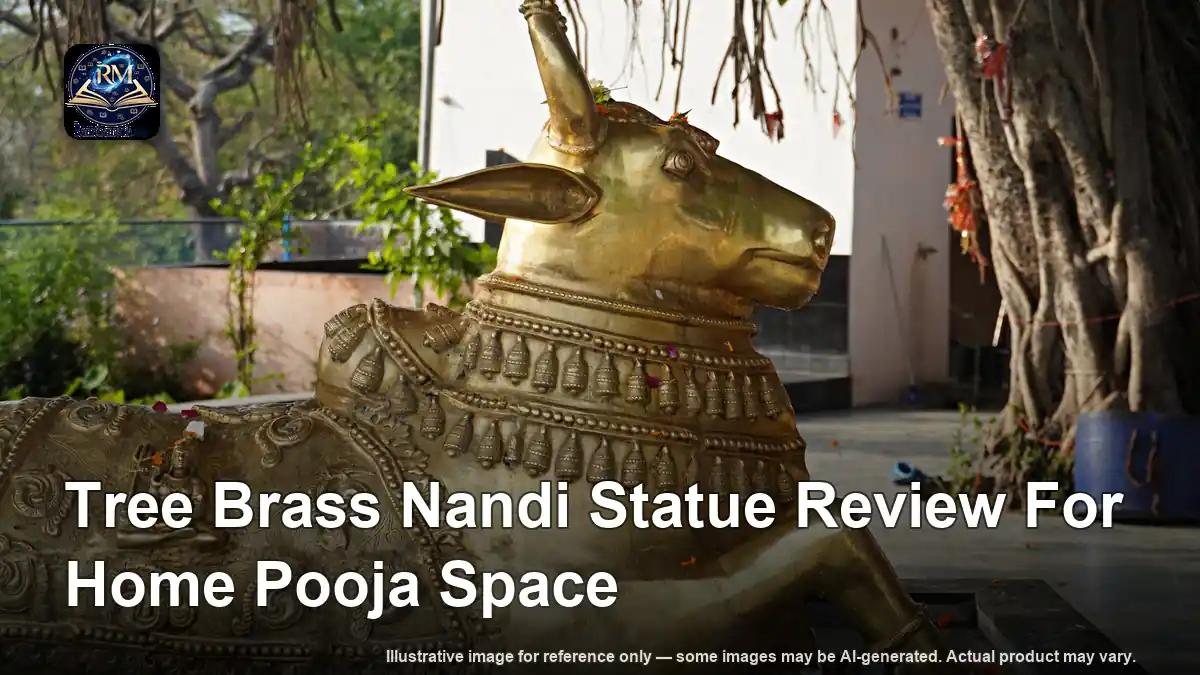
Tree Brass Nandi Statue Review For Home Pooja Space : How can this product help you?
This review examines the Tree using verified buyer feedback and the manufacturer’s listed specifications. Setting up a dedicated home mandir or aligning a living space with… The Tree brass Nandi statue addresses this specific requirement by pairing a compact 9 by 11 centimetre profile with an approximate 810 gram solid brass casting. Its… The Tree Brass Nandi Statue is a solid cast-metal devotional idol measuring 9 by 11 centimetres, designed for domestic pooja altars and Vastu South-West zonal placement…
Read more about this productBuy on Amazon
As an Amazon Associate, RamthaMedia earns from qualifying purchases.
Panchangam Amanta System — The South Indian New Moon Calculation
In Southern India, encompassing the states of Andhra Pradesh, Telangana, Karnataka, Tamil Nadu, and parts of Maharashtra and Gujarat, the Panchangam tradition follows the Amanta calculation. The Sanskrit term ‘Amanta’ combines ‘Amavasya’ (new moon) and ‘Anta’ (end), literally signifying a calendar month that concludes with the new moon. In this system, the exact moment the new moon phase finishes marks the end of the old month, and the very next sunrise welcomes the first day (Shukla Pratipada) of the brand-new month.
Under the Amanta framework, every lunar month begins with the bright, waxing phase of the Moon and concludes with the dark, waning phase. For example, the sacred month of Shravana begins only after the Ashadha Amavasya has fully concluded. Southern devotees wait for the arrival of the new moon before stepping into the holy austerities of Shravana. This perspective aligns calendar transitions with the visible rebirth of the lunar crescent in the evening sky, treating the emerging light as the dawn of a fresh temporal cycle.
Panchangam Purnimanta System — The North Indian Full Moon Method
Across Northern and Central India, including states such as Uttar Pradesh, Bihar, Rajasthan, Madhya Pradesh, Himachal Pradesh, Uttarakhand, Punjab, and Haryana, the Panchangam follows the Purnimanta system. The word ‘Purnimanta’ is a compound of ‘Purnima’ (full moon) and ‘Anta’ (end), denoting a calendar month that reaches its formal completion on the full moon day. Consequently, as soon as the full moon concludes, the succeeding day (Krishna Pratipada) marks the official beginning of the next calendar month.
Because the Purnimanta month begins immediately after the full moon, its first fifteen days consist of the Krishna Paksha (waning phase), followed by the Shukla Paksha (waxing phase), and it culminates on the next Purnima. Thus, the northern calendar enters the holy month of Shravana exactly when the Ashadha Purnima concludes. The entire waning fortnight that South Indians consider the final portion of Ashadha is counted by North Indians as the opening fortnight of Shravana Masam.
Panchangam Time Gap — The Mystery of the Fifteen Day Shift
When comparing both traditions side by side, the mechanics of the fifteen-day shift become abundantly clear. The bright fortnight (Shukla Paksha) occurs simultaneously in both North and South India. During this two-week window, both the Amanta and Purnimanta calendars agree completely on the name of the month and the number of the Tithi. The divergence occurs exclusively during the dark fortnight (Krishna Paksha), which Purnimanta places at the beginning of the incoming month and Amanta places at the conclusion of the ongoing month.
This structural alignment explains why major festivals that occur during Shukla Paksha—such as Sri Krishna Janmashtami, Vinayaka Chavithi, and Durga Navaratri—are celebrated across the entire country on the exact same universal calendar days, even though the nominal month names might seem different to a casual observer. For instance, in the year 2025, Shravana Masam in North India commences around July 26 following the Ashadha Purnima, whereas in South India, it commences around August 10 or 11 following the Ashadha Amavasya. Both regions faithfully observe the same sacred rhythms of the celestial bodies without contradiction.
Panchangam Solar Karthes — Agricultural Wisdom and Cosmic Transits
Beyond lunar months, the classical Panchangam incorporates solar divisions known as Karthelu (solar Nakshatra transits). A Karthe represents the specific stellar mansion (Nakshatra) that the Sun occupies at any given time. As the Sun traverses the 360-degree zodiac across the year, it passes through all 27 Vedic Nakshatras. Each Karthe lasts approximately 13 to 14 days, providing an indispensable solar guide for agricultural planning, monsoon forecasting, and rural lifestyle rhythms.
Centuries before modern meteorological instruments existed, Indian farmers relied upon Karthes like Ardra, Punarvasu, Pushyami, Ashlesha, Makha, Purva Phalguni, Uttara Phalguni, and Hasta to determine the exact periods for ploughing, sowing, weeding, and harvesting. Because the Sun’s ingress into a constellation is an absolute astronomical event, the physical seasons remain unified. However, the regional descriptions of these agricultural periods in local almanacs reflect the corresponding 15-day lunar calendar offsets, demonstrating the profound practical utility of Vedic timekeeping.
📖 Tourism in India: Why Is the Golden Opportunity Slipping Away?
Panchangam Observances — The Spiritual Grandeur of Shravana Masam
The arrival of Shravana Masam heralds one of the most spiritually vibrant periods in the Indian calendar. In Northern India, Shravan Maas is celebrated with extraordinary devotion dedicated entirely to Lord Shiva. Millions of devotees embark on the sacred Kanwar Yatra, walking hundreds of miles on foot to fetch holy water from the Ganges River and offer it to Shiva Lingams across famous pilgrimage centers. Every Shravan Somwar (Monday) is observed with rigorous fasting, elaborate Rudrabhishekam ceremonies, and deep devotional contemplation.
In Southern India, the arrival of Shravana Masam brings a wave of domestic and temple festivities, emphasizing the worship of Goddess Lakshmi alongside Lord Shiva. South Indian households observe the auspicious Varalakshmi Vratam on the second Friday of the month, followed by Mangala Gowri Vratam and Rakhi Purnima. As the monsoon showers rejuvenate the landscape with lush greenery, the spiritual atmosphere throughout India turns introspective, joyous, and deeply attuned to cosmic grace.
RECOMMENDED BOOK

The Maya Simulation: Quantum Physics and the Science of Consciousness by A. Ravinder
Is the world around us real? Or is it just a Maya Simulation?
A guide that bridges the ancient wisdom of the Yoga Vasistha with quantum physics and modern consciousness science — for readers ready to question the nature of reality and calm the mind with practical tools like the Zero Voice Technique. It explores mind, maya and consciousness in plain language, and offers a practical path for the seeker on the spiritual journey. Available in print and ebook instant-read versions.
Buy on AmazonBuy on Ramthamedia
As an Amazon Associate, RamthaMedia earns from qualifying purchases.
Spiritual Meaning of Panchangam Cycles
In the Vedic worldview, time is not merely a linear sequence of mechanical seconds; it is Kala Purusha, a sacred and living manifestation of the Supreme Divine. The continuous waxing and waning of the Moon mirrors the journey of the human mind (Manas). Scriptural wisdom states ‘Chandrama Manaso Jatah’—the Moon was born from the cosmic mind of the Supreme Being. Just as the Moon passes through darkness and returns to radiant fullness, human consciousness navigates through spiritual ignorance toward the luminous light of Self-realization.
The simultaneous existence of the Amanta and Purnimanta systems embodies the profound philosophical principle of unity within apparent diversity. While Northern and Southern traditions utilize different starting points to frame their calendar months, both honor the identical celestial harmony created by the Sun and the Moon. This teaches the spiritual seeker that external pathways and cultural customs may vary according to regional conditions, yet the inner spiritual objective—devotion, purity, and realization of the Divine—remains eternally unified.
The observance of austerities during Shravana Masam signifies the inner purification of human desires. The monsoon rain washes away the dust of the earth, symbolizing how devotional discipline, mantra japa, and selfless service wash away karmic impurities from the heart. By aligning personal lifestyle with sacred temporal cycles, a devotee attunes their individual consciousness to universal cosmic rhythms, transforming everyday time into an ongoing spiritual sacrifice.
Living in harmony with sacred timekeeping encourages modern individuals to introduce mindfulness and structural discipline into their daily routines. Instead of viewing time as an external pressure, observing the natural phases of the Moon and the seasonal transits of the Sun helps restore mental peace and emotional balance. By dedicating specific periods like Shravana to self-discipline, healthy fasting, and spiritual contemplation, one cultivates resilience, inner stillness, and deeper harmony with nature amidst the bustling demands of modern life.
📖 Somnath Jyotirlinga: How Did the First Sacred Shrine Rise After Countless Invasions?
Chapter Summary
The traditional Indian Panchangam incorporates two primary lunar calculation methods: the South Indian Amanta system (which ends the lunar month on the new moon) and the North Indian Purnimanta system (which ends the lunar month on the full moon). This single structural difference accounts for the fifteen-day shift observed in the commencement of holy months like Shravana Masam between Northern and Southern India. While North India begins Shravana with the dark fortnight following Ashadha Purnima, South India begins Shravana fifteen days later following Ashadha Amavasya. Despite this chronological offset, both traditions share identical calculations for solar transits (Karthelu) and celebrate core national festivals during the aligned bright fortnights. These dual traditions highlight the rich mathematical sophistication, agrarian utility, and unified spiritual core of ancient Indian astronomy.
Scripture Notes
- Main Message: Jyotisha Shastra, revered as the eye of the Vedas (Vedanga), teaches that temporal measurements must reflect the cosmic order (Rta). The coexistence of the Amanta and Purnimanta calculations affirms that astronomical timekeeping is both an exact mathematical science and an instrument for spiritual harmony.
- Philosophical Teaching: Time (Kala) is celebrated in the Upanishads and Puranas as an aspect of the infinite Supreme Lord (Mahakala). Human systems of calendar calculation are reverent attempts to organize human action in synchronization with cosmic rhythms, demonstrating that outward distinctions dissolve in the unified worship of the Divine.
Frequently Asked Questions
Why does Shravana Masam begin 15 days earlier in North India?
North India follows the Purnimanta Panchangam, where each lunar month begins immediately after the full moon day. South India follows the Amanta Panchangam, where each month begins after the new moon day. Because of this structural difference, the dark fortnight of Shravana starts fifteen days earlier in the northern calendar.
What is the difference between Amanta and Purnimanta Panchangam?
The Amanta system considers the new moon (Amavasya) as the conclusion of the month, meaning the month begins with the bright fortnight (Shukla Paksha). The Purnimanta system considers the full moon (Purnima) as the conclusion of the month, meaning the month begins with the dark fortnight (Krishna Paksha).
What are Karthes in the Indian Panchangam?
A Karthe is a solar calendar division based on the Sun’s transit through one of the 27 lunar mansions (Nakshatras). Each Karthe lasts around 13 to 14 days and serves as an ancient meteorological guide for agricultural activities like sowing, rainfall prediction, and harvest cycles.
Why is Shravana Masam considered especially sacred for Lord Shiva?
According to sacred Puranic lore, the Samudra Manthan (churning of the cosmic ocean) took place during Shravana Masam, during which Lord Shiva consumed the Halahala poison to protect the universe. Devotees perform abhishekam with holy water and observe fasts during this month to express gratitude and seek his supreme blessings.


