
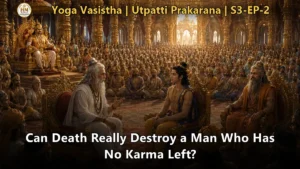
Death cannot touch a person whose desires and attachments have burned away, because death itself feeds only on the residue of past karma. Vasistha tells Rama the story of Akashaja, a sage so free of clinging that Death, Time’s own agent, hunted him across the universe and returned empty-handed to Yama, who explained why: without the sense of ‘I did this,’ there is nothing left for death to claim.
There is a fear that visits every person quietly, usually at night, usually when nothing else is wrong: the fear that no matter what you achieve, no matter how carefully you live, something will eventually come and take it all away. It waits for you the way rain waits for a monsoon.
Sage Vasistha, seeing this same fear in young Rama’s face, does not console him with soft words. Instead, he tells him about a man who broke this fear completely long ago — a hermit named Akashaja, who lived so lightly upon the earth that death, the great equalizer, found itself for once with nothing to equalize.
📚 Yoga Vasistha — full guide & all episodes
Akashaja — The Hermit Who Owed Death Nothing
Sage Vasistha began by describing a realized soul named Akashaja, a knower of Brahman who lived deep in meditation. He wished good for all beings and walked the path of righteousness without deviation.
Akashaja had grown old in years, yet age had not touched him the way it touches ordinary men. No illness weakened him. No decline dimmed his eyes. He simply continued, season after season, untouched by the wearing hand of time.
Death looked upon every living atom in creation as its rightful due. It had claimed kings and beggars alike, saints and sinners, without distinction. But Akashaja remained just beyond its reach, again and again, no matter how many times Death turned its attention toward him.
Death’s Private Confusion
This failure puzzled Death itself. It was accustomed to devouring the old to make room for the new — that, after all, was its entire function in the order of the universe. Yet here was a man ancient in years whom it simply could not swallow.
“I do not perish,” Death said to itself. “I consume every creature in due course. Then why does this one hermit alone escape me? Why can I not fold his ‘the old’ into ‘the new’? Every effort I make against him comes to nothing. There must be a reason.”
Death (to itself): Effort never goes to waste for those who are capable — so I will not give up trying. But first I must understand what is actually happening here.
Fire That Could Not Burn
Resolving not to abandon its pursuit, Death went to the town where Akashaja lived and entered his hermitage. Death then summoned a fire equal in ferocity to the fire that consumes the universe at the end of an age, and set it blazing around him.
Akashaja sat immersed in deep meditation. Even the roar of that terrible fire could not disturb him. Death, unwilling to accept defeat so easily, fed and directed the flames all around the hermit’s seat.
But somehow the fire could not pierce the circle of that stillness. Death then tried, with tremendous effort, to seize Akashaja bodily with its own hands. Death is, without question, immensely powerful — yet what good is that power when the very form one imagines grasping cannot be touched by physical hands? Death stood right in front of him and still could not lay a single finger upon him.
Yama Is Summoned
Having exhausted every method and gaining nothing, Death gave up its fruitless struggle and went to its own master and lord — Yama, the god of death and justice — to ask why this one man alone could not be consumed.
“Lord,” Death said, “why am I unable to devour this hermit Akashaja?”
Yama: O Death, you alone, by your own strength, cannot truly kill anyone. In truth, it is a person’s own past karma that becomes the cause of their death. If you cannot consume this hermit, the reason is most likely that he carries no such karma bound to false ownership.
Yama: Go and search whether any residue of doership still clings to his inner sky, his consciousness. Only where a person still holds the thought ‘I did this, this is mine to do’ does karma remain lodged in their being. Where there is no sense of being the doer, no karma remains at all.
A Search Across Every Direction
Following this counsel, Death searched every corner of the earth and every direction of space, hunting for even a trace of Akashaja’s binding karma. But it found nothing — the way a man cannot find the second son of a barren woman, because no such person exists to begin with.
Just as no other house occupies the exact plot already imagined as belonging to someone in an invented city, Death could locate no karma anywhere belonging to this hermit. Exhausted and defeated once more, Death returned, heaving long breaths, to stand again before Yama, the very embodiment of righteous law.
Death: My lord, I searched everywhere thoroughly. But I could not find even a trace of karma in the inner sky of his mind. You are all-knowing. In times of doubt and difficulty, it is only the master who can show the way to the servant. Where does his karma lie? I could find no sign of it anywhere in his awareness.
Yama’s Long Reflection
Yama, who is the very form of dharma, sat in deep thought for a long while, weighing every possibility, before he spoke again.
Yama: O Death, I too have examined this hermit’s matter at length. He simply has no karma. He was born purely from the space of desirelessness, from the infinite sky of pure being — and everything born from that boundless, spotless space naturally shares the same stainless nature.
Yama: Therefore in him there is nothing bound up with pride or craving that could give you any opening at all. I have examined his heart thoroughly. Even in the karmas already assigned to him from before, there is not the faintest trace of the thought ‘I am the one who did this — I am the doer.’ Where the false notion of doership born of ego does not exist even slightly, how could there possibly be any doership left to speak of? Since even the very illusion called ‘the body, the individual form’ does not cling to him, where is the ground on which doership could stand?
What Truly Chains a Man to Death — Akashaja’s Lesson
Yama continued, laying out the deeper law that governs why death has any power at all over a living being, and why Akashaja remained completely beyond its reach.
The material body a person carries, he explained, is only the accumulated culmination of past deeds and the deeds yet destined to unfold. This body is nothing but the meeting point where the fruits of past actions ripen in the present, and where the seeds of future actions take root to bear fruit later.
Yama: This physical body is merely the total sum of past karma appearing before us in the present. When one’s inner tendencies grow attached to the outcomes of that karma — thinking ‘this is mine, this belongs to me’ — only then does karma actually take root within a person’s being. Where such a sense of ownership over deeds has vanished entirely, from where would karma arise at all?
Akashaja’s Freedom Explained
Yama went on to explain the precise nature of Akashaja’s liberation, distinguishing it carefully from ordinary ignorance or mere renunciation of action.
Akashaja, Yama said, is entirely free from bound perception — free from the habit of seeing the world through the lens of attachment and false ownership. He carries no residue of unfulfilled longing from the past, nor does he generate any fresh craving in the present. Since he holds no notion whatsoever of himself as a separate, limited individual, the false sense of being a doer, the root cause from which karma is born in the first place, simply never arises in him. And where the seed itself is absent, how could the tree of karma ever grow?
The Sky That Cannot Be Grasped
Yama then offered Death an image drawn from everyday experience, to make the deeper truth unmistakably clear.
In its essential nature, he said, space has no connection whatsoever with objects. It may appear to take a form because of what fills it, or it may remain formless — but space itself, the absolute space, remains forever untouched, beyond all such distinctions. In the very same way, Akashaja’s inner nature, though it appears connected to the world through the body and its actions, is in truth eternally free, unbound, and untouched by anything whatsoever.
Yama: This hermit has become one with that same stainless, ownerless space. Therefore, O Death, you have absolutely no authority over him — no doorway through which your power can enter.
The Verdict That Ends the Chase
Having heard this complete explanation, Death understood at last why every one of its efforts against Akashaja had failed from the very beginning, and why they were destined to keep failing no matter how many times it tried.
Yama’s final word to Death was simple, yet it settled the matter beyond all further question: a man without the sense of ownership over his actions cannot be reached by death, however powerful death may be, because death’s entire authority operates only through the channel of karma bound by the feeling ‘I am the doer of this.’ Where that channel does not exist, death has nowhere to enter and nothing to seize.
What Gives Death Its Power — Insights from Akashaja
| Condition of the Mind | Presence of Karma | Death’s Access |
|---|---|---|
| Feels ‘I am the doer’ of past and present actions | Karma remains bound and active | Death can act through that karma |
| Holds no sense of ownership over any action, past or future | No karma takes root at all | Death has no channel to enter |
| Identifies with the body as a separate, limited self | Karma accumulates around that identification | Death governs through the body’s fate |
| Rests in the nature of pure, unbound awareness, like space | Nothing accumulates, since nothing is claimed | Death finds nothing to seize |
ఆధ్యాత్మిక అంతరార్థం — The Meaning of Akashaja’s Story
This story is not really about a hermit named Akashaja escaping physical death through some special power. Vasistha is showing Rama something far more precise: what actually binds a person to the fear and finality of death is not the body at all, but the persistent inner habit of claiming ownership over one’s own actions.
Every time a person says, even silently to themselves, ‘I did this, this achievement is mine, this failure is mine, this deed belongs to me,’ a thread of karma is woven and tied to their sense of self. Death, as Yama explains, does not create these threads — it simply follows them, the way a hunter follows a trail already laid down by the animal itself.
Akashaja was not indifferent or careless about right and wrong; he lived by righteousness and wished good for everyone. His freedom came from a different place entirely — from never mistaking himself for the one performing the action. He acted, yet without the inner claim of ‘I am the doer.’ That single missing thread was enough to make him invisible to death’s grasp, because there was simply nothing left of the kind death depends upon to find its hold.
Notice, just for today, how often you attach the words ‘I did’ or ‘this is mine’ to something you have merely witnessed happening through you. That small pause of noticing is itself the first step toward the freedom Akashaja embodied.
Chapter Summary — The Story of Akashaja
Vasistha tells Rama of Akashaja, a righteous sage whom Death cannot consume despite repeated attempts with fire and force. Baffled, Death consults Yama, who explains that death operates only through karma bound by the sense of ownership — ‘I did this.’ A thorough search finds no such karma in Akashaja, because he was born of pure desirelessness and never once claimed doership over his actions. Yama concludes that Akashaja, like space itself, remains untouched by the world despite appearing connected to it, and therefore lies entirely beyond death’s authority.
Scripture Notes on Akashaja
- Main Message: Death’s power operates strictly through karma bound by the sense of personal ownership; where that ownership dissolves, death loses all its authority.
- Philosophical Teaching: The body is the accumulated meeting point of past and future karma, but karma itself only takes root through the ego’s claim of doership. Remove that claim, and one stands as untouched as space itself.
- Connection to the Next Chapter: Having understood why Akashaja could not be touched, Rama now turns to ask Vasistha to explain further how this same freedom from doership can be practiced by one still living in the midst of ordinary human duties.
Death does not kill; it only follows the trail a person’s own claimed deeds have left behind.
Where no one claims to be the doer, there is nothing left for death to find.
Like space touched by nothing it contains, the free soul remains connected to the world yet forever untouched by it.
Frequently Asked Questions About Akashaja
What is the story of Akashaja in Yoga Vasistha about?
It is the story of a righteous sage whom Death cannot consume no matter how many times it tries, because he holds no sense of personal ownership over his actions, and therefore carries no karma for death to act upon.
📖 Who is the Jiva? The Secret of Consciousness Trapped in Illusion | Yoga Vasistha S3 EP-49
Why couldn’t Death kill Akashaja even with fire?
Death’s fire and force were powerless because Akashaja’s protection was not physical; it came from the complete absence of any ‘I am the doer’ feeling in his mind, which is the only thing death can actually use as a foothold.
Does this story mean death cannot ever be avoided?
No, the story is not about escaping the body’s natural end; it teaches that the fear and bondage associated with death dissolve when a person stops claiming ownership of their actions, which is a state of mind available to anyone regardless of when the body eventually falls away.
What does Yama mean by karma being ‘bound by ownership’?
Yama explains that an action only becomes binding karma when a person inwardly claims it as ‘mine’ — the deed itself is neutral, but the thought ‘I did this’ is what ties its consequences to a person’s sense of self.
How is space used as an example in this chapter?
Yama compares the liberated sage to space itself, explaining that just as absolute space remains untouched whether it appears to hold objects or not, a person free of doership remains untouched by the world despite living and acting within it.
What is the practical lesson from Akashaja’s story for daily life?
The practical lesson is to notice and gradually release the habit of claiming personal ownership over outcomes — successes and failures alike — since this very claim is what keeps a person bound to fear, karma, and death’s reach.
Conclusion — The Lasting Message of Akashaja
There is a quiet peace in understanding that what truly binds us was never the body’s mortality but the mind’s own habit of claiming ownership over what merely passes through it. Vasistha leaves Rama with this seed of understanding, planted but not yet fully grown — and Rama, still young and still human, cannot help but wonder: if letting go of ‘I did this’ is enough to stand beyond death’s reach, how does one actually begin to live that way while still walking through the world of duties, relationships, and daily action? What will Vasistha say when Rama asks him exactly that?
👉 Click this link to read the next episode: Does Memory Alone Create the Body You Live In? | S3 EP-3 | Yoga Vasistha
👉 Click this link to read the next episode: Does Memory Alone Create the Body You Live In? | S3 EP-3 | Yoga Vasistha