
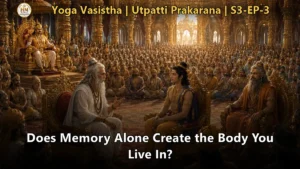
Why do you feel bound to the body you inhabit right now? Sage Vasistha tells Rama that every body — gross or subtle — exists only because a prior memory shaped it into being. Brahma himself, the first cosmic will, is bound by the same law: memory alone is the seed of embodiment, and the seer, the mind, and the entire visible world rise together from that single root.
You look at your hands, your face in the mirror, the weight of your own presence in a room — and it feels undeniably real, permanently yours. Yet in the profound inquiry into Brahma and creation, what if the very sense of ‘my body’ were nothing but a memory wearing the mask of the present moment?
In the flowing dialogue between Rama and the sage Vasistha, this question surfaces with startling force. Rama, having just accepted that mind alone is the true creative principle behind the universe, turns the logic back on his teacher — and on the cosmic architect Brahma himself.
📚 Yoga Vasistha — full guide & all episodes
Rama Turns the Question Back on His Teacher
Rama addressed the assembly with quiet respect. He had followed every step of Vasistha’s teaching about the mind being the true Brahma, unconnected to the five gross elements that begin with earth.
But a doubt remained lodged in him, sharp and unavoidable. If the body he wore today existed only because of memory carried over from some earlier state, then the same rule had to apply everywhere, without exception.
Rama pressed the point directly to Vasistha. He asked why Brahma, the very first being of creation, should be treated differently from any ordinary soul.
If memory alone accounts for the bodies of sages, kings, and seekers gathered in that hall, Rama reasoned, then Brahma’s own body must also rest on some memory that came before his so-called first creation.
Rama’s challenge cut against the comfortable idea that Brahma was self-caused, uncaused, a beginning with no beginning behind it. He wanted to know why that convenient exception should be allowed to stand.
Rama: You call the mind pure, unrelated to the five elements starting with earth, and you say this very mind is Brahma. I accept all of this. But tell me — is it not memory from an earlier existence that causes you, me, and everyone in this hall to carry the bodies we now wear? If so, why should Brahma alone be spared this rule? Why not say that his body, too, rests on some memory prior to his first act of creation, rather than calling him causeless and self-born?
Vasistha Names the Two Kinds of Bodies in Brahma’s Creation
Vasistha received the question with the calm of someone who had anticipated it long before it was asked. He told Rama that every embodied being, without exception, carries two bodies simultaneously.
The first is the gross body, the visible frame of flesh and bone that everyone recognizes at a glance. The second is the subtle body, invisible to the eye, yet far more decisive in shaping who a person becomes.
Vasistha explained that this subtle body is nothing other than the accumulated impressions, tendencies, and desires that a soul carries forward. It is memory itself, compressed into a form that seeks new expression.
He then turned to the deeper claim beneath Rama’s question. All causes, Vasistha said, ultimately exist because of that infinite, formless self which lies beyond all causation — the one reality that requires no cause to explain its own existence.
Vasistha: Listen, Rama. Every embodied being carries two bodies — the gross body and the subtle body. The subtle body is made entirely of accumulated impressions; it is the seed-cause of the gross frame you see. And all causes whatsoever exist only because of him, the one beyond all cause. He is beyond everything, and it is because of him that causation itself is possible.
The Circle Within the Circle of Brahma’s Manifestation
To make this teaching on Brahma and embodiment easier to hold in the mind, Vasistha described a picture of concentric zones nested one within another, like circles drawn inside larger circles.
The outermost boundary he called the zone of thought and perception — the widest field within which any experience whatsoever can occur.
Within that outer boundary sits a smaller ring, the subtle body along with its faculties of thought and perception, still finer and more essential than the visible world.
And within that inner ring lies the smallest, most concentrated point of all — the zone of self, the gross body and its immediate awareness, the place where a person says ‘I’ and means only this frame, this skin, this single life.
Five Truths About the Gross Body in the Vision of Brahma
Vasistha then offered Rama five statements about the gross body, each one meant to be turned over slowly in the mind rather than accepted at a glance.
Every visible body, he said, arises out of the subtle body — it does not stand on its own, uncaused, the way a shadow cannot exist without something casting it.
The gross body and the subtle body are bound to each other by the tightest possible relationship, one that resembles a cause meeting its own effect face to face.
The subtle body itself is bound to the self by a still deeper relationship, one Vasistha called a relationship of pure identity rather than mere connection.
Death, Vasistha continued, is nothing more than the falling away of the gross body — time simply loosens what impressions once tightened into form.
And when a person imagines that the destruction of the gross body means the destruction of the self, that imagining itself becomes the seed for yet another body to arise in its place.
Rama Presses Further — What Is Brahma’s World Actually Made Of?
Rama, clearly moved by the clarity of the explanation, offered his gratitude before pushing the inquiry one step further, unwilling to let the thread drop.
He wanted to know something more fundamental. Was this vast world, spread out before every perceiving being, born from real material substance, or was it something else entirely — perhaps only a kind of extended imagination given the appearance of solidity?
Vasistha’s answer arrived without hesitation, carrying the confident tone of someone stating a settled truth rather than offering a fresh opinion.
The world, he said, is nothing but the imagined form of Brahma’s own mind — its shape and texture no different from the shape a dream takes inside a sleeping person, vivid while it lasts, yet without any independent, self-sufficient existence outside the mind that conceives it.
Vasistha: Rama, this world is a great imagination — a wide field of mental fabrication, resembling the plot of a play. Ask yourself: does that plot have any material substance of its own outside the mind of the poet who imagines it? In the same way, this world is Brahma’s own extended imagination taking the shape of his own body, and it exists nowhere except within that imagining.
Brahma and the One Beyond All Beginnings
Vasistha reminded Rama not to imagine that Brahma himself possesses some ultimate, absolute beginning that stands apart from everything else.
The truth of Brahma’s own action, he explained, is that will or intention is itself the first principle, and this will-nature spreads itself outward as countless individual intentions, and through that spreading, the entire universe comes into visible being.
Brahma’s form and body, Vasistha continued, are themselves nothing but mind — untouched by the five gross elements beginning with earth, exactly as the mind of any single living being remains untouched by them.
One should never conclude from this, he warned, that the mind of every ordinary creature is therefore identical in scope to Brahma’s mind — the comparison illustrates a principle, not an equivalence of scale.
And yet, Vasistha insisted, it is genuinely the essential nature of consciousness that gives rise to the five elements starting with earth, since a mind holds within itself, in seed form, the qualities of everything it will later perceive — the way a small lotus seed already contains, folded within it, every feature the full lotus flower will one day display.
The Mind of Brahma and Its Dreamed-Up World Are Never Two
Vasistha pressed the teaching regarding Brahma toward its most intimate application. All that concerns the visible world, he said, exists first and only within the mind — no one can meaningfully separate the mind from the scene it perceives.
A scene becomes visible only because a mind is present to hold it; remove the mind entirely, and the scene itself dissolves along with it, leaving nothing behind to be seen.
Vasistha pointed to something every listener already knew from ordinary experience. In a dream, or while wandering through the pathways of one’s own imagination, a person sees full worlds of objects, complete in every detail — and where do those objects actually reside if not inside the heart, the seat of feeling and thought.
In exactly the same way, he continued, the world that appears to stand outside a person, however solid and external it seems, is in truth encountered within that same person’s own heart, not somewhere beyond it, however convincing the illusion of distance may feel.
A child terrified by an imagined ghost conjured entirely by his own frightened mind will tremble and suffer exactly as if the danger were real, Vasistha observed — and this same dreamed-up terror is precisely what torments the unenlightened, again and again, across their unexamined lives.
The Seed, the Tree, and the Manifestation of Brahma
To close this particular thread of teaching, Vasistha offered an image drawn from ordinary nature, one Rama could verify simply by walking through any forest.
A sprout lies folded invisibly within a seed, waiting; only when the right place and the right season arrive does that sprout unfold itself into a full, towering tree, visible for anyone to see.
In precisely the same manner, Vasistha said, the scene that lies folded within the mind waits for its own fitting conditions of place and time, and only then does it shine forth in the form of a deliberate, willed manifestation.
Rama then asked the natural question that follows: if this visible scene, this entire world of forms, were genuinely, independently real in its own right, where exactly would it exist once the mind that holds it were removed from the picture entirely?
Vasistha’s response carried the full weight of the teaching’s conclusion. If the scene were truly independent and real, then no being could ever hope for release from sorrow, since suffering and its opposite peace would simply be permanent, unshakeable features of a fixed reality — and this, he said, is plainly not what anyone experiences, since peace is available to those who see rightly.
Vasistha: If this visible scene were truly real in its own right, then there would be no possibility of sorrow ever coming to rest, and the ordinary business of suffering and relief could never be settled — for as long as the soul’s vision remains caught in this scene, final liberation, that state of undivided peace, could never be reached at all.
What Remains When Brahma’s Cosmic Scene Dissolves
Vasistha then turned toward the final resolution of the inquiry into Brahma and existence, speaking now not of causes and bodies but of the state that lies beyond both.
As long as the visible scene continues to trouble the perceiver, he explained, that perceiver cannot even be said to possess pure witnessing awareness in any complete sense — the scene itself stands as an obstacle to that clear seeing.
But once this dreamed-up scene finally withdraws itself from a person’s vision, what remains, Vasistha said, is a condition the wise have chosen to call by a single, precise name.
That state, in which nothing further remains to be shed and nothing further remains to be sought, is what the wise call kevalatvam — absolute aloneness, the condition of pure being with nothing added and nothing subtracted — and this very state is what scripture names as final liberation, moksha.
The Two Bodies and Their Relationship in Brahma’s Teaching
| Aspect | Gross Body (Sthula Sharira) | Subtle Body (Sukshma Sharira) |
|---|---|---|
| Nature | Visible frame of flesh, made known to the eye | Invisible accumulation of impressions and tendencies |
| Origin | Arises from the subtle body as its effect | Arises from the self through the will to imagine and desire |
| Relationship to self | Bound to the subtle body as effect to cause | Bound to the self through a relationship of pure identity |
| What ends at death | Falls away when its time is exhausted | Persists, carrying impressions into a new gross body |
| Vasistha’s teaching | Its destruction is falsely imagined as the destruction of the self | It is itself the seed-cause of every future embodiment |
ఆధ్యాత్మిక అంతరార్థం
This dialogue does not merely explain how bodies come to exist — it dismantles the quiet assumption that the body a person calls ‘mine’ has any independent, self-sufficient reality. Vasistha shows that the gross body is simply the visible outcome of a subtle accumulation of memory and desire, and that this subtle accumulation is, in turn, nothing but an expression of the self imagining itself into form.
The teaching about Brahma is not really about a distant cosmic figure at all. It uses Brahma’s case to strip away the last hiding place for the ego — the idea that somewhere, at some ultimate origin, a truly independent, self-caused entity exists. Vasistha closes even that door: even the first will of creation operates through the same law of imagination spreading itself into form.
The image of the child frightened by an imagined ghost is placed deliberately at the heart of the teaching. It is not a decorative example — it is the whole argument in miniature. Fear, attachment, and the sense of a solid external world all operate by the same mechanism as that child’s terror: real in their effect, yet without independent substance outside the mind that conceives them.
What Vasistha ultimately offers is not a denial of experience but a reordering of what deserves to be called real. The seed containing the unseen sprout, the poet’s mind containing the unwritten play, the heart containing the dreamed world — each image points toward the same quiet conclusion: the witnessing self was never actually bound by the scene it appeared to inhabit.
The next time a fear, a memory, or a bodily discomfort feels overwhelmingly solid, pause and ask where exactly it resides — outside you, or within the same awareness that also holds your breath and your thoughts. That single pause is the seed of the discrimination this teaching points toward.
Chapter Summary
Rama questions why Brahma alone should be considered causeless when every other body arises from memory. Vasistha explains that all beings carry two bodies — gross and subtle — the subtle body being the seed-cause made of accumulated impressions, bound to the self through identity. He describes the self, subtle body, and gross body as three nested zones, offers five truths about embodiment, and reveals the entire visible world as Brahma’s own imagined form, no different from a dream. When this scene of imagination finally dissolves, what remains is kevalatvam — absolute aloneness, the state scripture calls final liberation.
Scripture Notes
- Main Message: The gross body, the subtle body, and the visible world are all expressions of imagination rooted in memory; none possesses independent reality apart from the self that conceives them.
- Philosophical Teaching: Vasistha teaches that causation itself operates within a hierarchy — gross body caused by subtle body, subtle body identical with the self — and that even Brahma’s creative will follows this same law, since will or sankalpa is the first principle from which the entire universe unfolds as extended imagination.
- Connection to the Next Chapter: Having settled the nature of the two bodies and the imagined world, the dialogue moves next toward how the seeker can directly recognize this truth within their own experience of waking and dreaming.
The subtle body is nothing but memory compressed into a form seeking new expression.
A scene becomes visible only because a mind is present to hold it.
That state in which nothing further remains to be shed is what the wise call absolute aloneness.
Frequently Asked Questions
What does Yoga Vasistha teach about why we have a physical body?
Yoga Vasistha teaches that the physical body exists because of memory carried over from a prior state of desire and impression. Sage Vasistha explains that the subtle body, made of accumulated impressions, is the seed-cause from which the visible gross body arises — the gross body never stands independently on its own.
What is the difference between the gross body and the subtle body in Yoga Vasistha?
The gross body is the visible physical frame, while the subtle body is the invisible accumulation of impressions, tendencies, and desires. Vasistha teaches that the subtle body causes the gross body, and the subtle body itself is identical with the self at a deeper level.
📖 Is the Mind Stronger Than the Body? The Tale of Indra and Ahalya | Yoga Vasistha S3 EP-48
Why does Rama question Brahma’s causeless existence?
Rama questions Brahma’s causeless existence because Vasistha had just taught that every body arises from prior memory. Rama reasons that if this rule applies universally, Brahma’s body should also rest on some earlier memory, rather than being treated as an exception who is self-born and uncaused.
Is the visible world real according to Yoga Vasistha?
According to Yoga Vasistha, the visible world is not independently real; it is Brahma’s own extended imagination taking the form of a body, comparable to a dream or the plot of a play, which has no substance outside the mind that conceives it.
What is kevalatvam in Yoga Vasistha philosophy?
Kevalatvam is the state of absolute aloneness that remains once the imagined scene of the world dissolves from a person’s vision. Vasistha identifies this state of pure, undivided being as moksha, or final liberation, in this dialogue.
How does Vasistha explain the fear a child feels toward an imagined ghost?
Vasistha explains that a child’s fear of an imagined ghost is entirely self-generated by the child’s own mind, yet it produces real trembling and suffering. He uses this to show that the unenlightened suffer from the world in exactly the same self-created way.
What are the three zones described in this chapter of Yoga Vasistha?
The three zones are the outer zone of thought and perception, the middle zone of the subtle body with its faculties, and the innermost zone of self, which corresponds to the gross body and immediate awareness. Vasistha uses this nested structure to show how embodiment layers upon itself.
Does death end the self according to this teaching?
No, death only ends the gross body when its time is exhausted, according to Vasistha’s teaching. He warns that imagining the destruction of the gross body as the destruction of the self only creates the seed for another body to arise in its place.
Conclusion
The dialogue settles into a brief, weighted silence as the assembly absorbs what has been said — that every fear, every solid-seeming world, every body clung to as ‘mine’ rests finally on nothing but imagination rooted in memory. Peace mantras are recited, and the hall grows quiet with the kind of stillness that follows a truth too large to argue with. If the visible world is only a dream shaped by mind, what happens the moment a seeker finally recognizes the dreamer within their own waking life?
👉 Click this link to read the next episode: What Is the True Origin of This World? Vasistha’s Answer That Ends Rama’s Search | S3 EP-4 | Yoga Vasistha
👉 Click this link to read the next episode: What Is the True Origin of This World? Vasistha’s Answer That Ends Rama’s Search | S3 EP-4 | Yoga Vasistha
👉 Previous Episode: Can Death Really Destroy a Man Who Has No Karma Left? | S3 EP-2 | Yoga Vasistha