
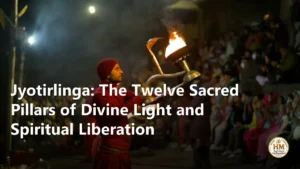
The twelve Jyotirlinga temples represent the self-manifested, infinite pillars of divine light where Lord Shiva revealed His formless cosmic reality. Spread across India from Somnath in Gujarat to Kedarnath in the Himalayas, these sacred shrines dispel human ignorance, grant profound inner peace, and liberate devotees from the cycle of birth and death.
In the vast expanse of Indian spiritual tradition, Lord Shiva is revered not merely as an anthropomorphic deity, but as the primordial, unmanifest consciousness that sustains the cosmos. While the divine manifests in countless forms across sacred geography, the twelve Jyotirlinga shrines stand supreme as the radiant epicenters of uncreated light. The Sanskrit term ‘Jyoti’ signifies supreme radiance and illumination, while ‘Linga’ denotes the cosmic pillar or formless sign from which all creation emerges and into which it eventually dissolves. According to sacred Puranic chronicles, these twelve sanctuaries mark the specific geographic locations where the Supreme Lord manifested as an infinite column of cosmic fire to dissolve the illusion of ego and illuminate the universe.
These holy pilgrimage sites weave a profound grid of spiritual energy across the Indian subcontinent. From the snow-capped Himalayan heights of Kedarnath in the north to the sunlit ocean shores of Rameshwaram in the south, the Jyotirlinga temples unite diverse landscapes under a single spiritual thread. Each shrine embodies a specific dimension of Shiva’s boundless grace, offering healing to the afflicted, supreme wisdom to seekers of truth, and spiritual liberation to those desiring freedom from worldly attachments. They are not merely historical stone monuments; they function as living conduits of timeless transcendental power.
For contemporary spiritual seekers, the darshan of these divine light pillars offers an invaluable opportunity for internal purification and conscious awakening. In an era marked by restless distractions, existential anxiety, and fragmented attention, turning toward the stillness of Shiva provides a grounding anchor of peace. Understanding the esoteric significance of these twelve shrines awakens the dormant light of awareness within the human heart, transforming external pilgrimage into an intimate journey of self-realization.
Read the complete Telugu edition of this article.
The Cosmic Origin of the Jyotirlinga Manifestation
The sacred Shiva Purana narrates the timeless event when Lord Brahma, the creator, and Lord Vishnu, the preserver, engaged in a profound metaphysical debate regarding cosmic supremacy. As their debate intensified across the unformed realms of existence, an incomprehensible column of blazing fire burst forth before them, piercing through the three worlds with neither beginning nor end. Intrigued by this majestic phenomena, Brahma assumed the form of a celestial swan to soar upward in search of its crown, while Vishnu took the form of a divine boar to bore into the subterranean depths to locate its roots.
After thousands of celestial years of searching, Lord Vishnu returned with humility, openly acknowledging the impossibility of measuring the infinite pillar of reality. In contrast, Lord Brahma falsely claimed to have discovered the summit, offering the Ketaki flower as a complicit witness to his assertion. At that precise moment, Lord Shiva manifested from the heart of the blazing pillar, establishing that supreme truth cannot be measured by pride or deceit. Moved by Vishnu’s truthfulness and yielding to the earnest prayers of both deities, the benevolent Lord softened His blazing cosmic fire into twelve accessible shrines of eternal light, establishing the first Jyotirlinga centers so that mortal beings could behold divine grace without being overwhelmed by its unmitigated brilliance.
RECOMMENDED BOOK

The Maya Simulation: Quantum Physics and the Science of Consciousness
by A. Ravinder
A guide that bridges the ancient wisdom of the Yoga Vasistha with quantum physics and modern consciousness science — for readers ready to question the nature of reality and calm the mind with practical tools like the Zero Voice Technique.
As an Amazon Associate, RamthaMedia can earn from qualifying purchases.
The Sacred Geography of the Twelve Jyotirlinga Shrines
The spatial distribution of the twelve Jyotirlinga shrines forms a masterwork of spiritual geography that harmonizes the five cosmic elements across India. The journey traditionally commences on the western coast with Somnath in Saurashtra, Gujarat, celebrated as the primal shrine of light. It proceeds to the sacred hills of Andhra Pradesh where Mallikarjuna at Srisailam unites the fierce power of Shiva with the compassionate presence of Mother Parvati. The sacred path winds through the heart of India with Mahakaleshwar in Ujjain, the guardian of cosmic time, and Omkareshwar along the Narmada River, where the landscape naturally forms the sacred syllable ‘Om’.
The sacred grid extends further into Maharashtra, which shelters three profound manifestations: Bhimashankar nestled in the Sahyadri mountains, Trimbakeshwar at the source of the holy Godavari River, and Grishneshwar near the Ellora caves. In Jharkhand lies Vaidyanath, the eternal divine physician, while Nageshwar resides in the sacred forest of Darukavana. To the north, Kashi Vishwanath anchors the holy city of Varanasi on the banks of the sacred Ganges, and Kedarnath stands resolute amidst the icy crags of the Garhwal Himalayas. The sacred circle culminates at the southern tip of the subcontinent with Rameshwaram, where Lord Rama Himself consecrated the holy Shivalinga before bridging the great ocean.
Detailed Spiritual Significance of Each Jyotirlinga
Each Jyotirlinga carries a distinctive mythological origin and esoteric frequency. At Somnath, the moon god Chandra worshipped Lord Shiva to attain freedom from the debilitating curse of consumption imposed by Daksha Prajapati. Shiva granted him revitalization and perpetual waxing phases, demonstrating His role as Mrityunjaya, the conqueror of decay and psychological torment. At Srisailam, where Mallikarjuna resides alongside Goddess Bhramarambika, the shrine uniquely merges a Jyotirlinga with an auspicious Shakti Peetha, serving as the mystical gateway to Mount Kailash where devotees are permitted to touch the sacred Lingam directly.
At Kashi Vishwanath in Varanasi, the eternal Lord resides as the master of the cosmos, where dying on the banks of the northward-flowing Ganges guarantees liberation through the impartation of the sacred Taraka mantra directly into the ear of the departing soul. In Ujjain, Mahakaleshwar stands unique as the only south-facing (Dakshinamurthy) Jyotirlinga, wielding supreme tantric authority over the fear of death; its famed Bhasma Aarti, performed with sacred ash, delivers the stark reminder that material forms are fleeting and that only pure consciousness endures.
In Rameshwaram, Sri Rama fashioned a sacred lingam out of sea sand with Mother Sita to atone for the sin of slaying the learned demon king Ravana, turning this seaside sanctuary into a supreme haven for absolving deep karmic impressions. High in the Himalayan sanctuary of Kedarnath, the Pandavas found final redemption from the sorrow of the Kurukshetra war after Shiva appeared in the form of a celestial bull. These holy shrines continually demonstrate that divine grace is infinitely accessible to those who approach with genuine devotion and surrender.
Mahashivratri and the Divine Awakening of Jyotirlinga
While monthly Shivaratri observances occur on every Krishna Paksha Chaturdashi, the great festival of Maha Shivaratri, falling in the auspicious month of Magha, represents the pinnacle of spiritual sadhana. On this sacred night, celestial alignments create an exceptional natural surge of spiritual energy, making the human nervous system uniquely receptive to higher states of awareness. Scriptural traditions reveal that it was during this midnight hour (Lingodbhava Kala) that Lord Shiva first revealed Himself as the boundless column of light, and on this day He entered the sacred bond of marriage with Mother Parvati.
The traditional observance of Maha Shivaratri relies upon four sacred pillars of discipline. Upavasa (fasting) is not mere starvation; it represents drawing the senses inward so that the mind remains seated near the Divine. Jagarana (night vigil) signifies keeping conscious awareness fully awake to dispel the internal darkness of ignorance. Continuous Abhisheka with sacred liquids such as milk, honey, and water mirrors an unbroken stream of meditation directed toward the Self, while the midnight Lingodbhava worship attunes the practitioner’s consciousness to the unmanifest light of the eternal Jyotirlinga.
Sacred Rules and Protocols for Jyotirlinga Worship
Authentic worship of Lord Shiva demands internal purity and strict adherence to scriptural protocols. Chief among these sacred offerings is the trifoliate Bilva leaf (Maredu dalam). The three leaflets symbolize the three Gunas (Sattva, Rajas, Tamas), the three eyes of Shiva, and the trishula weapon. The scriptures prescribe that Bilva leaves must always be offered whole, unblemished, and inverted, so that the smooth upper surface rests directly against the Shivalinga, allowing the sacred botanic structure to channel and transmit the subtle cosmic vibrations of the Linga to the worshipper.
The application of sacred ash (Bhasma or Vibhuti) across the forehead in three horizontal stripes (Tripundra) using the three middle fingers of the right hand is an indispensable spiritual practice. This mark serves as an immediate visual reminder of the impermanence of the physical body and burns away personal egoism. During worship, seekers should wear clean, unstitched natural fabrics such as cotton dhotis and uttareeyams, strictly avoiding black garments. Silence (Mauna) should be preserved in temple precincts, replacing idle speech with the continuous mental chanting of the Panchakshari mantra, ‘Om Namah Shivaya’. Devotees must also remember that the Ketaki flower remains strictly forbidden in Shiva worship due to its ancient false testimony.
📖 Jyotirlinga Temples — Sacred Guide to the Twelve Manifestations of Lord Shiva
Spiritual Meaning of the Jyotirlinga Pillars
The esoteric reality behind the twelve Jyotirlinga shrines transcends physical geography and external temple architecture. In classical non-dual philosophy, the Jyotirlinga represents the supreme Atman—the eternal, self-luminous awareness that shines perpetually at the core of every living being. Just as the cosmic pillar manifested without beginning or end, pure consciousness is unborn, indestructible, and entirely free from spatial and temporal limitations. The dispute between Brahma and Vishnu symbolizes the perpetual conflict of the human intellect and the preservation instinct when blinded by individual ego; the sudden emergence of the pillar of light demonstrates that spiritual truth can never be apprehended by intellectual pride, but only through humble, contemplative surrender.
Furthermore, the twelve shrines correspond internally to the subtle psychic anatomy of the human system. The energy nodes activated by these physical temples mirror the twelve petals of the Anahata (heart) chakra and the ascending currents of the Kundalini energy along the Sushumna Nadi. Journeying to these holy sites or meditating deeply upon their divine names harmonizes the five bodily elements (earth, water, fire, air, space) and dissolves deep-seated karmic impressions accumulated across lifetimes. The external pilgrimage is fundamentally a map designed to guide the seeker back to the internal altar of divine stillness.
The veneration of the Shivalinga through water, milk, and Bilva leaves conveys an essential message of detachment and non-possession. Shiva, adorned with ashes and residing in cremation grounds, embodies the supreme state of Vairagya (dispassion). By smearing the forehead with ash and offering Bilva leaves, the devotee surrenders the triple qualities of nature and recognizes that all created things eventually dissolve into the silent, unconditioned witness. In this profound state of spiritual unity, the distinction between the worshipper, the worship, and the worshipped completely dissolves into pure radiance.
In our modern, high-pressure world dominated by sensory overload and relentless achievement, the message of the Jyotirlinga serves as a vital sanctuary for mental peace. By adopting the principles of simple living, periodic silence (Mauna), mindful breath regulation, and inner meditation on the five-syllable mantra ‘Om Namah Shivaya’, one can create an unshakable core of serenity amidst external chaos. Integrating Shiva’s detachment allows us to perform our worldly responsibilities with excellence while remaining fundamentally untouched by anxiety, greed, and egoic pride.
Chapter Summary
This comprehensive guide explores the sacred reality of the twelve Jyotirlinga temples of Lord Shiva, detailing their cosmic origins, geographic distribution, and profound spiritual significance. Emerging from the Shiva Purana legend where the Supreme Lord manifested as an infinite column of divine fire to resolve the pride of Brahma and Vishnu, these shrines represent the eternal presence of formless consciousness on Earth. The twelve shrines—Somnath, Mallikarjuna, Mahakaleshwar, Omkareshwar, Vaidyanath, Bhimashankar, Rameshwaram, Nageshwar, Kashi Vishwanath, Trimbakeshwar, Kedarnath, and Grishneshwar—anchor India’s sacred geography from the Himalayas to the Indian Ocean. The article illuminates the inner secrets of Maha Shivaratri practices, including fasting, night vigils, and continuous abhisheka, while providing precise scriptural guidelines for offering Bilva leaves, applying sacred Tripundra bhasma, and observing meditative silence. Ultimately, the Jyotirlinga darshan serves as a transformative spiritual gateway, dissolving ignorance and leading seekers toward self-realization and eternal peace.
👉 Home Temple Pooja Stand with Door, LED Light and Storage
Scripture Notes
- Main Message: The central message of the Shiva Purana and ancient Itihasas regarding the Jyotirlinga shrines is that the Divine Reality is infinite, self-luminous, and beyond the grasp of intellectual pride. Lord Shiva manifests as the pillar of light to dissolve the egoic illusions of living beings and to offer a tangible refuge where humanity can experience liberation from karmic bondage through heartfelt devotion, humility, and steadfast contemplation.
- Philosophical Teaching: Philosophically, the Jyotirlinga represents the profound synthesis of Saguna (with attributes) and Nirguna (attributeless) Brahman. While the Shivalinga provides a tangible focal point for worship, its formless, smooth oval design deliberately resists anthropomorphic limitation, pointing the meditator directly toward the unmanifest cosmic consciousness that pervades all existence. True worship is the realization that the light shining at the heart of Somnath or Kashi is identical to the immortal light dwelling within one’s own spiritual heart.
Frequently Asked Questions
What is a Jyotirlinga and how does it differ from a regular Shivalinga?
A Jyotirlinga is a self-manifested (Swayambhu) radiant pillar where Lord Shiva revealed Himself as an infinite column of cosmic light. While regular Shivalingas are installed and consecrated by human hands or sages through specific rituals, the twelve Jyotirlingas are natural, primordial epicenters of divine power that appeared directly through Lord Shiva’s supreme will.
Which Jyotirlinga should be visited first during the pilgrimage?
According to the traditional Dwadasa Jyotirlinga Stotram composed by Adi Shankaracharya, the pilgrimage traditionally begins at Somnath in Saurashtra, Gujarat, acknowledged as the primal (Adi) shrine, and concludes at Grishneshwar near Ellora in Maharashtra, completing the sacred spiritual circuit.
Why is the Ketaki flower strictly prohibited in Shiva worship?
According to the Shiva Purana, when Lord Brahma falsely claimed to have reached the summit of the infinite cosmic pillar of light, the Ketaki flower falsely corroborated his claim. Consequently, Lord Shiva decreed that the Ketaki flower would remain forever unfit and prohibited in His sacred worship.
What is the spiritual significance of offering three-leaf Bilva to Lord Shiva?
The three leaflets of the sacred Bilva leaf represent the three Gunas (Sattva, Rajas, Tamas), the three eyes of Shiva, and the threefold functions of creation, preservation, and dissolution. Offering an intact Bilva leaf symbolizes the total surrender of one’s worldly nature and ego at the feet of the Supreme Lord.
📖 Kamakhya Devi Temple — The Sacred Mystery of the Divine Feminine
Why is the Kedarnath temple accessible for only six months each year?
Located at an altitude of 3,583 meters in the Garhwal Himalayas of Uttarakhand, Kedarnath experiences extreme snowfall and sub-zero temperatures during winter. The temple remains open from Akshaya Tritiya (April-May) until Kartik Purnima (October-November), after which the deity is worshipped at Ukhimath.
What spiritual benefits are attained by chanting the Dwadasa Jyotirlinga Stotram?
Scriptures declare that regularly reciting the sacred Dwadasa Jyotirlinga Stotram with devotion cleanses sins accumulated across seven lifetimes, dispels fear of untimely death, restores physical and mental vitality, and ultimately bestows spiritual liberation (Moksha).
External Source Links
🛒 Related: a review of a collectible Shiva idol for a home altar or car dashboard, on RamthaMedia.