
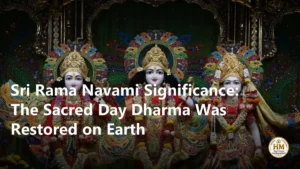
Sri Rama Navami marks the sacred descent of Lord Rama on Chaitra Shuddha Navami during the Treta Yuga to eliminate adharma and establish eternal righteousness. Beyond commemorating Rama’s birth at noon in the Abhijit Muhurta, this auspicious festival celebrates the celestial wedding of Sita and Rama, traditional healing prasadams, and the transformative power of the Taraka Mantra.
Sri Rama Navami represents far more than an annual religious observance on the Hindu calendar. It serves as an enduring spiritual compass and an ethical beacon for human civilization. According to sacred Vedic tradition, when the dark forces of adharma threatened cosmic balance during the Treta Yuga, the Supreme Preserver, Lord Vishnu, willingly descended into the mortal realm as an ideal human being to restore universal order and defeat the demonic king Ravana. Born on the ninth lunar day of the waxing moon in the month of Chaitra, Lord Rama embodied the absolute perfection of righteous living.
The planetary configuration at the precise moment of Rama’s birth carried immense cosmic significance. He manifested under the Punarvasu star in the Cancer ascendant (Karkataka Lagna) exactly at noon during the radiant Abhijit Muhurta, when the Sun stood at its highest celestial peak. This flawless astronomical alignment reflected the brilliant, illuminating character of the Solar Dynasty (Suryavansha), symbolizing the eradication of inner darkness and the awakening of supreme discernment within human consciousness.
In modern times, exploring the multifaceted dimensions of this holy festival allows seekers to understand the timeless synthesis of spiritual discipline, societal harmony, and scientific well-being. From the sacred sacrificial fire of the Putrakameshti Yajna to the profound symbolism of Sita Rama Kalyanam and the nutritional brilliance of traditional offerings, this day invites humanity to elevate everyday existence into a conscious expression of unyielding truth and noble duty.
Read the complete Telugu edition of this article.
Sri Rama Navami and the Cosmic Alignment of Chaitra Navami
The sacred emergence of Lord Rama on Chaitra Shuddha Navami represents an unprecedented turning point in cosmic history. In the ancient kingdom of Ayodhya, King Dasharatha of the illustrious Ikshvaku lineage ruled over a prosperous realm filled with material abundance, yet his heart remained burdened by the absence of an heir to carry forward the torch of righteousness. Acting upon the venerable guidance of Sage Vasistha, the king invited the revered ascetic Sage Rishyashringa to officiate the sacred Putrakameshti Yajna. This grand sacrifice was not merely a ceremonial rite, but an immaculate communion between pure human aspiration and divine grace.
As the oblation reached its spiritual culmination, the resplendent deity Agni emerged directly from the sacred fire holding a golden vessel of celestial payasam. Dasharatha distributed this divine ambrosia among his queens—Kausalya, Kaikeyi, and Sumitra—who soon conceived the divine incarnations. In the vibrant season of spring (Vasanta Ritu), when nature blossomed with renewed vitality, Lord Rama was born from Queen Kausalya. His arrival at high noon signified that just as the blazing mid-day sun dispels every trace of shadow, the presence of Rama dissipates ignorance, illuminating the intellect with eternal wisdom.
Delving into the profound reasons behind the Rama avatar reveals how the Supreme Divine subjected Himself to human limitations to demonstrate the practical victory of virtue over vice. You can explore the <a href=”https://ramthamedia.in/srirama-avataram-reasons-telugu-story/”>profound reasons behind the Rama avatar</a> to understand how his earthly journey established an unshakeable ethical foundation for all generations.
RECOMMENDED PRODUCT
DreamKraft Ram Darbar Idol Assessment for Indian Mandir : How can this product help you?
This review examines the DreamKraft using verified buyer feedback and the manufacturer’s listed specifications. Setting up a daily pooja space or selecting a traditional… The DreamKraft Ram Darbar Idol meets these practical requirements by providing a unified, single-piece aluminium casting measuring 16.5 cm in length and 21 cm in height with… The DreamKraft Ram Darbar Idol is a lightweight 375 g cast aluminium devotional murti designed with an integrated stand for home mandirs and decorative gifting, featuring…
Read more about this productBuy on Amazon
As an Amazon Associate, RamthaMedia earns from qualifying purchases.
Sri Rama Navami and the Divine Wedding of Sita and Rama
In South India, particularly across the Telugu-speaking regions, the festival of Sri Rama Navami is celebrated through the magnificent celestial wedding ceremony known as Sita Rama Kalyanam. While Northern traditions emphasize the grand birth festivities of Rama Janmotsav, Southern traditions view this sacred date as an all-auspicious confluence where the birth, divine wedding, and ultimate coronation of Lord Rama harmoniously converge. The historical temple town of Bhadrachalam on the banks of the sacred Godavari River stands as the epicenter of this divine nuptial celebration.
The union of Rama and Sita transcends the concept of a conventional earthly marriage, representing the cosmic reconciliation of humanity with divinity. When Sri Rama effortlessly bent and broke the formidable bow of Lord Shiva at King Janaka’s court, he demonstrated that supreme peace and virtue (personified by Mother Sita) can be attained only when spiritual strength overcomes worldly pride and ego (represented by the heavy bow). Janaka’s famous proclamation, ‘This is Sita, my daughter, who shall walk with you as your partner in dharma,’ established marriage as a shared spiritual voyage rooted in mutual reverence and selfless commitment.
The celebration at Bhadrachalam also carries deep historical resonance through the legacy of the saint-composer Bhakta Ramadasu (Kancherla Gopanna). Even during his severe imprisonment, Ramadasu’s devotional fervor inspired the regional ruler, Abul Hasan Tanisha, to recognize the divine majesty of Rama and initiate the sacred tradition of offering royal pearls (Mutyala Talambralu) for the wedding ceremony. This tradition, continuing unbroken under contemporary governance, stands as a testament to communal harmony, cultural unity, and the enduring power of surrender documented in the <a href=”https://www.britannica.com/topic/Ramayana”>encyclopedic analysis of the Ramayana epic</a>.
Sri Rama Navami Sacred Offerings — Health Secrets of Panakam and Vadapappu
The traditional offerings associated with Sri Rama Navami demonstrate the profound scientific acumen and holistic medical insight of ancient Indian traditions. Occurring during the transitional cusp where the pleasant spring season yields to the intense heat of summer (Greeshma Ritu), the human body experiences significant physiological transformations. To counteract sudden heat exhaustion, dehydration, and metabolic imbalances, ancient sages prescribed two potent, natural preparations as sacred prasad: Panakam and Vadapappu.
Panakam serves as an ancient, natural electrolyte beverage formulated with pure jaggery, crushed black pepper, aromatic cardamom, and sacred holy basil (Tulsi) leaves infused in cool water. Jaggery functions as a rich reservoir of unrefined iron and essential minerals, instantly restoring depleted vitality and regulating metabolic energy. The addition of black pepper provides strong antimicrobial properties that protect against seasonal throat infections and stimulate the digestive fire, while cardamom neutralizes internal toxins and cools the vascular system. The inclusion of fragrant Tulsi leaves transforms the sacred drink into a powerful protective shield against airborne illnesses.
Complementing the beverage, Vadapappu consists of raw, soaked yellow moong dal, recognized in classical Ayurveda for its exceptional cooling potency (Sheetaveerya). During rising temperatures, the body naturally accumulates excess internal heat and digestive fire (Pitta dosha), which frequently manifests as inflammation and fatigue. Consuming water-soaked lentils calms the aggravated Pitta while providing readily absorbable, easily digestible plant proteins. This harmonious pairing of prasad honors the Sun god while supplying human physiology with the exact nutritional defenses required to navigate the harsh summer heat.
Sri Rama Navami and the Eternal Power of the Taraka Mantra
Among the countless sacred invocations found throughout the Vedic corpus, the two-syllable holy name ‘Rama’ is celebrated as the ultimate Taraka Mantra—the supreme acoustic bridge that effortlessly ferries the human soul across the turbulent ocean of worldly existence (Samsara). The term ‘Taraka’ literally means ‘that which liberates and uplifts.’ This sacred vibration holds immense spiritual power because it represents the divine union of the two most potent mantras in Sanatana Dharma.
The mystic structure of the name Rama is formed by extracting the vital seed-syllables from two sovereign invocations. The syllable ‘Ra’ is the life-giving core extracted from the eight-syllabled Narayana Mantra (‘Om Namo Na-ra-yanaya’), while the syllable ‘Ma’ is the vital essence drawn from the five-syllabled Shiva Mantra (‘Om Na-ma-h Shivaya’). In spiritual science, if the syllable ‘Ra’ is removed from the Narayana mantra, it loses its protective vitality; similarly, if ‘Ma’ is removed from the Shiva mantra, it implies dissolution. By uniting these two cosmic syllables, the name ‘Rama’ bridges the Vaishnava and Shaiva traditions into a singular current of spiritual grace.
When Lord Shiva revealed the greatness of this name to Goddess Parvati, he declared that uttering the name of Rama just three times yields the spiritual merit of chanting the entire Vishnu Sahasranama (thousand names of Vishnu). On a psychological level, chanting the sound ‘Ra’ causes the mouth to open, releasing internal negativity, mental toxins, and egoistic impulses. Pronouncing the sound ‘Ma’ naturally closes the lips, sealing the consciousness and preventing external pollutants from entering. Countless mystics, such as Saint Tyagaraja and Bhakta Ramadasu, attained ultimate spiritual liberation purely through this continuous repetition, which matches the intense devotional absorption found during <a href=”https://ramthamedia.in/sivaratri/”>spiritual glory celebrated during Maha Sivaratri</a>.
Sri Rama Navami and Ramarajya — The Blueprint for Ideal Governance
The conceptual framework of ‘Ramarajya’ stands as the gold standard of righteous governance and administrative integrity in world literature. Sri Rama is revered across millennia as the Maryada Purushottama—the Supreme Being who subjected Himself to the absolute limits of moral law, ethical rectitude, and societal duty. In the Valmiki Ramayana, the golden era of his reign is described as a prosperous society completely devoid of poverty, untimely mortality, administrative corruption, and social strife.
The bedrock of Ramarajya was founded upon absolute sacrifice rather than the pursuit of personal privilege. On the very eve of his royal coronation, when asked to surrender his throne and embrace fourteen years of rigorous exile in the forest to honor his father’s pledged word, Rama accepted the decree with profound equanimity and joy. In an era where power is frequently sought for self-aggrandizement, Rama demonstrated that true leadership is defined by unconditional duty, unswerving adherence to truth, and the complete subjugation of personal ambition to collective welfare.
Furthermore, Rama’s strict adherence to monogamy (Ekapatni Vrata) set a revolutionary ethical benchmark in an age where royal polygamy was commonplace. His devotion to Mother Sita remained unshakeable even during periods of painful separation, during which he performed state sacrifices beside a golden likeness of his queen rather than taking another consort. This noble ideal inspired Mahatma Gandhi to adopt Ramarajya as the ultimate vision for independent India, emphasizing selfless public service, rapid justice for the underprivileged, and moral governance, as preserved in the national archives of the <a href=”https://asi.nic.in/”>records from the Archaeological Survey of India</a>.
📖 Tirumala Srivari Salakatla Brahmotsavams — A Complete Guide to the Sacred Nine-Day Festival
Spiritual Meaning
In the profound philosophical domain of Advaita and Vishishtadvaita Vedanta, the narrative of the Ramayana serves as an intricate allegory of individual spiritual evolution. Sri Rama represents the Supreme Transcendent Consciousness (Paramatma or Purusha), while Mother Sita embodies the Primordial Nature (Prakriti) and the individual soul (Jivatma). The descent of the soul into the material realm and its entrapment by the ten sensory and cognitive illusions of the ego (personified by the ten-headed demon king Ravana in Lanka) illustrates the fundamental human predicament of spiritual bondage.
The liberation of the soul requires an enlightened spiritual guide (Guru), who is perfectly represented by Lord Hanuman. Endowed with flawless wisdom, boundless strength, and pure humility, Hanuman crosses the vast ocean of doubt, locates the sorrowful soul in the grove of worldly attachments, delivers the comforting token of divine remembrance (Rama’s ring), and guides the soul back to eternal reunion with the Supreme Divine. Therefore, the sacred wedding of Sita and Rama celebrated on this day symbolizes the ecstatic reunification of the awakened individual soul with its eternal source.
Additionally, the inner Ramayana unfolds daily within the human consciousness. Ayodhya represents the impregnable citadel of the human body (the city that cannot be conquered by base passions). When the intellect (Dasharatha) surrenders its worldly attachments and aligns with divine wisdom, the light of supreme discernment (Rama) takes birth within the heart. Chanting the Taraka Mantra systematically purifies the energetic channels (nadis), silencing the restless wanderings of the mind and awakening the practitioner to innate spiritual sovereignty.
Embracing the lessons of Sri Rama Navami in contemporary life requires transforming philosophical concepts into daily conduct. Living as an embodiment of dharma means practicing uncompromising integrity at work, maintaining selfless fidelity in personal relationships, and responding to life’s sudden reversals with emotional stability. Just as Rama gracefully transitioned from the prospect of a golden crown to the austerity of forest bark without a shred of resentment, modern individuals can cultivate inner resilience by remembering that noble character and ethical choices matter far more than fleeting external circumstances.
RECOMMENDED BOOK

The Maya Simulation: Quantum Physics and the Science of Consciousness by A. Ravinder
Is the world around us real? Or is it just a Maya Simulation?
A guide that bridges the ancient wisdom of the Yoga Vasistha with quantum physics and modern consciousness science — for readers ready to question the nature of reality and calm the mind with practical tools like the Zero Voice Technique. It explores mind, maya and consciousness in plain language, and offers a practical path for the seeker on the spiritual journey. Available in print and ebook instant-read versions.
Buy on AmazonBuy on Ramthamedia
As an Amazon Associate, RamthaMedia earns from qualifying purchases.
Chapter Summary
Sri Rama Navami stands as an eternal celebration of moral perfection, spiritual awakening, and universal righteousness. This sacred day marks the precise noon-hour descent of Lord Rama during the Chaitra Navami alignment, born through the divine Putrakameshti Yajna to destroy tyranny and guide humanity toward truth. In Southern traditions, the day radiates through the celestial wedding of Sita and Rama, embodying the cosmic union of nature and spirit preserved through centuries of devotional culture at sacred sanctuaries like Bhadrachalam. The traditional offerings of Panakam and Vadapappu blend profound Ayurvedic science with devotional practice, providing seasonal defense against summer heat. Furthermore, the two-syllable Taraka Mantra ‘Rama’ unites the ultimate mystical power of the Shaiva and Vaishnava traditions to dissolve negative karma and uplift human consciousness. Above all, the enduring vision of Ramarajya remains the highest blueprint for selfless governance, moral courage, and compassionate living for all humankind.
📖 Sri Krishna Janmashtami — The True Story, Archaeo-Astronomy, and Sacred Rituals
Scripture Notes
- Main Message: The central message of the Ramayana and Sri Rama Navami is encapsulated in the ancient Sanskrit aphorism ‘Ramo Vigrahavan Dharmah’—Rama is the living, breathing embodiment of Dharma. Scripture emphasizes that righteousness is not an abstract intellectual philosophy, but a living commitment demonstrated through dutiful conduct, truthfulness, and boundless compassion toward all living beings.
- Philosophical Teaching: Vedantic treatises explain that the holy name of Rama transcends the historical personality, pointing directly to the infinite, joyful awareness residing in the cave of the human heart. The etymology of the name derives from ‘Ramante Yogino Yasmin’—that supreme reality in which illuminated sages and yogis constantly rejoice. Worshipping Sri Rama on his appearance day signifies awakening this blissful, immutable reality within one’s own consciousness.
Frequently Asked Questions
What is the exact astrological timing of Lord Rama’s birth?
Lord Rama was born on Chaitra Shuddha Navami (the ninth day of the waxing moon in the spring month of Chaitra) under the Punarvasu constellation in the Cancer ascendant (Karkataka Lagna). He appeared precisely at noon during the highly auspicious Abhijit Muhurta, when the Sun was at its highest point in the sky.
Why is Sita Rama Kalyanam celebrated on Sri Rama Navami in South India?
While North Indian traditions primarily observe Rama Janmotsav (the birth festival), South Indian traditions celebrate Sita Rama Kalyanam because of the deep-rooted belief that Lord Rama’s birth, his divine marriage with Sita, and his eventual coronation all occurred under the same sacred planetary alignment on this auspicious date.
What is the spiritual significance of the Taraka Mantra ‘Rama’?
The Taraka Mantra is composed of two sacred seed-syllables: ‘Ra’ from the eight-syllable Narayana mantra and ‘Ma’ from the five-syllable Shiva mantra. Chanting this name creates a powerful vibrational resonance that dissolves past karmic impressions, quietens mental disturbances, and liberates the soul from the cycle of rebirth.
What are the health benefits of offering Panakam and Vadapappu?
Panakam, prepared with iron-rich jaggery, black pepper, and cardamom, acts as an electrolyte drink that hydrates the body, aids digestion, and fights infections. Vadapappu, made of soaked moong dal, possesses natural cooling properties (Sheetaveerya) that balance excess Pitta dosha and provide easily digestible protein during the onset of summer.
How did the tradition of offering royal pearls at Bhadrachalam begin?
During the seventeenth century, the Muslim ruler Abul Hasan Tanisha, moved by the miraculous devotion and release of his imprisoned revenue collector Bhakta Ramadasu, recognized the divinity of Lord Rama and instituted the royal practice of sending pearls (Mutyala Talambralu) for the temple’s annual wedding ceremony, a custom upheld by state governments today.
What does the concept of Ramarajya teach modern society?
Ramarajya exemplifies an ideal societal order where administrative power is used solely for the selfless welfare of citizens. It upholds impartial justice, ethical leadership, moral fidelity, and the absolute elimination of poverty and social discord through uncompromising adherence to truth.


