
Atma enquiry is the direct spiritual method taught by Bhagavan Sri Ramana Maharshi to realize one’s true nature through the inward question, ‘Who Am I?’ By turning attention away from fleeting thoughts toward the source of the ‘I’-thought, the illusory ego dissolves, revealing the eternal Self as pure existence, consciousness, and bliss.
Bhagavan Sri Ramana Maharshi stands as one of the most revered and transformative spiritual masters of the modern era, illuminating the timeless truth of Non-Duality with unmatched clarity. Born in Tamil Nadu in 1879, his life exemplifies the spontaneous blooming of absolute enlightenment through direct Self-realization rather than scholarly erudition or elaborate ritualistic practices. His revolutionary inquiry into the mystery of existence, centered on the profound question ‘Who Am I?’, has guided millions of earnest seekers worldwide across diverse cultural, philosophical, and religious traditions.
In the sacred landscape of Indian spirituality, the mind is traditionally compared to the moon, having no luminous power of its own, while the Atma is the radiant sun whose light animates the entire universe of experience. The human struggle throughout existence arises because consciousness falsely identifies with the fluctuating mind, forgetting its immortal, self-luminous core. By unveiling the direct path of self-investigation, Sri Ramana cut through centuries of esoteric complexity, demonstrating that liberation is not a far-off attainment in the distant future, but the ever-present, underlying reality of our natural state.
Understanding this direct path is of immense importance to contemporary seekers who find themselves exhausted by external distractions, mental restlessness, and existential anxiety. Rather than prescribing burdensome dogmas, Ramana Maharshi invites us to sit quietly and trace the root of personal identity back to its pristine origin in the spiritual Heart. Through this practical investigation, the false ego dissolves into unbroken silence, allowing the timeless peace and joy of the true Self to shine forth unhindered in every moment of daily life.
Read the complete Telugu edition of this article.
Atma Realization of Ramana Maharshi at Sacred Arunachala
Venkataraman, who would later be revered as Bhagavan Sri Ramana Maharshi, lived an ordinary life until the age of sixteen when an overwhelming fear of physical death seized him without any apparent cause. Instead of fleeing from this sudden terror or seeking solace in worldly diversions, the young boy resolved to confront the reality of death with absolute earnestness. Lying rigid upon the floor, he held his breath, stiffened his limbs like a corpse, and initiated a penetrating inward inquiry: ‘Now that this body is dead, am I dead? Is this body the real I?’ In that supreme moment of concentrated awareness, he directly realized that while the perishable physical frame turned to dust, the inner conscious presence remained untouched, luminous, and immortal.
This spontaneous awakening revealed the eternal Atma through direct, unmediated experience without the aid of formal scriptures or a physical preceptor, demonstrating that spiritual wisdom is already inherent within every living being. Immediately following this irreversible transformation, young Ramana felt an irresistible spiritual pull toward the sacred hill of Arunachala in Tiruvannamalai, recognized in timeless tradition as the physical manifestation of Lord Shiva. Leaving his home and worldly attachments behind, he journeyed to Arunachala, making the holy mountain his permanent residence and spending years immersed in profound, unbroken absorption in the Self. Seekers can appreciate how this aligns with the broader <a href=”https://ramthamedia.in/shiva-parvati/”>sacred presence of Lord Shiva</a> that has anchored Indian spiritual heritage for millenia.
During his early years at Arunachala, Ramana Maharshi resided in deep silence within cave sanctuaries such as Virupaksha and Skandasramam, radiating a transcendent serenity that effortlessly drew spiritual aspirants from around the globe. He consistently taught that silent spiritual transmission was his direct and most potent instruction, while spoken words were merely concessions for those who could not yet perceive the depths of inner stillness. His luminous presence and universal teachings were later introduced to global audiences through British author Paul Brunton’s celebrated work, detailed in the <a href=”https://en.wikipedia.org/wiki/Ramana_Maharshi”>biography of Ramana Maharshi on Wikipedia</a>, establishing Arunachala as a beacon of pure Advaitic truth.
RECOMMENDED BOOK
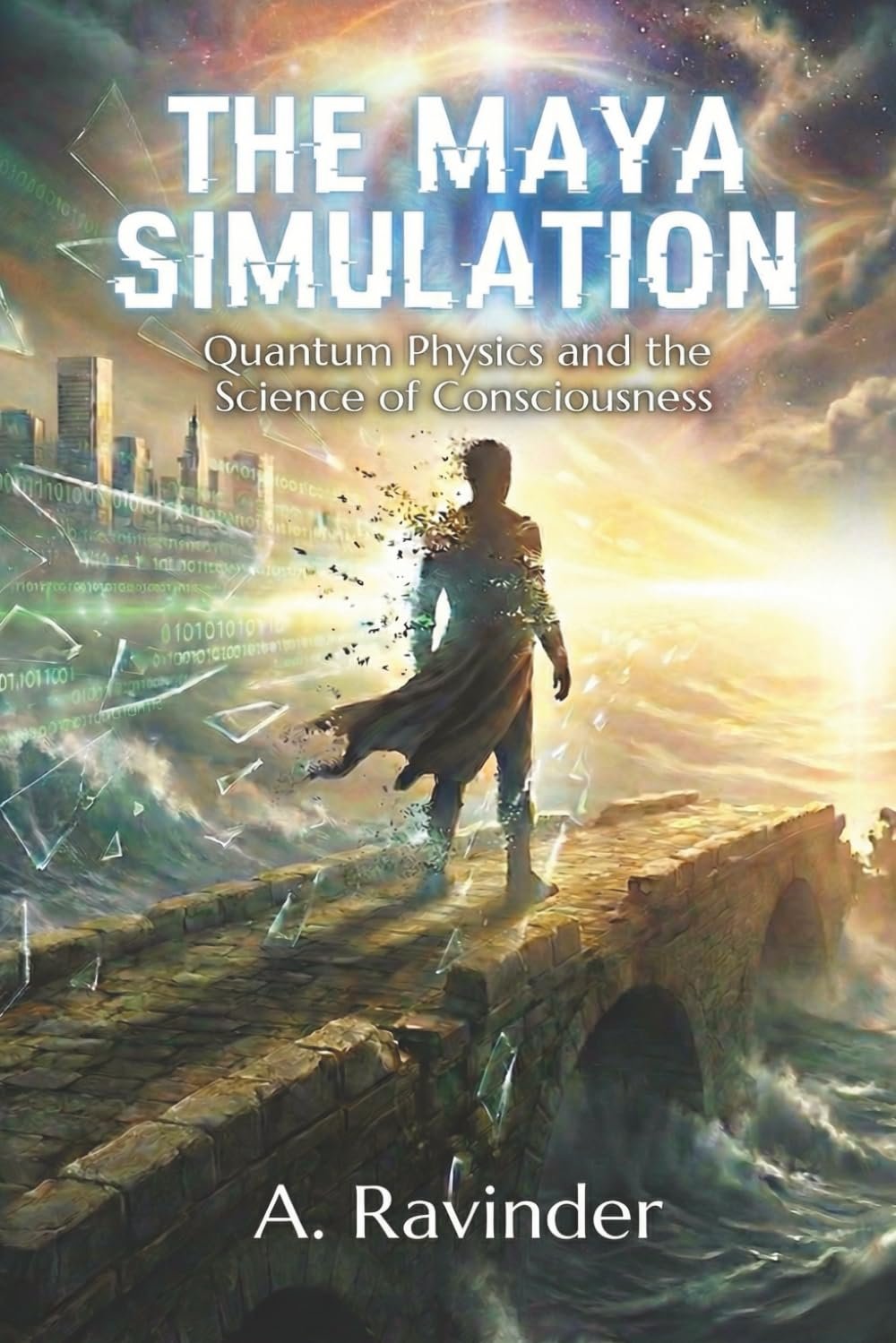
The Maya Simulation: Quantum Physics and the Science of Consciousness
by A. Ravinder
A guide that bridges the ancient wisdom of the Yoga Vasistha with quantum physics and modern consciousness science — for readers ready to question the nature of reality and calm the mind with practical tools like the Zero Voice Technique.
As an Amazon Associate, RamthaMedia can earn from qualifying purchases.
Atma Versus Ego in the Sacred Spiritual Heart
The core foundation of Sri Ramana’s philosophy rests upon discerning the vital difference between the false ‘I’, known as the ego or Ahamkara, and the true, unchanging Self. The illusory ego is merely the primary thought that arises in the mind, falsely binding the infinite light of consciousness to the perishable physical body, the senses, and transient mental impressions. When a person claims ‘I walked, I spoke, I suffered, or I achieved,’ they are operating entirely under the spell of this assumed individuality. Like a fragile water bubble arising upon the surface of the vast ocean, the ego imagines itself to be separate, enduring constant anxiety, fear, and desire until it sinks back into its oceanic source.
In contrast, the true Atma is pure Sat-Chit-Ananda—absolute Existence, Consciousness, and Bliss—which remains completely free from birth, change, action, and death. Ramana Maharshi explained that the ultimate truth is captured in the simple statement ‘I AM that I AM’, representing pure unconditioned Being without any qualifying attributes. The spiritual Heart, located on the right side of the human chest, serves as the spiritual center and true dwelling place of this supreme consciousness. Within this sacred center, the eternal Self radiates perpetually as the continuous vibration of ‘I-I’ (Aham-sphurana), which becomes vividly apparent the moment the false, grasping ego is dissolved through diligent inward investigation.
Consciousness functions like a vast cinema screen upon which the ever-changing scenes of the world, personal thoughts, and physical sensations appear and disappear in continuous flux. The screen itself remains unaffected, spotless, and unchanged regardless of whether the projected film depicts joyous celebrations or raging fires. In the same way, the mind acts as an interpretive filter that fragments pure awareness into multiplicity, creating the illusion of duality. When this mental filter is traced back to its origin in the Heart, the false sense of separation vanishes, leaving only the seamless majesty of <a href=”https://www.britannica.com/topic/Advaita”>Advaita Vedanta philosophy in Britannica</a> as a living, direct reality.
Atma Enquiry as a Practical Direct Path to Stillness
The practice of Self-enquiry, or Vichara, is not the repetition of a sacred mantra, nor is it an intellectual exercise in philosophical contemplation. It is an active, inward-turning of attention to locate the exact origin from which the fundamental ‘I’-thought emerges. When practicing, the seeker notices the unmistakable feeling of being present and asks internally, ‘From where does this awareness of existence arise within my experience?’ Whatever sensations, thoughts, or bodily feelings are perceived cannot be the ultimate perceiver, because the true observer is always prior to that which is observed. By persistently holding attention on the felt sense of the ‘I’, the wandering mind is compelled to travel backward toward its spiritual root.
Whenever extraneous thoughts arise during meditation or daily life, one must not engage in a exhausting struggle to violently suppress them, nor follow their seductive narratives. Instead, the practitioner immediately questions with razor-sharp vigilance: ‘To whom has this thought arisen?’ The natural answer arises, ‘To me.’ One then instantly asks, ‘Then who am I?’ This inward pivot immediately cuts off the energy feeding the distraction, drawing the awareness straight back to the source. Sri Ramana compared this vigilance to guards defending a fortress, where intruders are neutralized the very instant their heads appear at the gateway, preventing the accumulation of mental turmoil.
Self-enquiry is uniquely designed to be integrated seamlessly into the flow of everyday responsibilities rather than being confined to a secluded meditation cushion. While walking, speaking, working, or studying, an individual can maintain a quiet background awareness of non-doership, remembering that actions occur while the true Self remains the motionless witness. This continuous practice transforms ordinary work into dynamic Karma Yoga, ensuring that the mind does not run outward toward worldly attachments. Over time, the inner silence ceases to be a temporary state and reveals itself as the permanent, natural foundation of one’s entire life.
Atma Surrender and Jnana as Converging Ways of Liberation
Although the path of wisdom through Self-enquiry (Jnana) and the path of absolute surrender (Bhakti or Sharanagati) may appear distinct to external observers, Ramana Maharshi emphatically taught that they are fundamentally identical in their ultimate purpose. Both genuine paths demand the complete surrender and dissolution of the personal ego. In the practice of Vichara, the ego is destroyed by investigating its root until it vanishes into pure awareness, while in surrender, the seeker offers their entire individuality, desires, and burdens to God, acknowledging personal powerlessness before the Divine. In both approaches, the false sense of individual doership is utterly eliminated, allowing the singular reality to shine unimpeded.
True surrender does not mean offering superficial prayers for material gain while retaining the ego’s possessiveness; it means handing over the entire burden of one’s existence to the Divine source residing within the Heart. Just as a traveler on a train wisely places their heavy luggage on the floor rather than carrying it on their head, the wise devotee surrenders all personal anxiety to the supreme power that sustains the universe. Ramana Maharshi clarified that God, the true Guru, and the inward Atma are not three separate entities, but three expressions of one indivisible reality. When surrender reaches maturity, the devotee merges into the Beloved, discovering that the object of devotion was their own innermost Self all along.
📖 Basaveshwara — Who Was the 12th-Century Revolutionary Saint?
Atma Liberation from Latent Desires and Karmic Bonds
The primary obstacles that bind humanity to the cycle of suffering are the latent mental impressions known as Vasanas, which drive restless desires and compulsive behaviors. Through the sustained practice of Self-enquiry, these deep-seated tendencies are systematically starved of attention and burned in the fire of pure awareness. Bhagavan cautioned that as long as even a single subtle Vasana remains active—whether regarded socially as good or bad—the illusion of individuality persists, obstructing complete Self-realization. By constantly interrogating the ‘I’ that claims these desires, the practitioner dissolves the root cause of mental craving.
Freedom from karmic bondage occurs naturally when the illusion of individual doership (Kartritva) is shattered through Self-knowledge. As long as a person believes ‘I am the doer of these actions,’ they remain bound to experience the karmic fruits of past deeds across the cycles of Sanchita, Prarabdha, and Agami karma. When Self-enquiry establishes the seeker in the truth of being the detached witness rather than the physical actor, the illusion of doership dissolves entirely, and the accumulation of karmic debt ceases instantly. This liberating realization provides unshakeable emotional resilience, dispelling the groundless phobias and anxieties that arise from perceived separation.
Atma Awakening Through Constant Practice and Lifelong Peace
Attaining steady Self-realization requires persistent, patient practice (Abhyasa) to overwrite the ancient conditioning of identifying with the physical body and mental chatter. Seekers often fall prey to discouragement, questioning whether they possess sufficient purity or spiritual qualification to realize the truth. Ramana Maharshi firmly countered such doubts, advising that even the greatest sinner should not lament their past errors, but should completely discard the thought ‘I am a sinner’ and focus single-mindedly on the light of the Self. Consistent daily practice gradually weakens the old mental grooves, making the return to inner stillness effortless and spontaneous.
Ultimately, spiritual liberation is not a state to be acquired from outside or produced through strenuous effort, because our true nature is already perfection, peace, and unconditioned freedom. Spiritual discipline is purely a process of subtraction—a methodical shedding of the false concepts, identities, and fears that obscure the ever-present truth. By resting quietly in the simplicity of pure Being rather than the perpetual anxiety of becoming, the seeker realizes the lighthouse of Ramana’s teachings, stepping out of inner darkness into the timeless, blazing dawn of Self-knowledge that illuminates every dimension of reality.
Spiritual Meaning
The inner significance of Ramana Maharshi’s Self-enquiry lies in its radical deconstruction of human identity from the superficial layers of body, mind, and personality down to pure, unconditioned consciousness. In conventional life, consciousness remains entangled in external objects, validating its existence solely through thoughts, emotional states, and sensory impressions. By asking ‘Who Am I?’, the seeker deliberately reverses this outward flow of attention, compelling the mind to look inward at its own source, which shatters the hypnotic illusion that one is merely a mortal biological organism.
This sacred inquiry directly aligns with the profound Upanishadic declarations of absolute non-duality, demonstrating that the individual soul (Jiva) is not fundamentally different from the supreme reality (Brahman). The spiritual Heart, functioning as the center of awareness, is revealed not as an anatomical organ, but as the infinite space of pure consciousness where the divine vibration ‘I-I’ shines eternally without beginning or end. Transcending the dichotomy of subject and object, Self-enquiry reveals that the entire manifest universe is an appearance occurring within consciousness itself, dissolving all artificial barriers between the sacred and the secular.
Furthermore, the dissolution of the egoic ‘I’ uncovers the profound truth that absolute happiness is the intrinsic nature of every living being rather than a fleeting reward derived from worldly accomplishments. When the restless mind temporarily subsides during dreamless sleep, deep peace is experienced naturally without any external stimuli. Self-enquiry enables the conscious realization of this same profound bliss in the waking state, liberating the individual from the exhausting pursuit of temporary sensory pleasures and establishing unbroken equanimity in the midst of life’s unpredictable currents.
To live the wisdom of Self-enquiry in contemporary daily life, one must cultivate the quiet habit of witnessing mental reactions during stressful encounters, professional demands, and interpersonal relationships. When sudden anger, fear, or insecurity arises, instead of reacting impulsively or judging oneself harshly, pause for a moment and inwardly ask, ‘To whom has this turmoil come?’ Recognizing that the disturbance belongs to the fleeting ego and not to your true, unshakeable Self instantly restores clarity, allowing you to perform your duties with greater creativity, compassion, and profound inner peace.
👉 Home Temple Pooja Stand with Door, LED Light and Storage
Chapter Summary
This comprehensive exposition explores the life, awakening, and timeless teachings of Bhagavan Sri Ramana Maharshi, focusing on the direct methodology of Self-enquiry (‘Who Am I?’). Confronting mortality directly at age sixteen, Ramana realized the deathless nature of the Atma and settled permanently at sacred Mount Arunachala, radiating the silent power of non-dual truth. The text illuminates the crucial distinction between the perishable, illusory ego and the immortal, self-luminous Self residing in the spiritual Heart on the right side of the chest. It provides practical instructions for dismantling disruptive thoughts at their root by asking ‘To whom do these thoughts arise?’ and tracing awareness back to its source. The synthesis of Jnana (knowledge) and Bhakti (surrender) is clearly established, showing that both paths culminate in the total eradication of individual doership. Finally, the discourse outlines how sustained enquiry dissolves latent mental tendencies (vasanas), eliminates karmic debt, reduces everyday anxiety, and stabilizes the seeker in eternal, effortless bliss.
Scripture Notes
- Main Message: The central message of Ramana Maharshi’s direct path is that spiritual liberation is the natural, ever-present reality of the Self rather than an external goal to be attained through complex rituals or intellectual accumulation. By turning attention away from objective phenomena toward the subjective root of the ‘I’-thought, the illusory ego dissolves, revealing the eternal Atma as pure Sat-Chit-Ananda. Every seeker already possesses full access to this divine truth within the spiritual Heart, requiring only the removal of false mental identifications to experience unbroken peace.
- Philosophical Teaching: Rooted firmly in the highest realizations of Advaita Vedanta, this philosophical teaching asserts that the universe, individual consciousness, and supreme Divinity are fundamentally non-different. The mind is merely a bundle of thoughts anchored to the primary ‘I’-thought, acting as an interpretive filter over pure awareness. Through methodical Self-enquiry and unconditional surrender, the illusion of individual doership (Kartritva) is dismantled, eradicating the threefold karmic cycle and revealing the unconditioned state of pure Being—’I AM that I AM’—as the absolute truth of existence.
📖 Who is the Jiva? The Secret of Consciousness Trapped in Illusion | Yoga Vasistha S3 EP-49
Frequently Asked Questions
What is the core method of Atma enquiry taught by Ramana Maharshi?
The core method of Atma enquiry involves persistently turning your attention inward to investigate the origin of the ‘I’-thought. When thoughts, emotions, or sensations arise, instead of engaging with them, ask yourself, ‘To whom does this thought arise?’ When the answer ‘To me’ surfaces, immediately ask, ‘Who am I?’ This practice gently draws awareness away from external objects and mental narratives, leading consciousness back to its pristine source in the spiritual Heart.
How does Self-enquiry differ from repeating a sacred mantra?
Mantra repetition involves focusing the mind on a specific sacred sound or phrase to cultivate concentration and purify mental impressions. In contrast, Self-enquiry is not a verbal repetition or intellectual chant, but a direct, inward investigation into the nature of the thinker itself. Rather than providing the mind with an object to dwell upon, Vichara traces the subjective sense of personal identity back to its source until the ego dissolves in pure silence.
Can a person practice Self-enquiry while fulfilling daily family and professional duties?
Yes, Bhagavan Ramana Maharshi emphasized that Self-enquiry should not be restricted to formal meditation sessions. One can practice amidst daily activities by maintaining an inner awareness of non-doership. By recognizing that physical and mental actions occur naturally while the true Self remains the unaffected witness, daily work is transformed into Karma Yoga, allowing work to be executed with greater focus, efficiency, and calmness.
What did Ramana Maharshi mean by the spiritual Heart?
Ramana Maharshi identified the spiritual Heart, known as the Hridaya, as the center of pure consciousness, distinct from the physical blood-pumping organ. Located on the right side of the chest, it serves as the spiritual seat of the Self from which the mind emerges and into which it must ultimately dissolve. It is experienced in deep realization as the infinite, non-local space of pure awareness.