

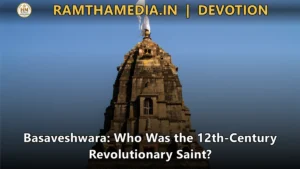
Basaveshwara was a visionary 12th-century philosopher, statesman, and social reformer who pioneered spiritual democracy in India. Born in Karnataka, he served as Prime Minister under King Bijjala, founded the democratic assembly Anubhava Mantapa, rejected caste hierarchies, and taught that honest human labor is itself divine worship.
Traveling along National Highway 65 from Hyderabad toward Solapur, motorists cross the Telangana border past Zahirabad and enter the historical landscape of northern Karnataka. The smooth asphalt stretches beneath flyovers where green overhead signboards display the name Basava Kalyan. To a hurried traveler, it may appear as just another quiet Deccan town, but beneath its soil rests the memory of an eight-century-old social revolution that transformed the socio-religious fabric of medieval India.
During the 12th century, long before modern democratic institutions took root, Mahatma Basaveshwara ignited a profound egalitarian awakening in this region. He dismantled orthodox ritualism, challenged feudal tyranny, and abolished rigid caste barriers that had divided society for generations. Through simple, evocative Kannada verses known as Vachanas, he brought profound philosophical truths directly into the vernacular speech of ordinary artisans, farmers, and weavers.
Understanding the life and message of Basaveshwara is profoundly relevant today. His revolutionary concept of spiritual democracy, his unyielding defense of women’s spiritual autonomy, and his declaration that physical labor is a sacred offering continue to inspire movements for human dignity and equality worldwide. His legacy remains a timeless testament to the power of compassion and righteous action over dogma and privilege.
Read the complete Telugu edition of this article.
For a scholarly biographical introduction to Basava, consult the Sahitya Akademi Basaveshwara profile.
For additional historical context, see the Karnataka Tourism page on Basavakalyan.
For a related perspective, read Basava Puranam — The Revolutionary Epic of Mahatma Basaveshwara.
Recommended reading or puja accessory
This optional item may be useful for readers who wish to continue their study or home practice.
Wooden Sambrani Dhoop Stand for home puja →
As an Amazon Associate, Ramthamedia.in may earn from qualifying purchases.
Basaveshwara and His Early Life of Spiritual Rebellion
In the year 1131 AD, the Deccan plateau stood at a complex cultural crossroad where ancient spiritual ideals had largely degenerated into rigid ritualism and social division. In the agrahara town of Bagewadi, situated in present-day Vijayapura district of Karnataka, a devoted Shaiva Brahmin leader named Madiraja and his wife Madalambika prayed earnestly for a child. Through their steadfast devotion, a son was born whom they named Basava. From his earliest years, the boy exhibited remarkable intellectual clarity, observing the world around him with deep empathy and questioning social contradictions that elders took for granted.
While other children absorbed traditional customs without reflection, young Basaveshwara observed the stark inequalities dividing the village streets. When he noticed that marginalized laborers were forbidden from entering his neighborhood, he questioned his father about whether the Divine creator recognized different human categories. His father cited ancient customs and ritual prescriptions, but the young boy’s innate moral conscience rejected any scripture that justified human discrimination. He recognized that nature provides sunlight, air, and river water equally to every living being, making artificial human divisions fundamentally unnatural.
The defining crisis of his youth arrived at the age of eight during his proposed Upanayana ceremony. Madiraja had gathered priests, scholars, and relatives beneath decorated pavilions to invest his son with the sacred thread (Janeu) and initiate him into the priestly class. As his father stepped forward to place the thread over his shoulder, young Basaveshwara raised his hand and halted the ritual. With unwavering composure, he asked how a physical piece of yarn could purify an immortal soul, especially when the same ritual privilege was systematically denied to his sisters and the working masses.
Refusing to accept a symbol of social division, Basaveshwara discarded the thread before the stunned gathering. Recognizing that the confines of orthodox orthodoxy would stifle his spiritual mission, he departed his ancestral home under the cover of night. Walking fearlessly through dense forests and unfamiliar pathways, he set out toward the sacred confluence of the Krishna and Malaprabha rivers at Kudala Sangama. His departure was not an act of youthful rebellion, but the conscious beginning of a lifelong pilgrimage toward universal human liberation.
For a related perspective, read Tirumala Srivari Salakatla Brahmotsavams — A Complete Guide to the Sacred Nine-Day Festival.
Basaveshwara at Kudala Sangama and the Philosophy of Ishtalinga
Arriving at Kudala Sangama, Basaveshwara sought refuge at the ashram of Guru Jataveda Muni, an enlightened teacher of the Ishanya tradition. Over the next twelve years, the young seeker engaged in rigorous intellectual and spiritual discipline. Rather than accepting traditional Sanskrit scriptures passively, he examined the Vedas, Upanishads, and Puranas with critical discernment, separating sublime metaphysical truths from accumulated superstitious dogmas. He meditated upon the natural elements, observing how the flowing rivers embodied divine grace without prejudice.
It was during this period of intense contemplation that Guru Jataveda Muni initiated Basaveshwara into the deeper mysteries of the divine, presenting him with a small consecrated emblem known as the Ishtalinga. The Guru explained that while worldly authorities fought over stationary stone idols housed in distant sanctuaries, the true Divine reality could be held directly upon the palm of one’s own hand. This portable emblem established an unbroken, personal communion between the seeker and the Supreme, rendering temple hierarchies and priestly intermediaries obsolete.
One stormy night, as the swollen rivers surged against the banks of the hermitage, Basaveshwara experienced an overwhelming philosophical epiphany that found expression in his immortal Vachana: ‘The rich may build temples for Shiva, but what can a poor man like me construct? My legs are the pillars, my body the shrine, and my head the golden cupola.’ He realized that the human body itself is a living sanctum, far more sacred than any static monument built of mortar and stone. This revelation democratized spirituality, shifting the locus of the sacred from elite temples directly to the living heart of every individual.
When traditional scholars arrived at Kudala Sangama to challenge his vernacular teachings, arguing that spiritual knowledge could only be communicated through classical Sanskrit, Basaveshwara met them with calm logic. He questioned whether a starving person requires food or a grammatical lecture on how the meal was cooked. True devotion, he maintained, transcends linguistic barriers because the Divine listens to the sincere longing of the heart rather than elaborate linguistic formulations. Prepared with profound inner conviction, he resolved to carry his egalitarian message directly into the center of political power.
For a related perspective, read Saamethalu — The Timeless Telugu Proverbs and Their Deep Meaning.
RECOMMENDED PRODUCT

Vado 5 Mukhi Rudraksha Mala Lab Verified Bead Review : How can this product help you?
This review examines the Vado using verified buyer feedback and the manufacturer’s listed specifications. Establishing a dedicated daily mantra japa or meditation routine… The Vado Certified 5 Mukhi Rudraksha Mala directly addresses this practitioner requirement by supplying natural Panchmukhi beads strung with individual stabilising knots and… The Vado Certified 5 Mukhi Rudraksha Mala is an authentic 108-bead spiritual strand crafted from natural 7 mm Panchmukhi seeds with individual stabilising knots for daily…
Read more about this productBuy on Amazon
As an Amazon Associate, RamthaMedia earns from qualifying purchases.
Basaveshwara in Kalyana — Administrative Mastery and the Dignity of Labor
Around the middle of the 12th century, Basaveshwara journeyed to the thriving metropolis of Kalyana, the political capital ruled by King Bijjala of the Kalachuri dynasty. His maternal uncle Baladeva, a high-ranking royal official, recognized his exceptional intellect and integrity. Basaveshwara entered the royal administrative service as a humble accountant (Karanam), intending to reform society not from distant mountaintops, but from within the operational structures of public life. His sharp intellect was swiftly tested when he resolved years of complicated treasury discrepancies in a single night.
Astonished by his financial precision and incorruptible character, King Bijjala appointed Basaveshwara as the Chief Royal Treasurer and Prime Minister (Maha Bhandari). Entrusted with immense executive authority, Basaveshwara did not use power for personal enrichment. Instead, he formulated two foundational social principles: *Kayaka* (the sacredness of labor) and *Dasoha* (the selfless redistribution of wealth). He declared that every citizen, from the monarch to the cobbler, must earn their livelihood through honest physical or intellectual work, stating emphatically that *Kayaka-ve Kailasa*—labor itself is heaven.
These radical policies alarmed corrupt courtiers and feudal landlords, who resented the elevation of working-class laborers. Conspiring to destroy the Prime Minister, they alleged to King Bijjala that Basaveshwara was embezzling royal revenues to feed thousands of mendicant followers and spiritual seekers known as Sharanas. Furious, the King demanded an immediate audit of the state treasury chests before the royal assembly, anticipating an empty vault.
When the iron chests were unlocked, the treasury was found overflowing with gold coins, containing even more surplus wealth than official ledgers recorded. Basaveshwara calmly addressed the assembly, explaining that the treasury was filled by the honest contributions of the Sharanas, who willingly surrendered their surplus earnings (*Dasoha*) for community welfare. Humbled by this revelation, King Bijjala sought pardon, but Basaveshwara recognized that lasting human transformation could never be achieved through palace decrees alone, prompting him to establish an independent platform for spiritual dialogue.
For a related perspective, read Konark — Why Is Surya Missing and Pooja Forbidden in the Sun Temple?.
Basaveshwara and Anubhava Mantapa — The Dawn of Spiritual Democracy
In the heart of Kalyana, Basaveshwara established the historic institution known as the Anubhava Mantapa (The Hall of Spiritual Experience). This revolutionary academy functioned as the world’s earliest socio-spiritual parliament, welcoming seekers from every strata of medieval society regardless of birth, gender, or profession. The great mystic Allama Prabhu was invited to preside over the assembly as its spiritual leader, ensuring that discussions were grounded in direct experiential wisdom rather than dogmatic speculation.
Within the Anubhava Mantapa, radical social hierarchies dissolved entirely. Haralayya the cobbler, Madiwala Machayya the washerman, Molige Marayya the woodcutter, and Nuliya Chandayya the grass-cutter sat alongside transformed scholars and former aristocrats, sharing their profound spiritual insights on equal terms. Each member articulated their realizations in concise, vernacular Vachanas, creating a vibrant body of democratic literature that addressed both existential truth and social ethics in the accessible language of the people.
The Anubhava Mantapa also became a beacon of radical gender equality. Fearless women mystics participated actively in high-level philosophical debates without patriarchal constraint. Among them, Akka Mahadevi stood out as an extraordinary figure of spiritual liberation. Having discarded royal marriage, worldly attachments, and even customary attire, she arrived at Kalyana clad only in her flowing hair, declaring that the eternal soul knows no gender. Basaveshwara and the assembly honored her supreme attainment, cementing women’s rightful place at the pinnacle of spiritual leadership.
The core teachings emerging from the Anubhava Mantapa emphasized practical morality over esoteric ritual. Basaveshwara formulated a timeless moral charter: ‘Do not steal, do not kill, do not utter falsehood, do not harbor anger, do not boast of yourself, do not despise others.’ By integrating pure ethical conduct with devotional surrender, the Sharanas demonstrated that a sacred life is realized through equitable daily living rather than ascetic withdrawal from the world.
Basaveshwara and Kalyana Kranti — The Crucible of Inter-Caste Revolution
As the egalitarian influence of the Sharana movement expanded across the kingdom, Basaveshwara resolved to demonstrate that social equality must transcend philosophical debate and manifest in concrete social reality. He sanctioned a historic inter-caste marriage between the daughter of Madhuvarasa, a former orthodox Brahmin scholar who had embraced the Sharana path, and the son of Haralayya, an enlightened cobbler from the untouchable community. Both families, having discarded caste identities through the wearing of the Ishtalinga, celebrated the union as a sacred affirmation of human oneness.
This unprecedented union provoked fierce outrage among entrenched feudal lords and conservative religious leaders. They regarded the alliance as a fatal blow to the ancient caste structure and pressured King Bijjala to intervene with severe punitive measures. Fearing widespread social unrest and the erosion of royal authority, Bijjala succumbed to orthodox pressure and ordered the immediate arrest of Madhuvarasa and Haralayya, condemning them to a barbaric execution where they were dragged through the streets by royal war elephants.
When news of this atrocity reached Kalyana, Basaveshwara was devastated by the state’s cruelty. Despite his lifelong commitment to absolute non-violence, radical factions among the Sharanas rose in fierce rebellion against the monarchy. Kalyana descended into violent chaos; royal palaces were stormed, the city was engulfed in flames, and King Bijjala was assassinated in the turmoil. The peaceful spiritual commonwealth that Basaveshwara had carefully nurtured was suddenly torn apart by conflict.
Refusing to participate in retaliatory violence or compromise his foundational principles of peace, Basaveshwara relinquished his administrative role. He offered a final farewell to the ruined citadel of Kalyana and walked back toward his spiritual sanctuary at Kudala Sangama. At the serene confluence of the Krishna and Malaprabha rivers, feeling his earthly mission complete, he merged into the eternal divine light of Kudala Sangamadeva, leaving behind an indestructible spiritual legacy.
Basaveshwara and the Sacred Legacy of Vachana Literature
Following the destruction of Kalyana, royal forces sought to confiscate and burn the palm-leaf manuscripts containing the Vachana literature of the Sharanas. In an extraordinary rescue effort, devoted disciples including Madiwala Machayya and Chennabasavanna gathered thousands of palm-leaf bundles and fled into the rugged forests of Ulavi and the surrounding hill ranges. Protecting these sacred writings with their lives through torrential rains and military pursuits, they ensured the preservation of this profound spiritual treasure for future generations.
The Vachana literature preserved through this sacrifice represents one of India’s most significant contributions to world philosophy. Written in rhythmic, direct Kannada prose, these compositions dismantled the artificial dichotomy between sacred philosophy and everyday life. Basaveshwara’s verses rejected the concept of static divinity, declaring: ‘The moving being (*Jangama*) is immortal; the stationary image (*Sthavara*) is perishable.’ This profound principle elevated active human service above the passive worship of stationary stone monuments.
Central to this enduring heritage is the institution of the Ishtalinga, which continues to provide millions of practitioners with a tangible emblem of universal equality. By wearing the consecrated linga upon the chest, every devotee affirms their inherent divine nature while relinquishing distinctions of caste, ancestry, and social status. It serves as a portable shrine, reminding the seeker that spiritual communion requires neither institutional mediation nor geographical pilgrimage.
Centuries after the historic events at Kalyana, the global relevance of Basaveshwara’s message continues to expand. His bronze statue standing along the banks of the River Thames in London symbolizes international recognition of his pioneering role in advocating human rights, gender equality, and democratic governance. His timeless call—’Think not of anyone as a stranger; consider everyone as your own’—remains an essential beacon for modern global civilization.
📖 Basava Puranam — The Revolutionary Epic of Mahatma Basaveshwara
Basaveshwara and Basava Kalyan — Exploring the Historic Citadel
Originally known in classical inscriptions as Kalyani, the historic town of Basava Kalyan in the Bidar district of Karnataka served as the glorious capital of the Western Chalukyas (1050–1189 AD) and the Kalachuri dynasty. In 1956, following the reorganization of Indian states, the government formally renamed the city Basava Kalyan in honor of the revolutionary philosopher who reshaped its history. Today, the town stands as an open-air historical sanctuary where monumental ruins narrate stories of imperial grandeur and spiritual awakening.
At the architectural center of the town lies the ancient Basava Kalyan Fort, originally established in the 10th century by King Nalaraja and subsequently expanded by Chalukyan and Bahmani rulers. Featuring seven formidable concentric gateways, the Akhand Darwaza, the Rani Mahal, and deep defensive moats, the citadel represents a masterpiece of medieval military engineering. Within the fort complex, travelers can explore subterranean passages and watchtowers that once oversaw the vibrant life of the 12th-century capital.
Adjacent to the fort, the Archaeological Museum preserves invaluable artifacts documenting the cultural richness of pre-revolutionary and medieval Kalyana. The museum houses exquisite 10th and 11th-century black stone sculptures of Jain Tirthankaras in deep meditative postures, highlighting the cosmopolitan religious environment that characterized the region before the Sharana movement. Ancient stone inscriptions (*Shila Shasanas*) in classical Kannada and Sanskrit provide crucial historical verification of royal land grants, administrative reforms, and the evolving social dynamics of Basaveshwara’s era.
Modern pilgrims visiting Basava Kalyan encounter several major commemorative sites, including the modern Anubhava Mantapa complex, the rock-cut meditation caves associated with Akka Mahadevi and Basavanna, and a colossal 108-foot statue of Basaveshwara positioned near the city entrance. Located approximately 160 kilometers from Hyderabad along National Highway 65, the city serves as an enriching cultural destination for travelers seeking to understand the birthplace of India’s earliest social democracy.
RECOMMENDED BOOK

The Maya Simulation: Quantum Physics and the Science of Consciousness by A. Ravinder
Is the world around us real? Or is it just a Maya Simulation?
A guide that bridges the ancient wisdom of the Yoga Vasistha with quantum physics and modern consciousness science — for readers ready to question the nature of reality and calm the mind with practical tools like the Zero Voice Technique. It explores mind, maya and consciousness in plain language, and offers a practical path for the seeker on the spiritual journey. Available in print and ebook instant-read versions.
Buy on AmazonBuy on Ramthamedia
As an Amazon Associate, RamthaMedia earns from qualifying purchases.
Basaveshwara in Telugu Literature — Palkuriki Somanatha’s Basava Puranam
The revolutionary message that originated in Karnataka crossed linguistic and geographical boundaries during the 13th century, taking deep root across the Telugu-speaking regions of Andhra and Telangana. The primary architect of this cultural transmission was the extraordinary rebel poet Palkuriki Somanatha, born in the village of Palkuriki in modern Jangaon district of Telangana. A passionate devotee of the Sharana philosophy, Somanatha resolved to present Basaveshwara’s life and teachings directly to the Telugu people in their indigenous idiom.
Challenging the entrenched convention that great literature must be composed exclusively in Sanskrit or heavily Sanskritized Telugu champu metres, Somanatha authored the landmark epic *Basava Puranam* in simple, melodic *Dwipada* (two-line couplets). He boldly declared his preference for *Janu-Telugu* (pure native Telugu), arguing that direct, heartfelt language understood by the common populace is infinitely superior to complex grammatical acrobatics intended only for royal courts.
In the *Basava Puranam*, Somanatha created a pioneering biographical masterpiece, depicting Basaveshwara as the divine incarnation of Nandishwara sent to emancipate humanity from social darkness. Beyond narrating Basaveshwara’s life, the epic chronicles the inspiring sacrifices, spiritual miracles, and moral integrity of numerous contemporary Sharanas, including cobbler Haralayya and washerman Madiwala Machayya. Somanatha’s vivid poetic style captures the intellectual clashes in Bijjala’s court with dramatic intensity and intense devotional fervor.
The enduring success of *Basava Puranam* established Virashaivism as a major socio-religious force throughout the Telugu lands, inspiring subsequent classical poets such as Piduparti Somanatha and influencing generations of rural devotees. Through Somanatha’s literary courage, Basaveshwara’s radical vision of human dignity became permanently woven into the cultural and spiritual heritage of the Telugu people.
Spiritual Meaning of Basaveshwara’s Teachings
The spiritual essence of Basaveshwara’s philosophy centers upon the radical reclamation of the human body as an active living shrine. By dismantling the conceptual divide between the sacred interior of temple sanctums and the secular exterior world of everyday life, he taught that genuine enlightenment is discovered not through physical renunciation, but through mindful, ethical participation in worldly responsibilities.
The consecration of the Ishtalinga signifies the total dissolution of spiritual elitism. When an individual receives and wears the personal linga, all inherited social markers—including caste lineage, gender limitations, and ceremonial purity laws—are completely erased in the singular realization of the divine presence within. The Ishtalinga represents the cosmic reality (*Bhavalinga*) brought into intimate, personal communion (*Pranalinga*).
Through the twin doctrines of *Kayaka* (dedicated labor) and *Dasoha* (selfless community service), Basaveshwara redefined spiritual practice (*Sadhana*) as active social righteousness. Work performed with pure consciousness is transformed into a direct meditative offering, while surrendering surplus earnings to nourish the collective community eliminates selfish greed, purifying the mind and establishing cosmic harmony.
In modern daily life, Basaveshwara’s philosophy offers a powerful antidote to materialistic consumerism and social fragmentation. By treating our daily professional work as a sacred duty (*Kayaka*) and sharing our excess resources with compassion (*Dasoha*), we bridge the artificial separation between spiritual ideals and societal welfare, fostering a truly just and empathetic community.
📖 Sri Rama Navami Significance: The Sacred Day Dharma Was Restored on Earth
Chapter Summary
This comprehensive study explores the life, philosophy, and enduring historical impact of Mahatma Basaveshwara, the 12th-century philosopher-statesman who spearheaded a monumental social revolution in medieval Karnataka. Born into an orthodox Shaiva Brahmin family in Bagewadi, Basaveshwara rejected inherited caste privileges and ceremonial rituals at an early age. After years of deep spiritual meditation and intellectual refinement at Kudala Sangama, he rose to become the Prime Minister under King Bijjala in the imperial city of Kalyana. There, he formulated the transformative doctrines of Kayaka (sacred labor) and Dasoha (charitable redistribution), established the world’s first democratic spiritual parliament called the Anubhava Mantapa, and composed sublime Vachana poetry in everyday language. Despite violent political opposition culminating in the tragic Kalyana Kranti, his egalitarian vision survived through the courageous preservation of Vachana manuscripts. The article also examines the architectural heritage of Basava Kalyan, its fort and archaeological treasures, travel logistics from Hyderabad, and the profound literary transmission of his legacy into Telugu culture through Palkuriki Somanatha’s classic epic, the Basava Puranam.
Scripture Notes
- Main Message: The central message of Basaveshwara’s teachings is that true religion is rooted in universal compassion, moral purity, and radical human equality. External rituals, caste hierarchies, and static temple structures are secondary to the living temple of the human heart and the sacred discipline of honest daily labor.
- Philosophical Teaching: Basaveshwara’s Virashaiva philosophy is built upon the foundational concepts of Shatsthala (the six-stage path of spiritual evolution), Kayaka (work as worship), Dasoha (unconditional sharing), and the distinction between Sthavara (perishable static structures) and Jangama (eternal dynamic consciousness). By rejecting priestly mediation and establishing direct communion through the Ishtalinga, his philosophy bridges intense personal mysticism with revolutionary social action.
Frequently Asked Questions
Who was Mahatma Basaveshwara?
Mahatma Basaveshwara was a 12th-century philosopher, statesman, social reformer, and mystic poet from Karnataka. He served as Prime Minister under King Bijjala, rejected caste hierarchies, established the democratic Anubhava Mantapa, and pioneered the Virashaiva/Lingayat spiritual tradition.
What is the meaning of ‘Kayaka-ve Kailasa’?
‘Kayaka-ve Kailasa’ is Basaveshwara’s core philosophical doctrine translating to ‘Work is Worship’ or ‘Labor itself is Heaven.’ It teaches that every honest occupation is divinely sacred, and performing one’s daily work with sincere devotion is the highest form of spiritual realization.
What was the Anubhava Mantapa?
The Anubhava Mantapa was a spiritual and philosophical academy founded by Basaveshwara in Kalyana. Presided over by Allama Prabhu, it functioned as the world’s earliest socio-spiritual parliament where men and women of all social backgrounds gathered to engage in open philosophical discourse.
What are Vachanas in Basava philosophy?
Vachanas are concise, rhythmic prose-poems composed in simple, spoken Kannada by Basaveshwara and other Sharanas. They convey profound spiritual truths, ethical guidelines, and social critique in everyday language accessible to ordinary people.
What is the significance of the Ishtalinga?
The Ishtalinga is a small, consecrated emblem of Lord Shiva worn on the body by Lingayat devotees. It symbolizes universal equality, personal communion with the Divine without priestly intermediaries, and the realization of the body as a living temple.
Why is Basaveshwara called Vishwaguru?
Basaveshwara is honored as Vishwaguru (Universal Teacher) because his visionary teachings on human rights, caste abolition, gender equality, and democratic governance anticipated modern constitutional values by over eight hundred years.
Who wrote the Basava Puranam in Telugu?
The celebrated 13th-century poet Palkuriki Somanatha authored the Basava Puranam in Telugu. Written in the popular Dwipada metre and indigenous Janu-Telugu idiom, it became the primary literary vehicle spreading Basavanna’s philosophy across Andhra and Telangana.
What caused the historic Kalyana Kranti?
The Kalyana Kranti was triggered when Basaveshwara sanctioned an inter-caste marriage between the daughter of a former Brahmin and the son of a cobbler. Orthodox backlash pressured King Bijjala into brutally executing the parents, sparking widespread civil unrest across Kalyana.
What is the philosophical difference between Sthavara and Jangama?
In Basaveshwara’s Vachanas, ‘Sthavara’ refers to static, perishable stone temples and rigid social forms, while ‘Jangama’ represents living, moving spiritual consciousness embodied in enlightened seekers dedicated to selfless service.
How can one travel from Hyderabad to Basava Kalyan?
Basava Kalyan is located approximately 160 km from Hyderabad via National Highway 65 (Pune/Mumbai Highway) passing Sangareddy, Zahirabad, and Humnabad. It takes around 3 to 3.5 hours by private car or regular KSRTC/TSRTC buses.


