
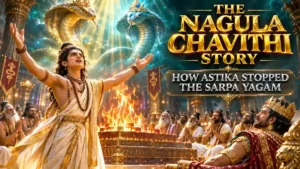
The Nagula Chavithi Story of Astika and Janamejaya appears in the Mahabharata. Some families recall it during the festival, while regional traditions vary. Astika asked the king to end the snake sacrifice and protect the Nagas. Family accounts and interpretations differ.
For the wider background, read the Karthika Masam main guide.
On Nagula Chavithi, families honour Naga Devata. When children ask about the festival, some families recount the Mahabharata story of Astika and King Janamejaya's snake sacrifice. Why did the king begin the sacrifice, and how did Astika bring it to an end?
The Astika Parva in the Mahabharata's Adi Parva recounts Janamejaya's snake sacrifice and Astika's request to stop it. Some people remember this story in the context of Nagula Chavithi. That does not establish it as the festival's only origin; family stories and observances vary by region.
Read the complete Telugu edition of this article.
Who was Janamejaya?
Janamejaya was a king of the Kuru dynasty in the Mahabharata. His father was Parikshit. The Astika Parva describes Parikshit's death following a bite by Takshaka, a Naga. After learning of his father's death, Janamejaya resolved to conduct a sacrifice against the Nagas.
The narrative describes many Nagas falling into the sacrificial fire. Janamejaya's decision arose in the context of grief and a desire for revenge against Takshaka. A reader can recognise the king's loss while also noticing the danger his decision created for other Nagas.
This is an episode in the Mahabharata. It does not have to be treated as a mandatory ritual for the festival. If your family tells the story, introduce it along with the household tradition in which it is remembered.
What happened to Parikshit?
Parikshit was a Kuru king who came after the Mahabharata war. The Astika Parva includes events before his death, a curse and Takshaka's role. Telugu summaries may arrange or explain these events differently, so a brief retelling should not be confused with a complete translation of the passage.
For this story, the important connection is that Parikshit's death led to Janamejaya's decision. The king began the snake sacrifice in response. Astika later came to the sacrificial gathering and asked for it to end.
When telling children the story, choose details suitable for their age. Instead of dwelling on violent descriptions, discuss how one person's decision affected others and who tried to change its course. Children can then understand the sequence without needing to hear every detail at once.
Related reading Lamp and wick guide in Telugu
Who was Astika?
Astika was a sage in the Mahabharata. His mother belonged to the Naga lineage, and his father was the sage Jaratkaru. The Astika Parva tells how Astika went to Janamejaya's sacrifice with the purpose of protecting the Nagas.
At the gathering, Astika praised the king and those present. Pleased with his words, Janamejaya offered him a boon. Astika asked that the sacrifice stop and that no more Nagas fall into the fire. The king granted the request and brought the rite to an end.
This request is the turning point in the story. Present it as a Mahabharata narrative, not as proof that the event happened exactly as described in historical time. Nor should it be presented without evidence as the sole origin of Nagula Chavithi.
Why is Astika's request significant?
When given the opportunity to ask for a boon, Astika asked for the sacrifice to stop rather than requesting wealth or power for himself. Readers may reflect on how a word or decision can affect the lives of others. The request places the safety of those in danger at the centre of the story.
Janamejaya honoured the boon and stopped the sacrifice instead of continuing the decision he had first made. Devotees may see this change as an opportunity to reflect on compassion and restraint. Some understand the episode as a reminder that grief directed at one cause should not become harm to every living creature.
Families and commentators may explain the meaning of the story in different ways. Ask children what they noticed: who made a decision, who made a request, and what changed afterwards? Let them answer in their own words instead of demanding one interpretation.
Related devotional guide Kedara Gowri vrata in Telugu
How is the story related to Nagula Chavithi?
Nagula Chavithi is a festival in Telugu regions in which families honour Naga Devata. It is associated with Kartika Shukla Chavithi. Households observe it according to local and family traditions, and some recount Astika's story when speaking about Nagas.
A story being told on a festival day is different from proving that the festival originated from that story alone. The Mahabharata passage consulted here describes Astika stopping the sacrifice. The wider history of Nagula Chavithi and its regional customs requires separate research.
Your family may tell a different vrata story. Respect it as a family or regional tradition. If you want to know the source, check the book's introduction, translator or a reliable text. Do not invent a chapter or verse number when it is unknown.
Are the Nagas in the story the same as real snakes?
Nagas in the Mahabharata are characters in an epic narrative, with names, lineages and stories. A snake found near a home or field is a living animal. You can discuss the epic with devotion while treating real wildlife with practical care.
The Wildlife Institute of India's snake manual states that snakes do not deliberately drink milk. Do not try to feed milk to a live snake. Anthills and burrows can be habitats for small creatures, so avoid pouring milk, food or other worship materials inside them.
If you see a snake, keep your distance and keep children away. Do not touch, capture, chase or try to kill it. Contact the local forest department or trained snake rescuers and follow their local instructions. A live snake does not need to be captured for worship.
How can the family pray at home?
If your household worships before a picture or idol of Naga Devata, clean a stable prayer space and place it there. Flowers or food may be offered according to family custom and availability. Ask an elder if you are uncertain about a particular household practice.
If you light a lamp, first check whether open flames are permitted in your building. Place the diya on a heat-resistant plate away from flowers, clothing and books. Supervise the flame, extinguish it safely before leaving, and let the vessel cool before moving it.
A picture or special item may not be available in every home. You may offer a prayer you know. Food offerings and prayers differ between families; there is no need to assume that every household must use the same number of flowers or prepare the same dish.
How should you choose a story to read?
If you have a vrata book used by your family, examine its introduction. Look for the writer or translator and any sources it identifies. Story order and names may differ between publications. A concise version may omit background that appears in a fuller Mahabharata translation.
When introducing Astika's story, first explain who Janamejaya, Parikshit and Astika are. Too many names at once may be difficult for children. Begin with the sequence: the king starts the sacrifice, Astika asks for a boon, and the sacrifice ends. Add background when the listener is interested.
Do not invent dialogue and present it as a quotation from the source. If a local vrata story differs, identify it as a local version. Religious accounts of merit are matters of belief; hearing a story should not be promised as a guaranteed route to health, wealth or another specific outcome.
Three questions to discuss together
| Question | What to discuss |
|---|---|
| Why was Janamejaya angry? | How did his father’s death affect his decision? |
| What boon did Astika request? | His request to protect others by ending the sacrifice. |
| What should you do near a real snake? | Keep away and contact trained help. |
Children do not need to give an identical answer immediately. Tell the story at a level appropriate to their age and listen to their questions. A family conversation can include both the devotional context of the festival and practical respect for wildlife.
How can you read the Mahabharata account?
The Astika narrative in the Adi Parva includes several preceding events: the Naga lineage, Astika's birth and Janamejaya's sacrifice. A brief article cannot introduce every episode at once. First understand the relationships among the main characters; then read a fuller translation if you want more context.
Check which edition a translation follows. Some books summarise the story, while others include conversations and earlier events in greater detail. Different wording alone does not prove one version wrong. Consider whether each is a summary, an adaptation or a translation of a particular text.
What does the end of the sacrifice invite us to consider?
Janamejaya grieved his father's death. His response affected many Nagas, and Astika asked him to stop. A family can discuss both decisions: the king's initial choice and his later decision to honour the boon.
Anger after a loss is understandable. The story offers a way to ask what happens if that anger harms others who were not responsible for the original event. Such a conversation need not replace a devotional reading; it can sit alongside the family's own understanding.
What if your household tells another Naga story?
Some families read a story from a vrata book, while others recount one learned from elders. Its names or events may differ from the Mahabharata's Astika narrative. Explain which story comes from the family and which was read in a named translation rather than hiding the difference.
It is acceptable not to know a story's source. You can later consult a book, commentator or priest. Asking questions can help a family learn more about the tradition it values.
How can you teach practical care around snakes?
Keep the epic's Naga characters distinct from a real snake found near a home. Teach children not to approach, throw stones, move it with a stick or try to catch it. They should tell an adult and keep away.
Family members can find out in advance how to reach their local forest department or trained rescuers. Do not offer snakes milk or food, and do not damage anthills or undergrowth used as habitats. Leaving wildlife undisturbed is a practical expression of respect for nature.
Where should a lamp be placed while reading?
If your household reads beside a lamp, keep the book away from the flame. Set the diya on a stable heat-resistant plate, and let adults handle the oil and wick. The flame must be supervised while it burns.
Extinguish it safely before leaving and wait for the vessel to cool before moving it. Where building rules prohibit flames, read or listen without lighting one. Family worship can be adapted to the circumstances of the home.
Conclusion
Astika's intervention in the snake sacrifice appears in the Mahabharata's Adi Parva. Although some families recall it during Nagula Chavithi, it should not be described as the festival's only origin. Distinguishing the textual account from a regional custom makes the tradition clearer.
Today, listen to the story your elders tell and discuss why Astika requested an end to the sacrifice. Share the practical lesson that real snakes should be left alone and their habitats protected.
Frequently Asked Questions
Where is the story of Astika found?
It appears in the Astika Parva of the Mahabharata's Adi Parva.
Why did Janamejaya begin the snake sacrifice?
The story places the sacrifice in the context of his father Parikshit's death and Takshaka's role in it.
What boon did Astika request?
He asked Janamejaya to stop the snake sacrifice.
Is this the only Nagula Chavithi story?
No. Families and regions may tell other vrata stories; the festival should not be reduced to one unverified origin.
Should snakes be fed milk?
The Wildlife Institute of India says snakes do not deliberately drink milk. Do not try to feed it to a live snake.
Sources
The Astika Parva of the Mahabharata and the Wildlife Institute of India snake manual were consulted. Regional vrata stories may differ.