
Sadar, also known as the Dunnapothula Panduga (Buffalo Carnival), is an iconic livestock thanksgiving festival celebrated by the Yadav community in Hyderabad on the second day after Diwali. Founded in 1946 by Chaudhari Salandri Mallaiah Yadav at Narayanguda, it has evolved into an official Telangana state festival featuring colossal champion Murrah bulls and vibrant traditional music.
Hyderabad Sadar Festival Highlights and Key Insights
- Celebrated annually on the second night following Diwali, the historic Sadar Sammelanam centers around the bustling Narayanguda YMCA junction in Hyderabad.
- Pioneered in 1946 during the late Nizam era by Chaudhari Salandri Mallaiah Yadav, the carnival is now officially celebrated as a prestigious Telangana State Festival.
- The premier attraction remains the grand parade of elite champion Murrah bulls brought from Haryana and Punjab, executing athletic two-legged salutes amid traditional Da-Dan-Ki percussion.
- Rooted in the scriptural lore of Lord Krishna lifting Mount Govardhana to shield cattle pastoralists, the carnival blends reverent Go-Puja with vibrant folk traditions.
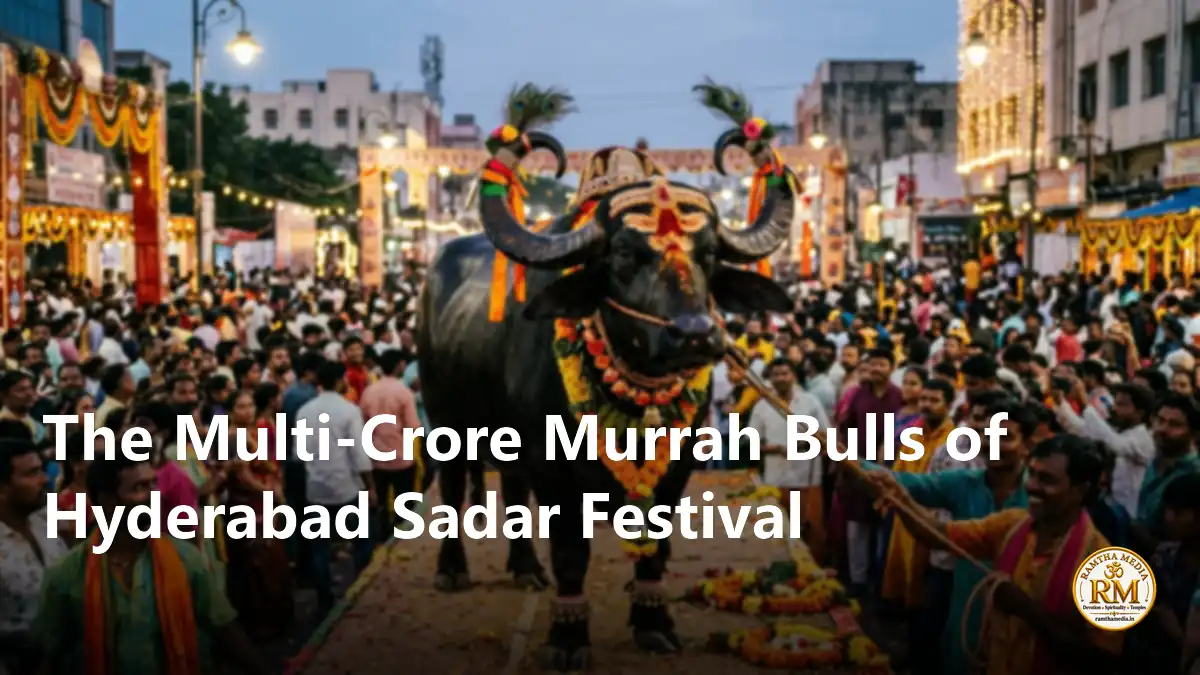
When Diwali arrives across India, most people imagine warm earthen lamps, fireworks, and family feasts. Yet two days after the festival of lights concludes, the streets of central Hyderabad transform into a staggering carnival witnessed by tens of thousands. As dusk falls past 7 PM, the historic avenue between Narayanguda YMCA and Kachiguda reverberates with thunderous brass drums, pulsating beats, and colossal black Murrah bulls draped in floral garlands.
This is the legendary Hyderabad Sadar Festival (Dunnapothula Panduga). Far from being a modern spectacle, it is an eighty-year-old cultural tradition born from a humble herdsman’s self-respect and vow. Behind the festive revelry lies a multi-thousand-crore dairy economy, advanced bovine genetics, and a deep-seated spiritual reverence for livestock that stretches back to the Dvapara Yuga.
The Spark of Honor — Origin at Narayanguda in 1946
The genesis of Sadar traces back to Chaudhari Salandri Mallaiah Yadav, a hardworking dairy farmer residing in Hyderabad during the twilight of Nizam rule in 1946. A sudden epidemic swept through the Deccan, devastating cattle herds and pushing dairy-dependent families toward ruin.
In desperation, Mallaiah Yadav undertook an arduous pilgrimage by foot and bullock cart to the shrine of Ujjaini Mahakali in Madhya Pradesh. Kneeling before the goddess, he pledged, “Mother, protect my voiceless animals. If my herd survives this blight, I will parade my finest cattle through the heart of Hyderabad every year in thanksgiving.” Upon his return, his entire livestock miraculously recovered.
Honoring his vow, Mallaiah Yadav rallied the local Yadav community and organized the first community cattle parade at the Narayanguda YMCA grounds in 1946. Over eight decades, that thanksgiving congregation expanded into the iconic ‘Pedda Sadar’ celebrated today.
The Mythological Anchor — Mount Govardhana and Lord Krishna
Sadar is deeply anchored in Hindu scriptural ethos. In the Srimad Bhagavatam, when the cowherds of Gokula prepared elaborate animal sacrifices to propitiate Indra, young Sri Krishna intervened with a transformative realization.
“True divinity does not reside in distant deities demanding sacrifice; it manifests in the Govardhana hill that provides pasture, and in the cattle that sustain our breath and livelihood. Respect for nature and animals is the highest worship.”
When an infuriated Indra unleashed torrential downpours to submerge Gokula, Krishna lifted the Govardhana hill upon his little finger for seven consecutive days, safeguarding every cow, calf, and herdsman. The traditional Govardhana Puja celebrated post-Diwali blossomed into the distinct urban folk carnival of Sadar in Telangana.
📌 Related In-Depth Guide — Discover the sacred observances and daily lamp-lighting rituals of the auspicious month Karthika Masam Spiritual Significance and Observances
Step-by-Step Go-Puja at Home — Practical Guide
Devotees wishing to observe the sanctified Go-Puja tradition at home can conduct the ceremony with devotion and simplicity. In the early morning, clean the eastern courtyard or front entrance of the home and draw traditional rangoli patterns. Bathe the cow or calf gently with lukewarm water, applying fresh turmeric paste and fragrant vermilion across the forehead and horn bases.
Arrange a sacred brass platter containing consecrated raw rice, fresh blossoms, and incense. Offer tender green grass along with jaggery and soaked chickpeas directly to the bovine, performing three clockwise circumambulations while chanting prayers for peace and household prosperity. Devotees preparing for festive rituals can also consult our comprehensive Karthika Puja Items Checklist and Practical Preparations guide.
The Stature of Murrah Bulls and the Iconic ‘Salaam’ Feat
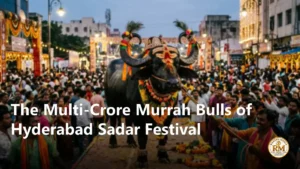
The pinnacle of excitement during Sadar is the famous ‘Salaam’ performance. While livestock naturally startle in noisy crowds, champion Murrah bulls undergo months of gentle behavioral training. At a precise signal from their master, a massive two-tonne bull rears backward onto its hind legs, lifting its forelegs high into the air in a breathtaking posture resembling a regal salute.
Handlers groom the bulls meticulously for the occasion. Their black coats are polished with natural mustard oil until they gleam like obsidian. Horns are wrapped in colorful ribbons topped with peacock plumes, while brass anklets (Gajjalu) chime musically around their muscular hooves.
The Rhythms of Da-Dan-Ki and Fierce Tiger Dances
The heartbeat of the festival is Da-Dan-Ki, a high-octane percussive rhythm indigenous to the Yadav community of the Deccan. Played on large marching drums and traditional dappu instruments, the tempo steadily accelerates until the entire avenue dances in unison.
Accompanying the drums are the celebrated ‘Puli Veshalu’ (Tiger Dancers)—youth painted from head to toe with vivid yellow and black feline stripes. Brandishing wooden sticks and maneuvering in acrobatic circles, their martial performances recreate the primal forest heritage of pastoral tribes.
National Champions — Diet, Care, and Luxury Transport
In recent decades, champion Murrah bulls from Haryana and Punjab—bearing illustrious names like Gholu-2, Yuvraj-2, Rolex, Kali, and Bheem—have become headline attractions. Valued between ₹15 crore and ₹30 crore each, they travel to Hyderabad in custom air-conditioned multi-axle freight carriers.
Their daily maintenance requires aristocratic attention and structured nourishment to sustain peak muscular vitality.
- 20 to 25 litres of fresh unadulterated cow milk per day,
- Kilograms of high-grade almonds, pistachios, cashews, and soaked dry fruits,
- Half a kilogram of pure desi ghee alongside nutrient-dense green fodder,
- Twice-daily mustard oil body massages and grooming baths to manage body temperature.
Bovine Genetics & The Multi-Thousand-Crore Dairy Economy
The staggering valuation of these bulls is grounded in high-yield dairy genetics. The Murrah breed of Haryana represents the pinnacle of buffalo milk productivity, with females producing 20 to 30 litres of rich, high-fat milk daily.
A single champion bull generates hundreds of thousands of semen doses annually through scientific cryopreservation. Purchased by dairy farmers nationwide for artificial insemination, these elite genetics enhance milk yields across ordinary rural herds, generating hundreds of crores in dairy revenue. Sadar is thus both a celebration of heritage and a major national showcase of bovine genetic superiority.
Champion Murrah Bulls Overview Table
| Bull Name | Breed | Approx Weight | Height | Key Feats & Diet Highlights |
|---|---|---|---|---|
| Gholu-2 / Gholu-3 | Murrah | 1,800 – 2,400 kg | 7.0 ft | Bred by Padma Shri awardee Narendra Singh; fed 20L milk daily with dry fruits. |
| Yuvraj-2 | Murrah | 1,500 kg | 6.5 ft | 24-time national champion; elite genetic lineage prized by dairy syndicates. |
| Rolex | Murrah | 1,500+ kg | 6.0 ft | Renowned for executing flawless rear-leg ‘Salaam’ greetings before spectators. |
| Kali / Bheem | Murrah | 1,500 kg | 6.0 ft | Massive curled horns; transported directly from Haryana in dedicated AC freight trucks. |
Just as the Telangana government is advancing the monumental Manchirevula Omkareshwara Temple Project along the Musi riverfront to rejuvenate cultural landmarks, the Sadar festival is celebrated with prestigious state patronage.
From Golconda Roots to Official State Festival
The foundational story of Hyderabad is tied to pastoral traditions. Golconda fort owes its very nomenclature to ‘Golla Konda’ (Shepherds’ Hill), where early pastoral clans pastured their livestock before fortified walls arose under the Kakatiyas and Qutb Shahis. The Yadav community formed the milk-line and municipal strength of early Hyderabad. Echoing the widespread spiritual devotion surrounding the rare Kondagattu Sri Anjaneya Swamy Nijaroopa Darshanam after six decades, Sadar stands as a vibrant testament to communal solidarity.
Recognizing this unique cultural lineage, the Government of Telangana accorded Sadar official ‘State Festival’ status with budgetary patronage. The municipal corporation and city police oversee traffic diversions, high-capacity lighting, and security infrastructure to facilitate smooth public attendance.
Visitor Guide and Traffic Advisory
On Sadar night, vehicular movement across Kachiguda, Barkatpura, and Himayatnagar toward Narayanguda is systematically rerouted into designated bypass corridors by city traffic authorities. Commuters are advised to heed official advisories to avoid congestion.
Given the immense gathering and close proximity to heavyweight livestock, families accompanied by children and elderly attendees should exercise care. Taking the Hyderabad Metro to either Narayanguda or Chikkadpally station offers the most effortless transit choice, entirely circumventing vehicular bottlenecks.
Frequently Asked Questions (FAQ)
Why is the Sadar Festival celebrated in Hyderabad?
Sadar is an agricultural and pastoral thanksgiving festival celebrated by the Yadav community to honor cattle and buffaloes that sustain human livelihoods, tracing its mythological origins to Sri Krishna’s Govardhana Puja.
Where does the biggest Sadar carnival take place?
The historic and largest congregation, known as ‘Pedda Sadar’, takes place at the Narayanguda YMCA junction in Hyderabad, where it has been celebrated since 1946.
Who founded the Hyderabad Sadar Festival?
Chaudhari Salandri Mallaiah Yadav founded the festival in 1946 after fulfilling a vow to the goddess Ujjaini Mahakali for saving his cattle from a lethal epidemic.
Why are Murrah bulls so famous and valuable?
Murrah buffaloes from Haryana are the world’s highest milk-yielding breed. Champion bulls carry elite genetics, and their cryopreserved semen is in massive demand nationwide for artificial insemination, bolstering national milk yields.
Is the Sadar Festival an official state celebration?
Yes. Recognizing its historic and cultural significance, the Government of Telangana officially declared the Sadar festival a State Festival with state sponsorship.
Conclusion
In an age where machines receive ritual worship on Ayudha Puja, the Hyderabad Sadar Festival provides a timely reminder of humanity’s debt to living creatures that sustain human life. Behind the grandeur of multi-crore champion bulls lies an unshakeable bond between pastoral families and their voiceless companions—a proud, enduring chapter in the cultural identity of Telangana.