
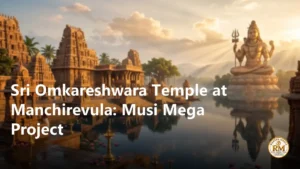
The Sri Omkareshwara Swamy Temple project at Manchirevula along the Musi Riverfront in Hyderabad is an ambitious ₹1,000-crore spiritual and cultural landmark developed by MRDCL. Inspired by Kakatiya sandstone architecture, the master plan features a monumental 100-foot bronze statue of Lord Shiva seated within the river, 6-lane arterial connectivity, and modern pilgrim infrastructure.
Manchirevula Omkareshwara Temple Project Key Highlights
- Situated along the scenic Musi riverfront at Manchirevula in Gandipet Mandal, this mega spiritual landmark represents a vital cultural cornerstone for West Hyderabad.
- Overseen jointly by MRDCL and the MAUD department, the comprehensive master plan commands an estimated outlay of ₹1,000 crore, with ₹811.85 crore allocated for primary phase executions.
- Crafted with iconic red sandstone echoing Kakatiya Ramappa heritage, the sanctum is anchored by a magnificent 100-foot bronze statue of Lord Shiva rising gracefully from the river waters.
- Devotee transit is bolstered by dedicated 6-lane arterial corridors connecting directly to the Outer Ring Road and Narsingi Junction, paired with a modern two-tier parking facility.
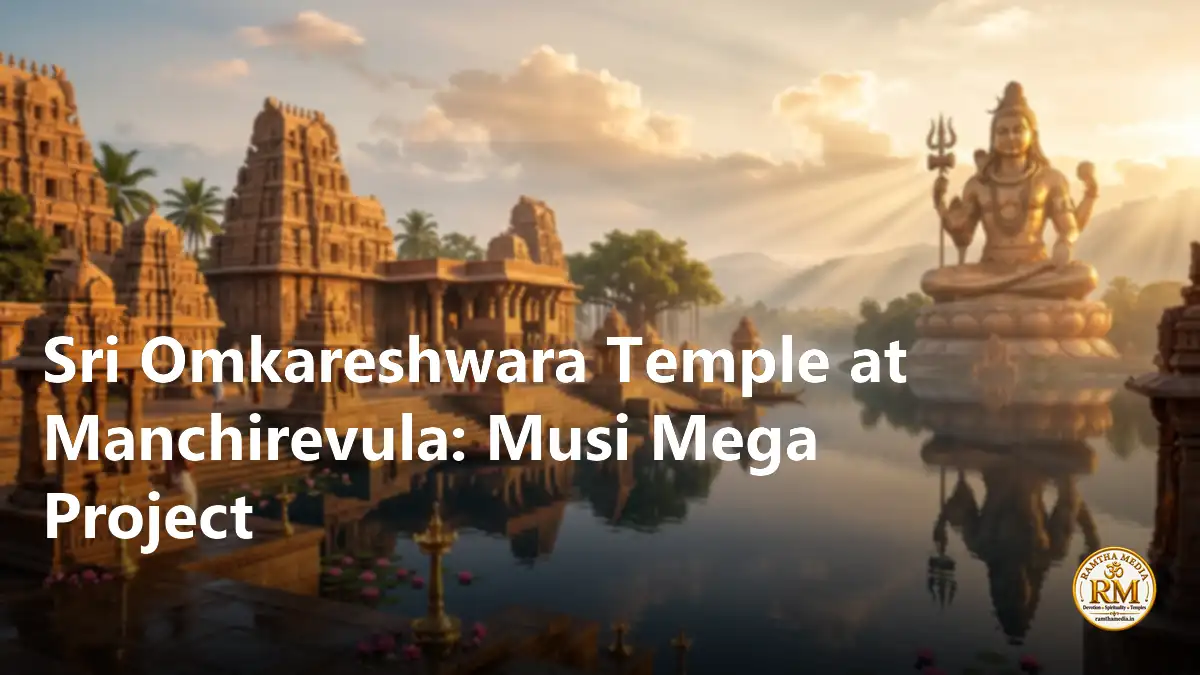
Hyderabad is on the threshold of an unprecedented urban and spiritual renaissance through the Musi Riverfront Revitalization initiative. Once a neglected waterway, the historic Musi River is being systematically transformed into an international corridor of ecological preservation, cultural grandeur, and tourism. At the heart of this comprehensive master plan lies the magnificent reconstruction of the ancient Sri Omkareshwara Swamy Temple at Manchirevula in Western Hyderabad.
Spearheaded by the Musi Riverfront Development Corporation Limited (MRDCL) with an estimated investment exceeding ₹1,000 crore, the project merges time-tested Kakatiya architectural wisdom with modern infrastructure engineering. Highlights include an awe-inspiring 100-foot bronze statue of Lord Shiva rising from the river waters, dedicated 6-lane approach expressways, and expansive pilgrim facilities. This analytical report examines the project’s financial allocations, archaeological significance, structural blueprint, and long-term socio-economic impact.
Project Sanction, Financial Blueprint, and Global Tenders
The Department of Municipal Administration and Urban Development (MAUD) granted administrative sanction for the comprehensive development of the Omkareshwara temple complex and associated arterial roads. For the primary civil execution, MRDCL invited global tenders with an outlay of ₹811.85 crore under a strict completion timeline.
Unlike conventional concrete constructions, this landmark project prioritizes monolithic stone masonry designed to endure for centuries. The master design honors traditional Vastu and Agama Shastra guidelines while catering to projected pilgrim footfalls over the next several decades.
Scientific Budget Allocation Table
To guarantee transparency and engineering excellence, financial resources have been systematically allocated across critical architectural components as detailed below.
| Component / Scope of Work | Budget Allocation (₹ in Crores) |
|---|---|
| Stone Procurement, Dressing, and Traditional Sculptor Labor | ₹254.00 |
| Ramappa-Grade Red Sandstone Sourcing & Transportation | ₹78.00 |
| Design Mix Concrete (Civil, Substructure, and Foundation) | ₹61.50 |
| 100-Foot Monumental Bronze Lord Shiva Statue in Musi River | ₹60.00 |
| Structural Reinforcement Steel Procurement and Fabrication | ₹54.00 |
| Internal Arterial Corridors, Storm Drainage, and Utilities | ₹35.40 |
| Hard Rock Deep Excavation for Foundation Anchors | ₹35.00 |
| Architectural Finishes, Elevation Embellishments, and Lighting | ₹25.00 |
| Traditional Stone Paving and Temple Courtyard Flooring | ₹11.70 |
| Sculpting of Sanctum and Subsidiary Shrine Deities | ₹8.50 |
Archaeological Legacy — The Brahmasutra Shivalinga and Veerabhadra Shrine
The settlement of Manchirevula possesses ancient spiritual roots. Deep within the riparian groves along the Musi, the centuries-old Sri Omkareshwara Swamy sanctum enshrines a remarkable natural stone Shivalinga. In classical Saivite iconography, geometric cords naturally present on a linga are identified as ‘Brahmasutras’. The Shivalinga at Manchirevula carries these sacred natural markings, earning it reverence as a Swayambhu (self-manifested) sanctum with spiritual potency comparable to the twelve Jyotirlingas. Devotees interested in sacred serpent motifs and traditional ritual protections can explore our guide on Nagula Chavithi Traditions and Observances.
Guarding the complex is a formidable shrine of Sri Veerabhadra Swamy, revered as the Kshetrapalaka (protector of the sacred territory). In bygone eras, spiritual seekers and villagers performed ceremonial ablutions in the flowing waters of the Musi before offering prayers here to neutralize astrological adversities and seek inner tranquility. For sacred holy river bath observances during auspicious seasons, devotees can reference our detailed guide on Karthika Masam Shiva-Keshava Worship and Traditions. The current redevelopment safeguards this sanctified heritage while resurrecting its pristine glory.
📌 Related In-Depth Guide — Explore our comprehensive guide to another historic temple milestone in Telangana Kondagattu Sri Anjaneya Swamy 60-Year Chandanotsavam Nijaroopa Darshanam Guide
Kakatiya Architectural Splendor and Temple Proportions
The architectural vocabulary of the reconstructed temple draws deep inspiration from the Kakatiya and Western Chalukya golden ages. Mirroring the timeless engineering of the UNESCO World Heritage Ramappa Temple in Mulugu, high-density red sandstone has been chosen as the primary construction medium. Sandstone allows master sculptors to carve intricate filigree work with breath-taking precision, while developing an impervious natural patina that shields the stone from weathering over generations.
The temple layout incorporates a grand Maha Mandapam, a pillared Mukha Mandapam, an inner vestibule (Antaralaya), and the innermost sanctum sanctorum (Garbhalaya). Monolithic stone columns will depict sacred narratives from the Siva Purana, Ramayana, and Mahabharata alongside ornate floral scrolls and dancing celestial nymphs (Apsaras). The Vimana gopuram rising above the sanctum will showcase soaring Dravidian tiers culminating in a golden Kalasham.
The 100-Foot Monumental Bronze Shiva Statue in the Musi
The central aesthetic attraction of the Manchirevula project is the colossal 100-foot bronze statue of Lord Shiva situated directly within the Musi River. Resembling iconic mid-water monuments such as the Statue of Unity in Gujarat or the Hussain Sagar Buddha, engineers will construct a heavily fortified artificial island foundation within the river channel.
Upon this elevated granite pedestal, Lord Shiva will be depicted in a tranquil seated meditation posture, holding the divine Trishula and Damaru, adorned with the crescent moon and the celestial Ganga cascading from his locks. Advanced dynamic projection mapping and laser illumination will illuminate the bronze monument after dark, casting shimmering reflections across the flowing waters against the backdrop of the Western Hyderabad skyline. An exclusive budget of ₹60 crore has been dedicated to this monumental sculpture.
Devotee Infrastructure and Two-Tier Parking Complex
Anticipating massive weekend surges and festive crowds during Mahashivaratri and Karthika Masam, planners have incorporated advanced crowd-management infrastructure. A two-tier multi-level parking complex is under development with capacity for 1,000 four-wheelers and 2,000 two-wheelers.
Additional pilgrim amenities include eco-friendly electric buggies for senior citizens and differently-abled visitors, modern high-speed elevators, a round-the-clock Annadana dining complex, a Vedic patashala, landscaped pilgrim meditation gardens, and fortified riverfront bathing ghats equipped with water-filtration systems.
Six-Lane Expressway Connectivity and Urban Transit
Manchirevula enjoys immediate proximity to Hyderabad’s premier IT and commercial corridors, including Gachibowli, Kokapet, and the Financial District. To prevent vehicular congestion, a brand-new 6-lane approach expressway is being laid to link the temple complex directly with the Outer Ring Road (ORR) at the Narsingi interchange. Pilgrims traveling from Rajiv Gandhi International Airport in Shamshabad will be able to reach the temple within 20 minutes via signal-free express corridors.
High-Level Technical Oversight Committee
To oversee structural integrity, budgetary discipline, and rigorous adherence to classical scriptural canons, the state government constituted an apex technical steering committee. Led by the Engineer-in-Chief of the Roads and Buildings Department as Chairman, the committee includes the Public Health ENC as Co-Chairman and the MRDCL Chief Engineer as Member-Convener, joined by the Endowments Chief Engineer and the Additional Secretary of Finance.
Crucially, to preserve pristine Kakatiya architectural authenticity and stone-carving traditions, acclaimed archaeologist, temple author, and Sthapati Dr. Emani Sivanagi Reddy serves as Principal Heritage Advisor, supervising all ornamental and architectural executions.
Alongside celebrated cultural gatherings such as the historic Hyderabad Sadar Festival and Murrah Bulls Carnival, this upcoming riverfront sanctuary establishes another major pillar in the city’s cultural panorama.
Musi Riverfront Transformation and Cultural Tourism
Modelled after successful global river restoration benchmarks like the River Thames in London and the Sabarmati Riverfront in Ahmedabad, MRDCL’s broader vision transforms the 55-kilometer urban river stretch into a green ecological sanctuary. Continuous promenades, urban forestry buffers, bicycle corridors, cultural plazas, and water recreation hubs are being established. Within this sweeping canvas, the Manchirevula Omkareshwara shrine serves as the spiritual crown jewel.
Economic Catalysts and Real Estate Growth in West Hyderabad
The sanction of this mega project has catalyzed rapid socio-economic momentum across Manchirevula, Gandipet, Narsingi, and Kokapet. Clean riverbanks, high-speed connectivity, and world-class heritage infrastructure are transforming the micro-market into one of Hyderabad’s most sought-after residential, hospitality, and cultural destinations, fostering widespread employment and commercial enterprise.
Frequently Asked Questions (FAQ)
1. Where is the Sri Omkareshwara Swamy Temple project located?
The project is located at Manchirevula along the banks of the Musi River in Gandipet Mandal, Ranga Reddy District, adjacent to West Hyderabad’s Financial District.
2. What is the overall budget and tender valuation for the temple?
The total estimated project outlay is approximately ₹1,000 crore, with MRDCL issuing initial global construction tenders valued at ₹811.85 crore.
3. What are the key features of the 100-foot Shiva statue?
A 100-foot monumental bronze statue of Lord Shiva seated in meditation will be installed on an engineered island pedestal within the Musi River, equipped with nocturnal laser and dynamic lighting.
4. What architectural style is being adopted for the temple?
The complex utilizes durable red sandstone in the classical Kakatiya and Chalukya architectural traditions, echoing the masonry craftsmanship of the UNESCO-inscribed Ramappa Temple.
5. How is the temple connected to Hyderabad city transit?
A dedicated 6-lane approach corridor connects the temple to the Outer Ring Road (ORR) and Narsingi Junction, offering rapid access from Gachibowli and Shamshabad Airport.
Conclusion
The Sri Omkareshwara Swamy Temple project at Manchirevula represents more than an architectural reconstruction; it symbolizes the spiritual and ecological revitalization of Hyderabad’s historic lifeline, the Musi River. Uniting sublime Kakatiya craftsmanship, an iconic 100-foot bronze Shiva monument, and state-of-the-art pilgrim infrastructure, this sanctuary is destined to shine as a monumental spiritual beacon for Telangana and India.