
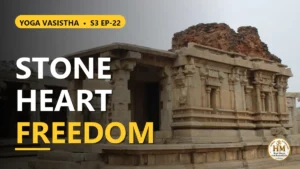
Can you attain liberation simply by hardening your mind like a rock? Yoga Vasistha says no to this notion of pashanatulyam (being stone-like). Through the story of King Vidooratha in the tale of Leela and Saraswati, Sage Vasistha reveals a profound truth — suppressing consciousness without true wisdom brings no real benefit; only a life lived with genuine understanding leads to true spiritual fulfillment.
Life is one long search. Some search outside themselves, others turn inward. But even on the inward path, a deep mistake often hides in plain sight — the belief that if you simply stop thinking, stop reacting, and turn yourself into something as hard as stone (pashanatulyam), that alone is enough.
In this vast, sky-wide story of consciousness, we now step into a new turn of events. Leela and Saraswati, both capable of traveling at will into any world they choose, arrive at a magnificent palace. There, a king’s life raises a question that touches every one of our own lives.
📚 Yoga Vasistha — full guide & all episodes
Two Divine Women Arrive at a Wondrous Palace
Leela and Saraswati, both embodiments of pure consciousness, possessed the power to travel wherever they wished. With that very power, the two of them entered a royal palace. Vasistha reminds us here that the substance of consciousness is present everywhere. He makes clear that the three qualities of true knowledge, true desire, and true will all arise only through meditation on that very substance of consciousness.
Vasistha says that nothing can obstruct this all-pervading, subtle substance of consciousness. The moment the two women stepped into the royal chamber, it filled with light, as if two full moons had risen at once.
A breeze carrying the fragrance of flowers began to drift through the palace. Everyone there, except for one king, lay deep in exhausted sleep, worn out from the battlefield.
The King’s Sleepless Eyes
The king alone lay on his bed with his eyes wide open, for reasons unknown even to him. When he saw the two women, radiant as celestial nymphs, seated on two thrones before him, he did not falter for even a moment. He rose at once and picked up flowers from a golden vessel beside him.
He placed the flowers at their feet, then sat down before them in a lotus posture. In silence, and with deep devotion, he bowed his head and offered his salutations.
Vidooratha: O divine women, I bow to you again and again. The very sight of you dissolves the thirst and the sins born of this cycle of birth. All darkness, within and without, has shattered at once. May you both be victorious!
👉 Previous Episode: Does Heaven for Warriors Really Exist? Does Dying in War Truly Earn It? | Yoga Vasistha S3 EP-21
Saraswati’s Question, the Minister’s Reply
The two women were moved by the king’s warm and heartfelt words. In that very moment, a thought stirred in the mind of Saraswati, whose every will comes true — a wish to learn about this place, for the sake of her devotee, Leela.
In answer to her wish, the king’s minister, who had also been lost in deep sleep nearby, suddenly woke. He rose at once, offered flowers to the two divine women, and sat down humbly before the king, waiting to be addressed.
Saraswati: O king, who are you? Whose son are you? How were you born? How did you come to be here? We wish to hear your full story. Let your minister tell it to us.
Minister: O divine ones, may you be blessed. Since you have asked, I will tell you the story of our king. Please listen.
The Legacy of the Ikshvaku Dynasty
The minister began his account. A king named Kundaratha, of the Ikshvaku dynasty, was known throughout the world. In his line came our former king, Nabharatha, whose son is none other than our present king, Vidooratha.
This king has ruled our kingdom with a warm and gracious nature, bringing joy to all of us. His parents, Nabharatha and Mitra, crowned him on the throne and then withdrew into the forest to live as ascetics.
From that day, he has ruled righteously for fifty years. Our great fortune is that you have come to this very place. It is only through the deepest penance that anyone could ever hope to encounter this substance of consciousness — would you not agree?
A Righteous King, A Long Life
The minister continued his account. This king had lived his entire life without ever straying from his sense of duty. From time to time, he would grieve quietly over the matter of his own children, swallowing that sorrow and carrying on with his days.
Never once did he covet another man’s wealth, nor did he ever cast an eye on another man’s wife. Content with what he had, he ruled over his people as though they were his own children.
And so sixty years passed. In that time, his people, his ministers, and his entire court grew old and passed away, one by one. Yet this king remains, still living by that same righteous path to this day.
Saraswati’s Words of Compassion
Hearing the minister’s account, Saraswati’s heart filled with compassion. She was quietly moved by the sight of a king who had lived a life of such untainted righteousness.
And yet, she understood clearly that outward righteousness alone is not enough — without true inner knowledge, even such a life remains incomplete. And so she resolved to speak with the king directly.
Saraswati: O king, you were crowned at the age of eight. Tell us, in some detail, of the joys and sorrows you have known since that day, the desires that have stirred in your mind, and the movements of your own inner heart.
The King’s Inner Truth — Weariness and Emptiness
At Saraswati’s question, sixty years of the king’s life rose at once in his mind. A strange weariness settled over his face. Standing before her, he began to speak honestly of what truly stirred within him.
There was no pride in his words, no trace of a king’s arrogance — only an honest, searching look into his own soul.
Vidooratha: Mother, what answer can I give to your question about ‘righteousness’? I have forgotten what that very word means. I carry this kingdom the way one carries a body — out of duty, and nothing more. I feel no love for it.
Vidooratha: My kingdom knows nothing but peace. But within me, there is nothing but restlessness. What good would it do you to hear the rest of my story?
A Grieving Heart, A Life Lived Like Stone
The king went on, opening his heart further. For sixty years, he had carried out his duty without fail, yet his mind had never once known peace. He confessed, with grief, that he had made himself hard as a rock—living in a state of pashanatulyam—and that even that hardness had brought him nothing.
A deep weariness, an emptiness, showed in his eyes. He felt that his entire life had turned into one great, unanswered question.
Vidooratha: I hardened my mind, made it like stone. I thought I could live without desire, without suffering. But it brought me nothing — no peace ever came.
👉 Click this link to read the next episode: Crystal, Dream, Gold — If This World Is False, Why Does It Feel So Real? | Yoga Vasistha S3 EP-23
Saraswati’s Profound Answer
As Saraswati listened to the king’s words, a clarity settled in her mind. She began to explain to him that merely suppressing the mind brings no benefit — that inner peace comes only through true knowledge.
Her voice carried both compassion and wisdom in equal measure. Everyone else in the hall waited eagerly to hear what she would say.
Saraswati: O king, hardening your mind like stone and sitting still will not bring you liberation. That is nothing but stubbornness. Only when true knowledge dawns does the mind find real peace.
Saraswati: You have been carrying your body, but you have never recognized the consciousness within you. That very recognition is what leads to true freedom.
Silence in the Hall, A New Understanding
A deep silence fell over the hall after Saraswati’s answer. A new light appeared on the king’s face — the look of a man who had just realized that everything he had believed all this time was wrong.
Leela, too, listened closely to this exchange. It felt to her as though this very answer held something for the questions in her own life as well.
State of Mind vs. Outcome — Pashanatulyam in King Vidooratha’s Story
| State of Mind | What the King Experienced | Vasistha’s Teaching |
|---|---|---|
| Hardness Like Stone (Pashanatulyam) | No peace ever came; restlessness remained within | Mere suppression is not liberation |
| True Knowledge | A new understanding through Saraswati’s teaching | Recognizing consciousness is the true path to freedom |
| Outward Righteousness | 60 years of untainted, righteous rule | Incomplete without inner knowledge |
The Spiritual Meaning of Pashanatulyam
King Vidooratha’s story teaches us a vital truth — no matter how righteously or disciplined a life may appear on the outside, without true inner knowledge, that life remains incomplete.
Merely suppressing the mind, forcibly killing off desire — this state of pashanatulyam, or being ‘hard as stone’ — brings no peace, only stubbornness. Real peace comes only through recognizing consciousness itself.
Are you merely suppressing some emotion in your life right now, or are you truly trying to understand where it comes from? Take a moment today to notice the difference between the two.
Chapter Summary
Leela and Saraswati enter a wondrous royal palace. There, King Vidooratha alone is awake, and he bows before them. His minister recounts the king’s story — a ruler who has governed righteously for sixty years, yet remains restless within. When Saraswati questions him, the king reveals his inner anguish — that he made himself hard as stone (pashanatulyam), yet found no peace. Saraswati then teaches him that true peace comes not from suppressing the mind, but from true knowledge alone.
Scripture Notes on Pashanatulyam
- Main Message: Outward righteousness alone is not enough; true peace comes only when true knowledge dawns within.
- Philosophical Teaching: Hardening the mind like stone (pashanatulyam) is not a path to liberation; recognizing consciousness itself is the true way to freedom.
- Connection to the Next Chapter: The new questions stirred in the king’s mind by Saraswati’s teaching will unfold in greater depth in the next episode.
Hardening your mind like stone and sitting still will not bring liberation — that is nothing but stubbornness.
You have been carrying your body, but you have never recognized the consciousness within you.
I carry this kingdom the way one carries a body — out of duty, and nothing more. I feel no love for it.
Frequently Asked Questions About Pashanatulyam
What does ‘pashanatulyam’ (hard as stone) mean?
Pashanatulyam means hardening the mind until it becomes like a rock, devoid of any feeling. According to Yoga Vasistha, this is not a true path to liberation, because it brings no inner peace — it only leaves behind stubbornness.
Who was King Vidooratha?
Vidooratha was a king of the Ikshvaku dynasty, son of Nabharatha and Mitra. Crowned at the age of eight, he ruled righteously for sixty years, yet remained restless within.
What did Saraswati teach the king?
Saraswati taught the king that merely suppressing the mind does not bring peace — true freedom comes only when one recognizes the consciousness within through genuine knowledge.
Is outward righteousness not enough?
This story tells us it is not. Even though Vidooratha ruled righteously for sixty years without fault, his life remained incomplete because he lacked inner knowledge.
Why did Leela and Saraswati enter the royal palace?
Leela and Saraswati, both embodiments of pure consciousness, possessed the power to travel wherever they wished, and by the force of true will, they entered the royal palace.
What should we learn from this story?
This story teaches us that true inner peace comes not from forcibly suppressing our desires and emotions, but from understanding their very root.
Conclusion — Moving Beyond Pashanatulyam
King Vidooratha’s story plants a question in all our minds — are we, too, living in a state of pashanatulyam like ‘stone,’ merely suppressing some sorrow or desire within us? How Saraswati’s answer turns the course of the king’s life will unfold further in the next episode.
👉 Click this link to read the next episode: Crystal, Dream, Gold — If This World Is False, Why Does It Feel So Real? | Yoga Vasistha S3 EP-23