
Manojayam, or the conquest of the mind, cannot be achieved through wealth, relatives, pilgrimages, or physical fasts. According to Sage Vasistha, the mind is mastered only through three spiritual disciplines: Sravana (hearing the truth of the Self), Manana (deep reflection), and Nididhyasana (steady contemplation). This true mind mastery yields eternal peace and unshakeable bliss.
Even after earning wealth and securing every worldly comfort, an inexplicable emptiness often lingers within the heart. No matter how much one acquires or travels, an inner restlessness remains unsatisfied — an experience familiar to many seekers.
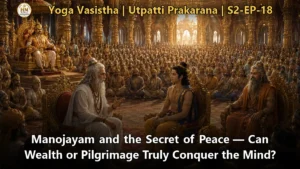
Addressing this very dilemma, Sage Vasistha instructs Sri Rama in the royal court. To understand what liberation truly is and how it is attained, the sage reveals that one must first understand and master the nature of the mind.
📚 Yoga Vasistha — full guide & all episodes
Wealth, Pilgrimages, and Fasts Cannot Bestow Liberation
The royal assembly sat in absolute silence. Sage Vasistha broke the stillness with an uncompromising declaration.
“My dear ones, liberation is never attained through wealth, nor through kinsmen and friends, nor through sacred pilgrimages or residence in holy places,” Sage Vasistha said.
Mere bodily mortifications, exhausting fasts, and ritualistic acts yield no lasting freedom. None of these external practices can permanently quiet the turbulent mind.
Sri Rama wondered in his heart how true liberation could ever be found. Sensing his disciple’s unspoken inquiry, Sage Vasistha addressed the gathering once more.
True liberation lies not in any outward ritual, but in an inner transformation. That transformation belongs entirely to the realm of the mind.
Vasistha: My dear ones, liberation is never attained through wealth, kinsmen, sacred pilgrimages, or exhausting bodily fasts.
Sravana — Attentive Listening to the Nature of the Self
Sage Vasistha outlined the three foundational disciplines essential for liberation. The first of these is Sravana.
“Sravana means listening with undivided attention to the sacred scriptures and the master concerning the true nature of the Self,” the sage said.
This is not a casual hearing to be dismissed after a single instance. To comprehend the Self, the mind must settle entirely upon the teaching.
Through Sravana, the intellect receives its primary compass. It learns what to seek and where the ultimate truth resides.
Yet hearing remains only the initial step. Following this, the seeker must assimilate the truth deeply into consciousness.
Vasistha: Sravana means listening with devout attention to the scriptures and the preceptor regarding the eternal nature and essence of one’s own Self.
Manana — Continuous Inner Reflection
The sage presented the second essential discipline — Manana.
“Manana is the continuous inquiry and contemplation within the heart upon the essence received through hearing,” Vasistha said.
The heard truth must be turned over repeatedly in the mind. Only through such sustained deliberation does it take firm root within.
Without deep reflection, hearing remains a momentary experience that fades away. Manana anchors wisdom firmly into everyday life.
Through this contemplation, the mind attains intimacy with truth, preparing itself for the final discipline.
Vasistha: Manana is the process of repeatedly inquiring into and stabilizing within the heart the essence received through hearing.
👉 Previous Episode: Who is the Jiva? The Secret of Consciousness Trapped in Illusion | Yoga Vasistha S3 EP-49
Nididhyasana — Undivided Contemplation
Sage Vasistha turned to the most critical discipline: Nididhyasana.
“Nididhyasana is the restraining of the mind from wandering in countless directions,” the sage said.
It is the direct experiential absorption in the attributes of the Self — its indivisibility, eternity, omnipresence, and immeasurability.
Through this practice, thoughts achieve profound constancy. That unbroken steadfastness is the true path to conquering the mind.
Combining these three practices — Sravana, Manana, and Nididhyasana — enables the seeker to conquer the mind completely.
Vasistha: Restraining the mind from drifting in diverse directions is Nididhyasana. It is the direct realization of the indivisible, eternal, and all-pervading Self.
The Mind Filled with Brahman Becomes Pure Sattva
When the mind is suffused with the bliss of Brahman and looks upon all existence with equanimity, its lower tendencies dissolve into pure Sattva.
“O Rama, established in this vision of equality, you too shine forth as Brahman itself,” Vasistha said.
This exalted state is the supreme goal of every living being. Consciously or unconsciously, all human struggles revolve around this very quest.
Yet, bound by the illusions of its own making, the conditioned soul remains oblivious to this innate divinity.
A profound stillness descended upon the assembly as the courtiers absorbed these words.
The Illusion of Chasing Material Objects
The sage addressed why humanity continuously forgets this eternal truth.
“Countless individuals live under the delusion that acquiring material possessions is the sole purpose of life,” Vasistha said.
Whether those possessions are gained or lost, a person never finds lasting fulfillment in them.
The very dissatisfaction born of worldly pursuits serves an awakening purpose: it stirs the yearning to know the Self.
Worldly frustration is a spiritual catalyst — an inner call urging the seeker to turn inward.
📖 Read More: How Does Brahman Appear as the Universe? The Secret of Kandaradevi’s Liberation | Yoga Vasistha S3 EP-45
Discrimination as the Path to the Supreme State
The sage illuminated how this deep-seated dissatisfaction must be resolved.
“The supreme state of Brahman, which removes all discontent, is attained solely through self-inquiry,” Vasistha said.
Such inquiry requires keen discernment that transcends the pull of the senses.
“It is universal wisdom to renounce the trivial for the sake of the supreme,” the sage remarked.
Those who long for tranquility willingly abandon worldly entanglements that breed sorrow, striving earnestly to transcend the phenomenal realm.
📖 Pashanatulyam: Can a Heart of Stone Truly Set King Vidooratha Free? | Yoga Vasistha S3 EP-22
Subtle Intellect and Freedom from Rebirth
Seated in a comfortable, steady posture, the wise examine all phenomena with a refined and subtle intellect.
Through such focused inquiry, they attain the sorrowless state of the Self and become free from the cycle of rebirth.
“O Raghava, many in this assembly and countless sages upon this earth have realized that supreme state,” Vasistha said.
That state is universally known as the pinnacle of all joy, imperishable and akin to nectar.
The enlightened masters of the past and present have unanimously declared this timeless truth.
Vasistha: O Raghava, countless sages on this earth have realized that supreme state. It is the pinnacle of all bliss, imperishable, and ambrosial.
Peace Alone Brings Mind Mastery, and Mind Mastery Brings Bliss
The sage acknowledged that sweet and tempting objects exist in this world.
Yet all material pleasures are transient and bound to perish. Where can water truly be found in a desert mirage?
Neither in heaven, nor on earth, nor in the netherworlds does any object possess the power to grant lasting happiness.
Therefore, conquering the mind through peace and contentment is the highest and noblest pursuit.
“From such mastery of mind alone arises unalloyed bliss; for this, discrimination must blossom,” Vasistha said.
Vasistha: Mastering the mind through peace and contentment is proper and supreme. From such mind mastery alone arises unalloyed bliss.
Self-Knowledge Belongs Equally to All
Sage Vasistha proclaimed the universal accessibility of Self-knowledge.
Whether gods, demons, or human beings, qualified seekers exist among all orders of creation.
Because the Self is the innate reality of everyone, it is erroneous to restrict this wisdom to particular lands, times, or lineages.
“Inquiry into truth is not the exclusive preserve of any select group,” Vasistha said.
All beings possess the inherent right to engage in contemplation and divine remembrance.
No Bodily Mortification Needed — Only Self-Inquiry
The sage clarified what is truly required to attain knowledge of the Self.
Realization requires only steady meditation upon the reality of the Self.
Severe bodily mortifications, exhausting pilgrimages, and harsh austerities are completely unnecessary for knowing the Self.
Those who attain liberation dwell in an inner state that is serene, pure, and free from delusion.
Devoid of worldly fear, such liberated beings live with absolute fearlessness.
The Meaning of Shamam — Inner Calmness
Having spoken of mind mastery, Sage Vasistha introduced the concept of Shamam (inner calmness).
Shamam is the tranquil state achieved by mastering the senses and quieting the agitations of the mind.
It is freedom from craving toward spontaneously occurring worldly objects, maintaining constant serenity.
One who possesses this profound inner calmness is truly called a ‘Shanta’ — the peaceful one.
Listening intently, Sri Rama reflected within himself on the contrast between worldly pursuit and inner peace.
Vasistha: Controlling the senses, freeing the mind from spontaneous cravings, and resting in deep tranquility is known as Shamam.
Shamam Is an Oasis in the Desert of Samsara
Sage Vasistha illustrated the supreme glory of Shamam with an analogy.
In this weary worldly journey driven by the restless search for pleasure, this serene state is like a cool oasis found in a barren desert.
Shamam is humanity’s truest kinsman, the root of courage and purity of heart, acting as life-giving medicine for the mind.
Those who cultivate Shamam experience a soothing bliss, as if bathed in refreshing dewdrops of joy.
Living with such equanimity is the essence of a truly tranquil life.
No Action Bears Fruit Without Shamam
To emphasize the indispensability of Shamam, Sage Vasistha cited an ancient teaching.
It was the instruction imparted by Sage Shukra to his son Shandilya.
Without Shamam, no spiritual endeavor can bear fruit — neither mantras, medicines, sacred baths, nor acts of charity.
Anger, hatred, fear, and delusion only strengthen within a mind lacking serenity.
Even if one enjoys boundless wealth and luxury, a mind devoid of peace remains perpetually tormented.
Vasistha: Without Shamam, no endeavor bears fruit — neither mantras, medicines, sacred pilgrimages, nor acts of charity.
No Joy Endures Without Peace — The Final Injunction
Concluding this discourse, Sage Vasistha imparted the core truth to Rama.
When fear subsides and conditions align, the mind rests securely in wisdom-filled peace.
That inner peace manifests as noble conduct, establishing itself as the seeker’s natural disposition.
“O Ramachandra, adorned with thoughtful peace! Adorn yourself with this jewel of Shamam,” Vasistha said.
He urged Rama to wear the sacred ornament of tranquility, bringing timeless honor to the solar dynasty of Ikshvaku.
Vasistha: O Ramachandra! Endowed with contemplative peace, adorn yourself with the sublime jewel of Shamam.
Three Disciplines for Manojayam (Mind Mastery)
| Discipline | Meaning |
|---|---|
| Sravana | Attentive listening to the teachings of scriptures and the preceptor regarding the true nature of the Self |
| Manana | Continuous inner inquiry and reflection within the heart to assimilate the heard truth |
| Nididhyasana | Undivided contemplation that restrains the mind from wandering and brings direct realization of the Self |
Spiritual Significance
External practices, however grand, can never conquer the mind; wealth, relatives, pilgrimages, and fasts offer only temporary solace rather than permanent peace. True mastery comes not from forceful suppression, but through the systematic inner disciplines of Sravana, Manana, and Nididhyasana. Attempting to bypass this sequence yields only fleeting results.
Sage Vasistha’s teaching on Shamam (inner calmness) directly reinforces this truth. By mastering the senses and freeing the mind from cravings, one establishes unshakable serenity. Without this foundational peace, no ritual or endeavor can bear enduring fruit.
Whenever you strive to achieve a worldly or spiritual goal today, pause for a moment and reflect: Is my mind truly calm? Remember that any endeavor undertaken without Shamam remains incomplete.
Chapter Summary
Sage Vasistha instructs Sri Rama that liberation cannot be bought with wealth, kinsmen, pilgrimages, or physical fasts. Instead, true Manojayam requires three disciplines: Sravana, Manana, and Nididhyasana, through which the mind becomes pure Sattva and merges with Brahman. Self-knowledge is the birthright of all beings. The sage then expounds on Shamam—inner calmness and mastery of the senses. Drawing upon Sage Shukra’s counsel to Shandilya, Vasistha emphasizes that no ritual or charity yields fruit without Shamam, blessing Rama to wear peace as his supreme ornament.
Scripture Notes
- Main Message: Manojayam, the true conquest of the mind, cannot be accomplished through external means; it is attained solely through the systematic internal disciplines of Sravana, Manana, and Nididhyasana.
- Philosophical Teaching: Self-knowledge is the universal birthright of all beings, requiring no physical mortification but pure self-inquiry founded upon Shamam (inner calmness).
- Connection to the Next Chapter: Sage Vasistha’s blessing urging Sri Rama to wear the ornament of Shamam sets the stage for a deeper exploration of inner calmness in the upcoming chapter.
Pleasure derived from wealth is like water in a desert mirage — visible to the eye, but unreachable to the grasp.
Shamam is an oasis in the barren desert of worldly existence, offering true rest to the weary mind.
Success devoid of peace is like a dry riverbed — it carries a name, but lacks the water of life.
Frequently Asked Questions
What is Manojayam?
Manojayam is the mastery and conquest of the mind, liberating it from cravings, fears, and discontent to achieve unshakeable peace. According to Sage Vasistha, this mastery is accomplished solely through three disciplines: Sravana, Manana, and Nididhyasana.
Can wealth and pilgrimages grant liberation?
No, Sage Vasistha explicitly teaches that wealth, kinsmen, sacred pilgrimages, and exhausting fasts cannot bestow liberation. External practices provide only temporary emotional relief and can never permanently quiet the mind.
What are Sravana, Manana, and Nididhyasana?
Sravana is listening attentively to scriptures and preceptors regarding the nature of the Self; Manana is sustained inner reflection on that truth; and Nididhyasana is deep, undistracted contemplation leading to direct realization.
What is Shamam in Yoga Vasistha?
Shamam is the state of inner calmness attained by controlling the senses and freeing the mind from spontaneous cravings. Sage Vasistha describes it as humanity’s truest friend and life-giving medicine for the restless mind.
Who is eligible to attain Self-knowledge?
Self-knowledge belongs equally to all beings, whether gods, humans, or others. Because the Self is everyone’s inherent reality, spiritual inquiry is not restricted by caste, region, or time.
Do spiritual actions bear fruit without Shamam?
No, spiritual actions do not bear fruit without Shamam. Citing Sage Shukra’s instruction to Shandilya, Vasistha asserts that mantras, medicines, sacred baths, and charities are ineffective if the mind remains agitated by anger and delusion.
Is severe bodily mortification necessary for Self-inquiry?
No, severe bodily mortification is completely unnecessary. Sage Vasistha clarifies that Self-realization requires only steady contemplation upon the Self, not painful physical austerities.
Conclusion
When the mind is truly conquered, that inner serenity becomes a person’s most precious ornament. How will Sri Rama integrate this blessing of Shamam into his life, and what profound wisdom will this path of peace unfold next? Stay tuned for the upcoming episode.
👉 Click this link to read the next episode: Why Does the Mind Fear Like a Ghost? The Power of Vicharana | Yoga Vasistha S2 EP-19