
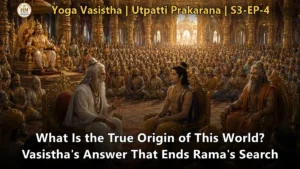
What is the real origin of this world we see around us? Sage Vasistha tells Rama that the world does not arise from any material cause the way a pot arises from clay — it rises the way a wave rises from the ocean, as a mere modification of consciousness itself, with no true separation between the two.
There are nights when a question keeps you awake — not a question about money, or health, or tomorrow’s work, but something quieter and larger: why does anything exist at all? Why is there a world, a body, a self, instead of nothing? Most of us push the thought away by morning. Rama could not.
Seated once again before the sages and the assembled court of Ayodhya, young Rama had already confessed his weariness with fleeting pleasures. Now a deeper unease rose in him. If everything perceived is impermanent, he asked, then where does this vast, solid-seeming universe actually come from? Sage Vasistha, unhurried as ever, turned to answer the question that sits beneath every other question a human being ever asks.
📚 Yoga Vasistha — full guide & all episodes
Rama Confesses a Deeper Restlessness
Rama sat with his hands folded, but his eyes carried the fatigue of a man who has been thinking too long without sleep.
He had grown suspicious of everything he had once accepted without question — the palace, the rituals, even the affection of his own family. None of it satisfied the ache inside him anymore.
He looked toward Vasistha, the sage who had guided his father Dasharatha’s line for generations, and spoke the question that had been circling in his mind for days.
Rama: Master, tell me plainly — where does this world of forms, this endless dance of birth and death, actually come from? Is it real, or is it merely a trick played upon the mind?
Vasistha: You ask the one question, Rama, that every seeker before you has asked, and every seeker after you will ask again. Listen carefully, for the answer is simpler than the question.
The Court Falls Silent
The assembly of sages, ministers, and princes, who moments earlier had been murmuring among themselves, grew completely still.
Even the young attendants standing near the pillars stopped fanning the hall, sensing that something important was about to be spoken.
Vishwamitra, seated beside Vasistha, gave a slow nod, as if he too had been waiting for exactly this question to surface from the prince’s troubled heart.
Vasistha Begins with a Gentle Correction for Rama
Vasistha did not rush toward metaphysics. He first addressed the fear hiding beneath Rama’s question.
He explained that the very framing of the question — ‘where does the world come from’ — assumes that the world is a separate thing that needed to be produced, the way a craftsman produces a pot from clay.
That assumption itself, he said gently, was the first knot that needed to be loosened before any real answer could be understood.
Vasistha: Rama, you ask for a cause, as though the world were an object standing outside consciousness, waiting to be explained. But nothing has ever stood outside consciousness. Not even for a moment.
The Image of the Wave and the Ocean Explained to Rama
To make this clear, Vasistha offered an image that Rama could hold in his mind long after the words had faded.
He said that when a wave rises on the surface of the ocean, no one asks what material was used to build it, because the wave was never separate from the water to begin with.
The wave is simply the ocean in a state of movement, and the moment it settles, it is the ocean again — nothing new was created, and nothing old was destroyed.
Vasistha: In the same way, this world is consciousness in a state of movement. It does not emerge from consciousness as a separate product; it is consciousness appearing as multiplicity, the way water appears as a wave.
Rama Asks About the Moment of Creation
Rama leaned forward, still unsatisfied, and pressed further. If this were true, he asked, then surely there must have been a first instant when the world began to move, a moment before which there was only stillness.
He wanted a timeline, a beginning he could place his mind around, the way one places a beginning on a story.
Vasistha’s expression remained calm, almost amused, as though he had anticipated this very turn in the conversation.
Rama: But Master, even a wave has a moment when it rises from the calm surface. Does creation not also have such a moment — a beginning in time?
Vasistha: You are still thinking in time, Rama, and time itself is one of the ripples we are trying to understand. There was no ‘before’ this world, because there was no time in which a ‘before’ could exist.
The Teaching on Time Itself for Rama
Vasistha then turned to explain to Rama that time is not a container in which the world happens, but rather a feature that appears along with the world itself.
He compared it to a dream: within a dream, years may seem to pass, kingdoms may rise and fall, yet the dreamer’s actual body has not aged even by a second on the waking bed.
Time inside the dream and time outside it are simply not related, because the dream generates its own sense of duration the instant it begins.
Vasistha: Ask instead: who is the dreamer of this waking world we call reality? Once you find that dreamer, the question of ‘when it began’ will dissolve on its own.
Vishwamitra Adds a Question of His Own
Sage Vishwamitra, who had remained quiet through the exchange, now spoke, partly to help Rama and partly, it seemed, to test the depth of Vasistha’s teaching for the benefit of the younger sages present.
He asked whether this meant the world was entirely false, a mere illusion with no reality at all, since it was being compared repeatedly to dreams and waves.
It was a fair question, and one that many listeners in the hall had been silently wondering as well.
Vishwamitra: Vasistha, if the world is like a wave or a dream, are you saying it does not exist at all? That seems to contradict what we see with our own eyes every day.
📖 Crystal, Dream, Gold — If This World Is False, Why Does It Feel So Real? | Yoga Vasistha S3 EP-23
Neither Fully Real Nor Fully False — Vasistha Clarifies for Rama
Vasistha welcomed the question with visible warmth, as though it were exactly the clarification the assembly needed before going further.
He explained to Rama and the gathering that the world is not unreal in the sense of a rock that does not exist at all, like the horns of a rabbit; it is experienced, it is functional, and within it, actions have consequences.
But it is also not real in the sense of being permanent and independent, the way people habitually assume when they call something ‘real.’ It occupies a middle position that ordinary language struggles to name.
Vasistha: The world is like a bracelet made of gold. The bracelet appears and can be used, worn, admired — yet what truly exists, unchanging beneath its shape, is only the gold. The form comes and goes; the substance remains.
Consciousness as the Unchanging Gold — The Lesson for Rama
Building on this image, Vasistha explained that consciousness itself is the gold, and every object, every person, every mountain and river and passing thought is a shape the gold has temporarily taken.
Nothing new is ever manufactured when a world appears, just as no new gold is created when a bracelet is shaped from it.
What changes is only the appearance, the name, the form — never the substance from which everything is made.
Vasistha: Rama, when you finally see that you yourself are the gold and not merely one bracelet among many, the question of the world’s origin will no longer trouble you, because you will see there was never anything outside you to originate.
Rama’s Silence and a Flicker of Understanding
For a long moment, Rama said nothing. The restlessness in his eyes had not vanished, but something in his posture had softened, as though a great weight had shifted rather than lifted entirely.
He looked at his own hands, at the pillars of the hall, at the faces of the assembled sages, seeing them for a strange instant as forms rather than fixed, separate things.
It was not yet full realization — Vasistha could see that clearly — but it was the first crack of light entering a room that had been sealed for a long time.
Rama: Master, if what you say is true, then I have spent my whole life mistaking waves for the ocean, and bracelets for gold.
Vasistha: That mistake, Rama, is the only mistake anyone has ever made. And correcting it is the entire purpose of this teaching we are walking through together.
Two Ways Rama Can Understand ‘Where the World Comes From’
| Ordinary Assumption | Vasistha’s Teaching |
|---|---|
| The world is a separate object created from some material cause. | The world is consciousness itself appearing in motion, like a wave in the ocean. |
| Time exists first, and creation happens within it. | Time appears together with the world, the way duration appears the instant a dream begins. |
| Something must be either completely real or completely unreal. | The world is like gold shaped into a bracelet — the form is temporary, the substance is eternal. |
| The self is one object among many objects in the world. | The self, as pure consciousness, is the very substance from which all objects are shaped. |
ఆధ్యాత్మిక అంతరార్థం
Vasistha’s teaching to Rama does not deny the reality of daily life; it relocates where that reality is anchored. The world we touch, see, and worry over is not condemned as false, but it is shown to be dependent — the way a wave depends entirely on water for its brief shape and motion.
The deeper invitation here is to stop searching for a beginning in time, because the very search assumes that consciousness is contained within time rather than time being contained within consciousness. Once that assumption is questioned, the anxious search for ‘why does anything exist’ softens into simple observation.
The image of gold and the bracelet carries the heart of the entire chapter: forms multiply endlessly, and each form seems urgent and separate while it lasts, yet nothing has ever been added to or removed from the one substance underlying them all.
The next time a worry about the future or a memory of the past pulls hard on your attention, pause and ask silently: what is the one awareness in which this worry or memory is appearing? Notice that the awareness itself never changes shape, even as thoughts rise and pass through it like waves.
Chapter Summary
Rama asks Vasistha where the world truly originates, troubled that everything he sees might be built on nothing solid. Vasistha replies that the world is not manufactured from any separate cause; it is consciousness itself appearing in motion, exactly as a wave is the ocean in motion. When Rama presses for a moment of creation in time, Vasistha shows that time itself arises together with the world, much like the years that pass within a single dream. Responding to Vishwamitra’s question, Vasistha clarifies that the world is neither wholly real nor wholly false, comparing it to a gold bracelet — the shape is temporary, the gold is eternal. Rama falls quiet, sensing for the first time that he has been mistaking passing forms for the unchanging substance behind them.
Scripture Notes
- Main Message: The world is not a separate creation arising from some external cause; it is consciousness itself appearing in the form of multiplicity, exactly as a wave is nothing but the ocean in movement.
- Philosophical Teaching: Time and world arise together, not one before the other, and no genuine understanding is possible while a seeker keeps demanding a ‘when’ for something that stands outside time altogether. Reality is best understood not as a binary of real versus false, but as substance versus form, gold versus bracelet.
- Connection to the Next Chapter: Having glimpsed that the world is consciousness in motion rather than a separate creation, Rama will next ask Vasistha how something as vast and varied as this universe could ever emerge from something as still and formless as pure consciousness — a question that carries the teaching one layer deeper.
A wave never asks what it was made from, because it was never separate from the ocean to begin with.
The mistake of seeing waves and forgetting the ocean is the only mistake anyone has ever truly made.
Time does not hold the world; the world, on appearing, brings its own time along with it.
Frequently Asked Questions
What does Yoga Vasistha say about the origin of the world?
Yoga Vasistha teaches that the world does not originate from a separate material cause the way a pot arises from clay. Instead, it is described as consciousness appearing in motion, comparable to a wave rising within the ocean — never truly separate from its source.
Did the world have a beginning in time according to Vasistha?
No single moment in time marks the world’s beginning, because Vasistha teaches that time itself appears together with the world, much like the sense of years passing inside a single night’s dream, unrelated to time on the outside.
Is the world real or an illusion in Yoga Vasistha’s teaching?
The world is presented as neither completely real nor completely false; Vasistha compares it to a gold bracelet, where the bracelet’s shape is temporary and changing, but the gold underlying it remains constant and unchanging.
What is the meaning of the wave and ocean example in this chapter?
The wave and ocean example shows that the visible world and the underlying consciousness are not two different things; the world is simply consciousness in a state of movement, just as a wave is simply the ocean in a state of movement.
Why does Rama question the origin of the world in this chapter?
Rama questions the world’s origin because he has already grown disillusioned with fleeting pleasures and now seeks to understand whether the entire visible universe rests on something solid or is built upon an illusion.
What is the significance of the gold and bracelet analogy in Vedanta?
The gold and bracelet analogy illustrates the relationship between substance and form: countless ornaments can be shaped and reshaped, but the gold itself never increases or decreases, showing how consciousness remains constant beneath ever-changing worldly forms.
Conclusion
A hush settled over the hall as Vasistha’s words faded, leaving behind not certainty but a gentler kind of wondering in every listener present. Rama’s search had not ended, yet the ground beneath his question had shifted, the way a wave finally understands it was always the ocean. If the world is truly consciousness in motion, one question remains, quietly waiting for the next gathering: how does something so still give rise to something so vast and varied?
👉 Click this link to read the next episode: Can the World Exist Without the Mind? The Secret Vasishtha Revealed That the Mind Itself Is an Illusion | Yoga Vasistha S3 EP-5
👉 Click this link to read the next episode: Can the World Exist Without the Mind? The Secret Vasishtha Revealed That the Mind Itself Is an Illusion | Yoga Vasistha S3 EP-5
👉 Previous Episode: Does Memory Alone Create the Body You Live In? | S3 EP-3 | Yoga Vasistha