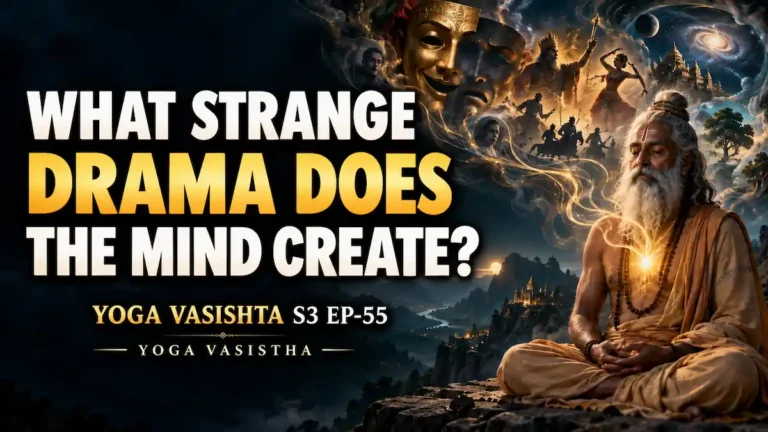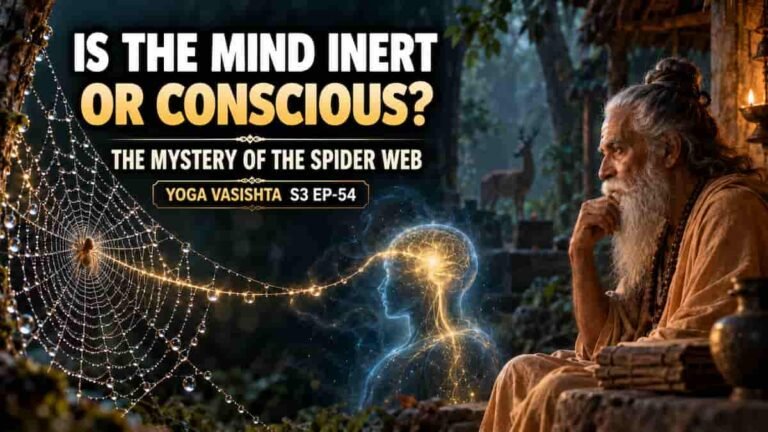

If you ask what the mind actually is, and where it comes from, the answer the Yoga Vasistha gives is startling. According to Sage Vasishtha, the mind is not separate from pure consciousness at all — it is simply a movement of will that makes both the real and the unreal shine forth. Just as the sky appears blue though it holds nothing at all, the mind too is a formless stir that creates the illusion of form.
At some point in life, almost everyone is struck by the same doubt that Rama brought before Sage Vasishtha — is the world I see, the joy and sorrow I feel, actually real, or is it all just a game my own mind is playing? The question sounds simple, but its depths run far deeper than they first appear.
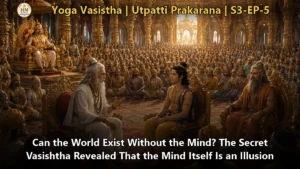
In that assembly hall in Ayodhya, the same doubt rose in Rama’s mind. Recalling the teaching Sage Vasishtha had given the day before, Rama wanted greater clarity on the true nature of the mind itself. Let’s see where that conversation led.
📚 Yoga Vasistha — full guide & all episodes
Rama Asks Sage Vasishtha — What Is the Shape of the Mind?
A hush settled over the hall. Rama turned to Sage Vasishtha and asked his question with quiet humility. He recalled that the teaching from the previous day had made one thing clear — that this entire world arises from the mind and shines forth through it alone.
Rama: O revered one! Sage Vasishtha, from what you taught me yesterday, it is now clear that this whole world arises from the mind and shines through it alone. But what is the shape of this mind? Where does it live, why does it exist, and what is it truly like? Please explain this to us.
Vasishtha Explains — The Mind Is Like the Sky — a Form Without Form
A deep calm settled in Sage Vasishtha’s eyes. He began his answer with a simple question of his own — what exactly do we call the sky? Is there any substance there besides emptiness itself? Is there some object made of that blue color? That was the question he put before the assembly.
Sage Vasishtha: What is it we call the sky? Is there anything there besides emptiness? Is there some substance made of that blue color? There is none! In the same way, the mind — empty like the sky — has no separate form of its own either.
A Real Experience Within an Illusion — Vasishtha’s Mirage Metaphor
The hall listened with rapt attention. Vasishtha explained that just as the sky appears everywhere without being found inside or outside anything, the mind too pervades everything in its own nature in the very same way. To make this vivid, the sage offered a beautiful image — just as water appears to shimmer in a mirage, the experience of this world arises out of the mind itself.
Sage Vasishtha: It is true that the experience of this world comes from the mind, the way water seems to appear in a mirage. Just as a man watches a scene born purely of his own imagination, this shaping of the mind into form is, in exactly the same way, entirely an illusion.
👉 Previous Episode: What Is the True Origin of This World? Vasistha’s Answer That Ends Rama’s Search | S3 EP-4 | Yoga Vasistha
How Vasishtha Defines the Empty Mind
Vasishtha himself posed the question — how, then, can this empty mind be defined? — and offered his own answer for it. The hall waited eagerly for that definition.
Sage Vasishtha: Tell me, how is one to define this empty mind? So that you may understand, let me give you a definition — listen. What we call the mind can be described as that which makes both the real and the unreal — the existent and the non-existent — shine forth.
From Pure Consciousness to Mind — Vasishtha on the Clay and the Lump
Vasishtha made it clear that the mind has no shape beyond this. He explained that when the formless pure consciousness — chit — settles into a half-formed shape, that very settling is what we call the mind. In other words, he stressed, the mind is nothing other than pure consciousness itself.
To illustrate this, the sage offered the image of clay and a lump of clay. Just as clay itself is formless, a lump of clay takes on shape yet is never separate from the clay it is made of. In the very same way, he said, the mind should be understood as a shaped expression that never separates from pure consciousness.
Vasishtha on the Willer and the Will
Vasishtha began to go deeper still, explaining that will itself is the form the mind takes. He put a question to the assembly — before there can be an act of will, must there not already be one who wills?
Sage Vasishtha: Will itself is the form of the mind. But before there can be an act of will, is there not already one who wills? That which is pure and prior to everything is called chit — pure consciousness. And the very moment that chit begins to will, it is called the mind.
Sage Vasishtha: Is fluidity ever separate from water? Can the motion of air ever be called something other than the air itself? Wherever there is will, there the mind is. No one has ever experienced these two apart, anywhere, at any time.
How Brahma Came to Be — Vasishtha on the Light of Awareness
A quiet fascination settled over the hall. Vasishtha said that the mind is that which lights up every object and every phenomenon as an experience, in the form of pure awareness. Whether what is being lit up in this way is true or false, he added, is an entirely separate question.
Vasishtha explained that whatever the mind wills, in whatever manner, it receives that very thing back as its own experience. That pure consciousness, once bound up with this quality of mind, he said, is none other than Brahma, the grandfather-creator. And it is this very Brahma, the sage explained, who brings forth the material intellect — the faculty that perceives and grasps the world of objects.
Sage Vasishtha: Rama, my child! The wise rise above the flood of craving that runs through the mind. The mastermind behind this entire construction of the visible world is that very will — this act of casting one’s gaze outward — and it alone is the cause behind the world coming into apparent being.
Mind as the Architect of Action — Vasishtha on Seeing and Creating
The whole assembly hung on Vasishtha’s every word. He said that from this very act of seeing arises the entire vast illusion that takes the shape of the world. In every single creation, in every corner of it, countless causes come together to give rise to names and forms.
In stone, in mountain, in witness, in every living being, this subtle glow of action-bound tendency has one root cause alone — the mind, Vasishtha made clear. And to work out these deep-seated impulses, he said, the deluded keep spinning themselves through birth, death, old age, and endless wandering from place to place.
Vasishtha on Samsara — the Way Out of the ‘Triad’
A stir passed through the hall. Vasishtha warned that from such action springs the deepest harm, and that this ‘triad’ — the seen, the seer, and the act of seeing — must never be allowed to take root within. If this seen world enters the heart in the form of attachment and aversion, he said, it will keep this soul spinning through the three worlds without end.
Sage Vasishtha: O Rama! Listen to these words of mine, spoken from experience and with full conviction. The five elements beginning with space that appear outside, and the very notion of ‘I’ that arises within — both appear as separate only to the eye of ignorance, and only within the realm of everyday dealings.
Sage Vasishtha: In truth, seen from the highest reality, all of this is nothing but the imperishable Brahman, untouched by birth or death. There is not, and never has been, for even a single moment, any separate thing called ‘the world’ apart from Brahman.
Rama’s Doubt — the Son of a Barren Woman
Rama responded to these words at once. He said it was easy enough to hear that ‘this world does not exist,’ but it simply did not seem to match his own lived experience — and he voiced his doubt without hesitation.
Rama: My lord! It sounds fine to hear you say ‘this world does not exist.’ But our experience does not agree with it. Saying the son of a barren woman is splitting open a mountain, admiring how beautiful a rabbit’s two horns look, watching a boulder dance with outstretched arms — you can say all these things, but wouldn’t your statement that ‘this world does not exist’ be exactly the same kind of thing?
A World Like a Dream — Vasishtha’s Answer
Vasishtha replied without any agitation, his tone calm and steady. He told Rama that his words were not without sense, and asked him to listen closely. He said that this truly was, in one sense, like the case of the barren woman’s son — a pure illusion — and then asked: even in a dream, don’t we see houses and people? Are those things actually real?
Sage Vasishtha: O Raghava! My words are not without sense. Listen carefully to what I say. This truly is, like the barren woman’s son, nothing but an illusion. You say, ‘But I can see it, can’t I?’ — well, even in a dream, don’t you see houses and people? Do any of those things actually exist?
Sage Vasishtha: Although the mind itself is unreal, through the force of its own desire it conjures up a real-seeming body for itself, and upon that foundation spreads out this entire world like a magic show. It is the mind alone, restless by nature, that gives rise to itself and that deceives itself as well.
👉 Click this link to read the next episode: Can a Heart of Stone Free You From Bondage? Vasishtha’s Teaching on Self-Realization | Yoga Vasistha S3 EP-6
Vasishtha on the True Nature of Brahman
A stillness settled over the hall. Once Vasishtha declared that the mind, too, is unreal, Rama asked again — where, then, does this illusion-creating mind actually arise from? Vasishtha began his answer by describing what remains when the great dissolution comes.
Rama’s question turned to the great dissolution itself, and what remains once every last thing has passed away.
Sage Vasishtha: O Rama! When this entire visible creation, with all its names and forms, dissolves at the time of the great dissolution — what remains then? Only that which is peaceful, undivided, untouched, and without a second — pure existence itself. That state, which is nothing but experience alone, has no name of its own, yet the scriptures have given it the name Brahman.
Sage Vasishtha: Atman, Brahman, Paramatma, Shiva — all of these are simply names given to it so that it might be taught to others. None of these names belongs to its true nature. I say to everyone here — there is no need at all to see difference where there is only the naming and shaping of forms.
Vasishtha on the Supreme Reality — Beyond Seer and Seen
The gathering was drawing toward its close. Vasishtha said that this supreme reality creates these vast universes on the one hand, and yet on the other remains utterly silent, inactive, detached, and at peace, as though it had done nothing at all. The true nature of every living being, he said, is nothing other than this — a nature beyond all coming and going, all states and conditions.
Sage Vasishtha: O Rama! It is here, it is there — there is no other thing at all. This alone is worthy of worship, worthy of reverence, by all beings in every way. In those who grasp this truth, every trace of smallness is destroyed.
The Nature of the Mind — a Summary of Vasishtha’s Metaphors
| Metaphor | Truth It Points To |
|---|---|
| The sky appearing blue | The mind has no real form of its own — it is only an illusion |
| Water shimmering in a mirage | The world-experience born of the mind is not real, only a construction |
| Clay and a lump of clay | The mind is never separate from pure consciousness (chit) |
| Water and fluidity, air and its motion | Will and the willer are never truly separate from each other |
| The son of a barren woman, a rabbit’s horns | Just as these impossibilities are illusions, so too is the world’s apparent existence |
| Houses and people seen in a dream | Even things that don’t truly exist can appear entirely real in experience |
Spiritual Meaning of Vasishtha’s Teaching
This dialogue with Sage Vasishtha teaches that the mind is not some independent entity of its own — it is a half-formed shape taken on by pure consciousness. The mind exists only in the form of will; there is no such thing as a mind without will, just as fluidity is never apart from water — a truth as simple and self-evident as that.
Every metaphor Vasishtha offers points to the very same truth from a different angle — that neither the mind nor the world it conjures possesses any true, independent existence, even though both feel entirely real in the moment of experience. Just as the houses and people we see in a dream feel completely real while we dream, only to be revealed as illusion the moment we wake, this waking world too is understood to be illusion the instant true self-knowledge dawns.
If we remember Sage Vasishtha’s insight that the world we see every day is an experience conjured by the mind, we can begin to watch the very nature of the mind itself whenever anger, fear, or sorrow arises. Try spending a few minutes each day simply witnessing your thoughts, without reacting to them, as a mere observer.
Chapter Summary — Vasishtha’s Core Teaching
When Rama asked about the shape of the mind, Sage Vasishtha explained that the mind has no independent form of its own, like the sky — it arises only when pure consciousness takes on a half-formed shape through the act of will. Using images such as the mirage, clay and the lump of clay, and water and fluidity, he showed that the mind is never separate from pure consciousness. When Rama voiced his doubt using the image of the barren woman’s son, Vasishtha answered with the example of things seen in a dream, making clear that the world is nothing but a construction of the mind. He closed by describing the true, singular, undivided nature of Brahman itself.
Scripture Notes on Vasishtha’s Wisdom
- Main Message: As Sage Vasishtha reveals, the mind is not some independent entity separate from pure consciousness — it is merely an illusory shape that forms through the act of will. It is from this very mind that the experience of the world is conjured, the way a dream is conjured.
- Philosophical Teaching: The mind, which makes both the real and the unreal shine forth, is never separate from chit — pure consciousness. Just as a lump of clay is merely a shaped form of clay itself, the mind is merely the shaped form of consciousness. Those who grasp this truth are the ones who come to see the illusory nature of the world.
- Connection to the Next Chapter: From this truth that the mind itself is illusion, Vasishtha carries Rama forward into an even deeper teaching — the question of exactly how this illusory mind comes into being in the first place.
📖 What Is the Nature of the World? Is Reality an Illusion? | Yoga Vasistha S3 EP-34
Will itself is the form of the mind — there is nowhere a mind without will.
If you ask yourself whether the houses you see in a dream are real, you must ask the very same question about this waking world.
There is not, and never has been, for even a moment, any separate thing called the world, apart from Brahman.
Frequently Asked Questions
According to the Yoga Vasistha, what exactly is the mind?
According to the Yoga Vasistha, the mind is the state that arises when pure consciousness (chit) settles into a half-formed shape through the act of will. It has no independent form of its own — much like the sky appears blue though it is empty, the mind too is an illusory form.
Are the mind and pure consciousness (chit) different from each other?
No, according to Vasishtha, the mind is never separate from chit, pure consciousness. Just as a lump of clay takes on a shape yet is never different from the clay itself, the mind too is never separate from the consciousness it arises from.
What did Vasishtha teach through the mirage metaphor?
Just as water appears to shimmer in a mirage though there is no water there at all, Vasishtha explained that the experience of the world arising from the mind feels entirely real in the moment, even though it has no true, independent existence.
What did Rama question using the image of the barren woman’s son?
Rama said that while it sounded fine to hear that the mind and the world are illusion, it did not match his own lived experience. He voiced his doubt by comparing it to impossible things, like the son of a barren woman, to challenge Vasishtha’s claim.
How did Vasishtha prove that the world is an illusion?
Vasishtha pointed out that the houses and people we see in a dream feel completely real while we are dreaming, only to be revealed as nonexistent the moment we wake up. In the very same way, he explained, this waking world too is a magic show conjured by the mind.
How did Vasishtha define Brahman?
Brahman is the name the scriptures have given to the peaceful, undivided, untouched, existent reality that remains when all names and forms dissolve at the time of the great dissolution. Atman, Paramatma, and Shiva, Vasishtha said, are simply other names for this very same reality.
Why is the mind said to be an illusion?
The mind is called an illusion because it has no independent, lasting existence of its own. It is merely a temporary stirring of will that arises upon pure consciousness — not a true, self-standing entity.
Conclusion
Vasishtha’s declaration that this supreme reality alone is worthy of worship and reverence by all beings, in every way, moved every heart in the assembly that day. With that solemn proclamation — that in those who grasp this truth, every trace of smallness is destroyed — the day’s teaching came to a close. Even knowing now that the mind is illusion, one deeper question remains: how does it actually come into being, and why does it make this world feel so overwhelmingly real? What will Vasishtha say next?
👉 Click this link to read the next episode: Can a Heart of Stone Free You From Bondage? Vasishtha’s Teaching on Self-Realization | Yoga Vasistha S3 EP-6