
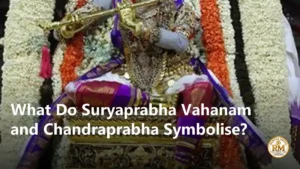
Suryaprabha Vahanam stands as the supreme symbol of dawn’s cosmic radiance and primal vital energy during the sacred Tirumala Brahmotsavams. In the sacred Vaikhanasa Agama tradition, blessing devotees with divine wisdom under the solar brilliance in the morning and offering tranquil peace of mind through Chandraprabha Vahanam at night represents the ultimate spiritual synthesis of action and surrender. During the 2026 Navaratri Brahmotsavams on October 18, the glorious procession of Suryaprabha takes place from 08:00 to 10:00 IST, followed by Chandraprabha from 19:00 to 21:00 IST across the four sacred Mada streets.
In the unrelenting rush and exhausting turbulence of everyday modern existence, every human heart quietly yearns for an inner dawn that dissolves confusion and awakens unshakeable clarity. The exhilarating dynamism that greets us at sunrise and the soothing serenity that descends under the gentle moonlight are universal experiences, offering a natural rhythm and profound emotional equilibrium to the seeking human mind.
During the auspicious Tirumala Navaratri Brahmotsavams on October 18, the majestic morning procession of Suryaprabha Vahanam and the nocturnal grace of Chandraprabha Vahanam physically manifest this sublime synthesis of blazing brilliance and cooling tranquility before millions of devotees. Traversing the four sacred Mada streets encircling the hill shrine, Lord Sri Malayappa Swami appears at dawn as the radiant Suryanarayana, the giver of cosmic life, and returns at dusk as the embodiment of serene peace, captivating the hearts of spiritual seekers.
Read the complete Telugu edition of this article.
For the wider festival background, read our Tirumala Salakatla and Navaratri Brahmotsavams main guide.
Why Suryaprabha and Chandraprabha Unfold on the Same Day on October 18
In the grand sequence of the Tirumala Sri Venkateswara Navaratri Brahmotsavams, conducting the Suryaprabha Vahana Seva in the morning and the Chandraprabha Vahana Seva at night on the seventh day is an extraordinarily ancient tradition rooted in the sacred Vaikhanasa Agama. Recognizing day and night—the twin foundational pillars of cosmic creation—as the direct manifestations of the Supreme Divine, this sacred ceremonial offering is fundamentally designed to bestow comprehensive spiritual balance upon every visiting devotee.
According to the authoritative official release of the Tirumala Tirupati Devasthanams (TTD) for 2026, Lord Sri Malayappa Swami will majestically process around the four sacred temple Mada streets on the resplendent Suryaprabha Vahanam on October 18 from 08:00 to 10:00 IST in the morning. Later that very evening, between 19:00 and 21:00 IST, the Lord will mount the exquisite Chandraprabha Vahanam to grant a mesmerizing and deeply tranquil darshan to the vast ocean of gathering devotees.
The primary metaphysical significance of these twin vahana sevas lies in proclaiming that the Supreme Lord is the ultimate source and central pivot of both solar and lunar realms, governing all cosmic consciousness. While the Sun God is extolled across the Puranas as the eternal reservoir of vital life force, dynamic knowledge, and physical vitality sustaining all living beings, the Moon God is venerated as the embodiment of cooling nectar, mental serenity, and inner purity.
Witnessing Lord Srinivasa within the span of a single day on divine carriers that mirror the invigorating rays of the morning sun and the soothing glow of the nocturnal moon instills a profound synthesis of Karma Yoga and Bhakti Yoga in the seeker’s consciousness. This festival sequence serves as an unmistakable reminder to discharge one’s daily duties with dynamic enthusiasm at dawn, and to surrender the weary mind in tranquil devotion at the feet of the Divine at dusk.
Even though these Ashwayuja Navaratri Brahmotsavams do not feature the traditional Dhwajarohanam flag hoisting ceremony or the wooden great chariot (Rathotsavam), the twin vahana processions on the seventh day offer an unparalleled spiritual experience. Accompanied by the thunderous chants of Govinda Nama echoing across the hill ranges, this divine procession is traditionally believed to dispel the darkness of ignorance from the human heart while instilling deep devotion and unshakeable peace.
Radiance and Traditional Symbolism in Suryaprabha Vahanam
According to the sacred Vedic verses of the Purusha Sukta, the Sun God emerged directly from the divine eyes of Sriman Narayana, the supreme ruler and protector of all universal creation. Vedic scholars explain that when Lord Sri Malayappa Swami mounts the Suryaprabha Vahanam on the seventh morning of the Brahmotsavams, appearing as Lord Suryanarayana Himself, an immense treasure of spiritual wisdom and dispassion is bestowed upon the devotees gazing upon the procession.
The Sun is worshipped as the direct physical eye of the cosmos (Pratyaksha Daivam), the eternal radiant deity who continually sustains the life force, vigor, and righteous action of all living entities. Mounted behind the deity, the magnificent golden circular solar halo (Prabhamandalam) gleams across the Mada streets, serving as a direct physical emblem of all-pervading solar energy and the sacred Brahma-Tejas that annihilates the inner gloom of ignorance.
RECOMMENDED PRODUCT
Apka Mart Sun God 56cm Metallic Wall Hanging Review : How can this product help you?
This review examines the Apka Mart using verified buyer feedback and the manufacturer’s listed specifications. Finding an authentic, substantial piece of traditional metal… The Apka Mart Sun God wall hanging addresses this requirement directly through its generous 56 cm circular format, lightweight aluminium composition, and distinctive copper… The Apka Mart Sun God wall hanging is a 56 cm handcrafted aluminium decor piece designed for living room entrances and traditional Vastu placement. It offers a substantial 2…
Read more about this productBuy on Amazon
As an Amazon Associate, RamthaMedia earns from qualifying purchases.
In scriptural descriptions, the majestic chariot of the Sun God is pulled by seven divine horses, which are traditionally revered as the personifications of the seven primary Vedic poetic meters: Gayatri, Brihati, Ushnik, Jagati, Trishtubh, Anushtubh, and Pankti. Charioteered by Anuru, the revered brother of Garuda, this radiant solar car represents the vast continuum of Vedic wisdom and the unbroken flow of cosmic time moving steadfastly along the path of truth and righteousness.
Traditional belief holds that witnessing this sublime morning service awakens inner intellectual brilliance and strengthens the spiritual resolve to pursue righteous living. Spiritual preceptors explain that just as the external physical world depends entirely on solar light for sustenance and activity, human inner consciousness relies fundamentally on the illuminating grace of the Supreme Divine.
As the procession moves forward amidst the majestic resonance of temple musical instruments, devotional bhajans, and the offering of camphor aartis, devotees experience an extraordinary surge of divine ecstasy. Believing that beholding the Lord of Venkatadri as the life-giving Suryanarayana provides boundless inspiration for their inner spiritual journey, tens of thousands gather with deep reverence to participate in this sacred morning spectacle.
The Spirit of Peace and Cooling Tranquility in Chandraprabha Vahanam
The sacred mantras of the Purusha Sukta declare with absolute clarity that the Moon God manifested directly from the cosmic mind (Manas) of Lord Sri Maha Vishnu, the supreme architect of the universe. In the Tirumala Brahmotsavams, when Lord Sri Malayappa Swami ascends the Chandraprabha Vahanam on the seventh night, processing through the sacred streets, it stands as an exquisite testament to inner purity, absolute tranquility, and the blossoming of heartfelt devotion.
In ancient Sanatana tradition, the Moon is revered as the divine lord of all medicinal herbs and vegetation (Oshadhipati), the gentle celestial presence who nourishes all plant life with sustaining moisture and cooling nectar. Devotees believe that when they behold the Lord gracing the Chandraprabha under the night sky, worldly anxieties, mental fatigue, and turbulent desires dissolve, allowing a soothing ambrosial coolness and spiritual joy to permeate their consciousness.
According to temple traditions, the darshan of Chandraprabha Vahanam possesses the divine efficacy to pacify the three fundamental categories of worldly suffering known as Tapatrayas: Adhyatmika (bodily and mental afflictions), Adhibhautika (sufferings caused by external beings), and Adhidaivika (distresses brought about by unseen cosmic forces). Scholars poetically compare this to the ocean tides swelling under the rays of the full moon, describing how waves of pure devotional bliss surge within the devotee’s heart upon seeing the Lord.
While the crescent moon is renowned as the crest-jewel adorning the matted locks of Lord Parameshwara, here in this supreme Vaishnavite holy shrine, the Moon God becomes the direct divine carrier serving Lord Sri Hari, exemplifying the highest pinnacle of servitude and loving devotion (Dasya Bhakti). This vahana seva visually demonstrates the core Vaishnava doctrine that all celestial beings, planetary deities, and cosmic forces find their ultimate fulfillment by surrendering at the lotus feet of Lord Srinivasa.
During this nocturnal procession taking place on October 18, 2026, between 19:00 and 21:00 IST, the darshan of the Lord amidst the cool breezes of the Tirumala hills enraptures the assembled gathering. Like the moonlight that effortlessly melts away the exhaustion of a grueling day, Lord Malayappa Swami shines atop Chandraprabha as the supreme guardian who relieves the pressures of worldly existence and grants profound peace to every seeking soul.
Why Symbolic Radiance Must Not Be Viewed as a Guarantee of Physical Cure
In temple announcements and devotional Puranic literature, witnessing the Suryaprabha Vahana Seva with sincere devotion is traditionally praised as an auspicious act conferring longevity, good health, and freedom from afflictions. However, spiritual seekers must clearly understand that this philosophical concept represents a devotional benediction and an inner spiritual aspiration (Phalasruti), rather than a literal physical guarantee or a substitute for scientific medical treatment.
📖 What Does Kalpavriksha Vahanam Teach About Our Wishes?
In ancient Indian culture, revering the Sun God as the provider of health and vitality has long been an integral spiritual and daily practice. While our ancestors intuitively connected the natural physical invigoration provided by morning sunlight with the worship of the Divine, they never formulated this religious veneration as a medical decree replacing rational therapeutic remedies for complex physical illnesses.
The traditional fruits of worship recited during temple festivities are intended to cultivate a disciplined lifestyle, righteous conduct, and steady contemplative awareness among the faithful. When the physical body experiences illness, seeking qualified medical consultation and taking prescribed medications remains an indispensable duty, while taking refuge in divine devotion provides mental fortitude, hope, and emotional resilience.
Confusing religious faith with clinical science by anticipating supernatural medical cures is neither spiritually healthy nor intellectually sound for a mature practitioner. Spiritual scholars emphasize that one must revere the Suryaprabha Vahanam as a sacred symbol designed to awaken the intellect and refine consciousness, rather than approaching it with superstitious expectations of irrational physical miracles.
Devotion is an elevated spiritual path that nurtures complete surrender before the Supreme and bestows the mental resilience needed to face life’s inevitable challenges with grace. Therefore, approaching the Suryaprabha Vahana Seva on October 18 purely as an inspiring spiritual opportunity to contemplate divine cosmic radiance, while beholding the Lord with sincere devotion, represents the truest traditional wisdom.
Past Examples of Exquisite Alankarams on Suryaprabha Vahanam
In the rich history of Tirumala Brahmotsavams, decorating Lord Sri Malayappa Swami in extraordinary mythological forms (Alankarams) while mounted atop the Suryaprabha Vahanam is an established tradition documented across past temple records. These sacred embellishments visually bring to life the Lord’s infinite divine plays and avataric glories, imparting an enchanting spiritual experience to the crowds along the Mada streets.
According to official temple archives, during the annual Brahmotsavams conducted on October 10, 2024, Lord Malayappa Swami graced the Suryaprabha Vahanam in the magnificent attire of Lord Badrinarayana, as recorded in official TTD press releases. Scholars noted that this specific alankaram vividly invoked the ascetic austerity of the sacred Himalayan shrine of Badrinath, portraying the radiant light of wisdom shining steadfastly amidst cold mountains.
Similarly, on the seventh day of the Salakatla Brahmotsavams on September 30, 2025, the Lord was once again adorned in the divine form of Badrinarayana atop the Suryaprabha Vahanam, receiving heartfelt worship from pilgrims. More recently, during the Salakatla Brahmotsavams that included this seva on September 21, 2026, Lord Malayappa Swami traversed the four Mada streets on Suryaprabha in a supremely radiant, resplendent posture.
Past alankarams should be read as historical examples. The latest timetable examined for this guide does not specify the decoration for 18 October. An old photograph therefore cannot confirm the forthcoming form. When a new announcement appears, check its date and whether it actually concerns this Navaratri service.
These historical insights are intended solely for traditional study and for appreciating the cultural magnificence of the festival. Rather than presuming that a past decoration will mechanically recur, pilgrims are encouraged to cherish whatever divine form is revealed on that auspicious day, seeking the grace of Lord Venkateswara with an open and devoted heart.
Past Night Manifestations of Krishna Forms on Chandraprabha
During the nocturnal Chandraprabha Vahana Seva, presenting Lord Sri Malayappa Swami in enchanting alankarams depicting the childhood sports and divine pastimes of Lord Sri Krishna has been a beloved custom across past Tirumala Brahmotsavams. Temple traditions highlight that the charming form of Lord Krishna playing His divine flute under the silvery beams of moonlight naturally enchants the hearts of onlookers, immersing them in deep devotional ecstasy.
Examining historical records, on the night of the seventh day during the Brahmotsavams on September 30, 2025, the Lord captivated devotees atop the Chandraprabha Vahanam dressed in the delightful form of Navaneetha Krishna. Holding a lump of butter in His divine hand with a gentle smile playing upon His lips, this child-like manifestation evoked profound maternal affection (Vatsalya Bhakti) and spiritual joy, as documented by TTD releases.
RECOMMENDED BOOK

The Maya Simulation: Quantum Physics and the Science of Consciousness by A. Ravinder
Is the world around us real? Or is it just a Maya Simulation?
A guide that bridges the ancient wisdom of the Yoga Vasistha with quantum physics and modern consciousness science — for readers ready to question the nature of reality and calm the mind with practical tools like the Zero Voice Technique. It explores mind, maya and consciousness in plain language, and offers a practical path for the seeker on the spiritual journey. Available in print and ebook instant-read versions.
Buy on AmazonBuy on Ramthamedia
As an Amazon Associate, RamthaMedia earns from qualifying purchases.
Furthermore, during the nocturnal seva on September 21, 2026, even as heavy rains swept across the sacred hill shrine, Lord Malayappa Swami appeared on Chandraprabha in the graceful alankaram of Murali Krishna beneath a specialized movable protective canopy known as the Ghataatopam. Undeterred by the torrential downpour, thousands of devoted pilgrims stood steadfastly along the Mada streets, rejoicing in the sight of the flute-bearing Lord.
Scholars explain that because Lord Sri Krishna took birth in the lunar dynasty (Chandravamsha), a profound mythological affinity exists between the Chandraprabha Vahanam and Krishna alankarams. Beholding the Lord adorned with a flute amidst serene lunar illumination is traditionally regarded as a sublime darshan that dispels all worldly sorrow and suffuses the inner being with nectarine peace.
The announced start time for Chandraprabha on 18 October is 7 PM. There is no need to speculate here about the internal process for choosing its decoration. The announcement examined does not supply that detail, so the earlier Krishna forms are presented only as examples. Keeping photographs labelled with their dates helps readers appreciate the variety across celebrations.
Differences Between Ratha Saptami Seven Vahanas and These Twin Processions
There are fundamental structural and ceremonial distinctions between the celebrated festival of Ratha Saptami, observed annually at Tirumala on Magha Suddha Saptami, and the twin Suryaprabha and Chandraprabha vahana sevas held on the seventh day of the annual or Navaratri Brahmotsavams. Understanding the distinct nature and logistical flow of these two grand occasions is crucial for visiting pilgrims and scholars alike.
Historical epigraphical records confirm that Ratha Saptami has been observed with immense splendor at Tirumala since at least 1564 CE. Often referred to as ‘Ardha Brahmotsavam’ or the one-day mini-Brahmotsavam, this unique festival witnesses seven major vahana processions occurring consecutively from dawn to night on a single day: Suryaprabha, Chinna Sesha, Garuda, Hanumantha, Kalpavriksha, Sarvabhupala, and finally Chandraprabha. The midday Chakrasnanam is a separate ritual in addition to the seven vahanams.
On Ratha Saptami, commemorating Surya Jayanti, the Suryaprabha procession commences exceptionally early at 05:30 IST in the morning, creating an awe-inspiring moment when the first rays of the rising sun touch the divine lotus feet of the deity. Following this, after the sacred Chakrasnanam dip in the Swami Pushkarini at noon, the remaining vahanas proceed throughout the day, culminating peacefully with Chandraprabha late at night.
In stark contrast, on the seventh day of the Navaratri Brahmotsavams on October 18, 2026, only two vahana processions take place: Suryaprabha in the morning from 08:00 to 10:00 IST, and Chandraprabha at night from 19:00 to 21:00 IST. The other vehicles mentioned in Ratha Saptami are distributed methodically across the full nine-day festival calendar according to prescribed Agama schedules.
While Ratha Saptami is an intensive single-day spiritual marathon immersing devotees in non-stop procession from sunrise to moonrise, the seventh day of the Navaratri Brahmotsavams provides a spacious and relaxed devotional rhythm. This allows pilgrims to absorb the spiritual energies of day and night separately and tranquilly, reflecting deeply on their respective spiritual lessons.
A Comparative Guide to Contemplating Morning and Night Manifestations
Devotees attending the Suryaprabha and Chandraprabha Vahana Sevas on October 18 can attain refined spiritual clarity by consciously contrasting their external ceremonial aesthetics and internal philosophical teachings. Preceptors explain that the blazing radiance revealed in the morning and the soothing coolness manifested at night represent two complementary attributes that together unveil the complete cosmic personality of the Supreme Being.
During the morning service, viewers can observe the relationship between the Surya Prabha form and the deity’s appearance. Connecting radiance with knowledge and alertness is a devotional interpretation. The colours of flowers or garments cannot be specified in advance from the timetable. Notice the details actually presented and treat the feelings they evoke as personal reflection.
The same approach applies to the night’s Chandraprabha procession. Its traditional associations with calm and coolness can guide contemplation. Do not assume that white flowers or particular ornaments must appear. Distinguishing the visible differences from the morning form from one’s own spiritual interpretation makes the comparison clearer.
Pilgrims waiting in the galleries lining the Mada streets absorb the vibrant vitality of life while witnessing Lord Malayappa Swami in the golden morning sunlight. Later in the evening, amid artistic illumination and the crisp breezes of the sacred Seven Hills, watching the Lord atop Chandraprabha grants a serene inward stillness, allowing the mind to rest in profound spiritual quietude.
Contemplating these two divine manifestations side by side reinforces the supreme importance of balance in human life. Ancient tradition teaches that just as righteous, energetic action is essential in the external world, pure and tranquil devotion is indispensable within one’s internal consciousness—a timeless principle eloquently taught by these morning and nocturnal processions.
Comparative Analysis of Suryaprabha and Chandraprabha Vahana Sevas
| Festival Dimension | Suryaprabha Vahanam (Morning) | Chandraprabha Vahanam (Night) |
|---|---|---|
| October 18 Schedule | Morning 08:00 – 10:00 IST | Night 19:00 – 21:00 IST |
| Primary Symbolism | Solar radiance, vital energy, Karma dynamism | Lunar tranquility, mental peace, spiritual surrender |
| Vedic Origin | Purusha Sukta (Sun born from the eyes) | Purusha Sukta (Moon born from the mind) |
| Past Example Alankarams | Badrinarayana form (2024, 2025) | Murali Krishna (2026), Navaneetha Krishna (2025) |
| Philosophical Meaning | Dispelling ignorance, external dynamism | Relieving afflictions, internal serenity |
📖 What Makes Sesha Vahanam Special? Tirumala’s First Sevas
The Core Spiritual Message of This Sacred Shrine
The sacred carriers of Suryaprabha and Chandraprabha teach that human life’s two inevitable dimensions—dynamic action and peaceful rest—must both be consecrated as offerings to the Divine. They signify that our societal duties during the day should be carried out with luminous vitality, while our minds at night should rest in serene, contemplative meditation upon God. Achieving inner equilibrium through the vision of the Supreme represents the true spiritual pilgrimage.
Pilgrims attending the darshan should make mindful preparations for the varying morning and evening hill weather, looking beyond external decorative grandeur to meditate upon the deeper spiritual harmony of action and peace.
Chapter Summary
During the Tirumala Navaratri Brahmotsavams on October 18, Day 7 features the Suryaprabha Vahanam at 08:00 IST and the Chandraprabha Vahanam at 19:00 IST. While Suryaprabha symbolizes wisdom, radiant energy, and active duty, Chandraprabha embodies cooling tranquility and relief from mental distress. Unlike Ratha Saptami which conducts seven vahanas in a single day, this follows a focused two-vahana schedule. Although past years featured Badrinarayana and Krishna forms, the 2026 alankarams will be determined on the day itself, guiding seekers toward total life equilibrium.
Scripture Notes
- Main Message: The Sun and the Moon represent the cosmic eyes and mind within the universal Virat Purusha form of the Supreme Being.
- Philosophical Teaching: By dedicating daytime Karma Yoga and nighttime Bhakti Yoga to the Divine, the individual soul attains enduring equanimity.
- Connection to the Next Chapter: The divine glories of the Swarna Ratham (Golden Chariot) and Ashwa Vahanam processions taking place on October 19 will be explored in the next chapter.
Fulfill your righteous duty with radiant brilliance, and anchor your mind in divine tranquility.
Far beyond external illumination, true divine grace is experienced as inner spiritual peace.
Frequently Asked Questions
What is the exact timing of Suryaprabha Vahanam on October 18?
Suryaprabha Vahanam takes place on October 18 from 08:00 to 10:00 IST along the four sacred Mada streets. Lord Sri Malayappa Swami processes in radiant glory to bless devotees as the cosmic sun deity.
What time does the Chandraprabha Vahanam procession commence at night?
Chandraprabha Vahanam commences at 19:00 IST and continues until 21:00 IST on the night of October 18. In the pleasant night atmosphere of Tirumala, the Lord traverses the temple streets to soothe the sorrows of devotees.
Does witnessing Suryaprabha Vahanam guarantee a complete cure for physical ailments?
Witnessing Suryaprabha Vahanam is traditionally revered as a devotional benediction for health and long life, but it should not be considered a medical guarantee or a substitute for proper scientific healthcare and medical treatment.
How is the Brahmotsavam Suryaprabha seva different from Ratha Saptami?
On Ratha Saptami, Suryaprabha begins exceptionally early at 05:30 IST to initiate a marathon of seven consecutive vahanas in a single day, whereas in the Brahmotsavams, it is conducted as a regular morning procession at 08:00 IST.
Which alankaram will be decorated on Suryaprabha Vahanam on October 18, 2026?
The TTD timetable of 27 September examined for this guide does not specify the alankaram for 18 October. The Badrinarayana forms documented in 2024 and 2025 are historical examples, not confirmation of the October 2026 decoration.
What is the deeper philosophical message behind witnessing Chandraprabha Vahanam?
Chandraprabha Vahanam conveys the profound message of mental serenity and total spiritual surrender. It reminds seekers to detach their minds from worldly turmoil and discover cooling inner peace through sincere contemplation of the Divine.
Conclusion
When the dedication to duty inspired by Suryaprabha Vahanam blends seamlessly with the inner peace bestowed by Chandraprabha Vahanam, human existence finds true fulfillment. Embracing radiant action with wisdom and resting in tranquil devotion at the feet of the Divine constitutes the highest spiritual pursuit of every seeker.
External Source Links
- Official TTD Navaratri Brahmotsavams Schedule
- Historical Badrinarayana Alankaram on Suryaprabha
- Chandraprabha Vahanam Navaneetha Krishna Darshan Details
- Historical Background of Mysore Maharaja Vahana Donations
Information checked: 28 September 2026. Cover background: TTD archive dated 2026-09-21; not a photograph of the forthcoming October 2026 festival. TTD News


