
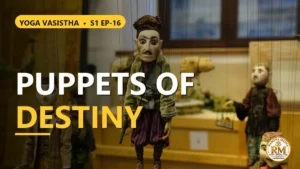
Rama stated that humans, held captive by an unknown power called ‘destiny’, act without true independence, much like puppets in the hands of a puppeteer.
Key Summary: In this chapter of Yoga Vasistha, Sri Rama reveals to Sage Vishwamitra how karma and destiny govern human existence. Expressing profound dispassion, Sri Rama portrays the relentless suffering caused by ignorance and the futile pursuit of fleeting pleasures despite knowing nothing in this world is permanent.
📚 Yoga Vasistha — full guide & all episodes
Introduction: This episode from Yoga Vasistha exposes human helplessness before the cosmic mechanism of ‘Kriya’ (action), ‘Kritanta’ (the dispenser of karma’s fruits), and ‘Destiny’. Here, Sri Rama speaks directly to Sage Vishwamitra, articulating his intense dispassion and deep anguish after observing the illusory nature of worldly life.
The Main Chapter
The Cosmic Dance Floor of Kritanta: “O noble Sage Vishwamitra! The principle of action (Kriya) creates and dissolves these worlds. People refer to this very power as destiny. The knowers of the Vedas call this action ‘Kritanta’—whose sole function is delivering the fruits of one’s deeds. Just as frost melts away under the rays of the sun, living beings emerge and perish solely under the sway of Kritanta. Indeed, this entire universe is his dance floor! Adorning the guise of a Kapalika dancer, he performs continuously, displaying the intricate postures of action and consequence. Appearing gentle on the surface yet driven by an unfathomable cosmic order, he ordains the joy and sorrow of all beings. Like a child playfully molding clay dolls and smashing them to pieces, he creates countless creatures only to annihilate them in the cosmic dissolution.”
RECOMMENDED PRODUCT

JaipurCrafts 22cm Metal Ram Darbar Idol Review : How can this product help you?
This review examines the JaipurCrafts using verified buyer feedback and the manufacturer’s listed specifications. Setting up a compact home altar or introducing a sacred… The JaipurCrafts Ram Darbar statue addresses these practical requirements through a cast aluminium alloy construction that delivers traditional gold-tone decorative warmth in… JaipurCrafts Ram Darbar is a 22-centimetre gold-coloured aluminium alloy murti weighing 460 grams, designed as a decorative relief showpiece for home mandirs and office…
Read more about this productBuy on Amazon
As an Amazon Associate, RamthaMedia earns from qualifying purchases.
Puppets in the Hands of Destiny: “O Sage! In this cosmos orchestrated by Destiny, Time, and Kritanta, we wander aimlessly in the depths of ignorance. Having entered this world with physical bodies, we have turned into helpless puppets in the hands of an incomprehensible cosmic force called Destiny. We roam wildly like beasts in a dense jungle. Ruthless Time snatches away whatever it pleases, plunging us into perpetual peril. Like a fragment of wood tossed adrift on ocean waves, we are swept away helplessly in the torrent of time. We spend our lives trembling in fear before an unknowable Destiny. Perhaps the unquenchable greed we cultivate inside burns us and binds us as slaves to this very fate.”
A Life Squandered in Vain: “Our childhood, youth, and old age pass away in meaningless pursuits, O Mahatma! Phantom fears and vain cravings continuously torment us. What we run after in pursuit of happiness turns into bitter sorrow on the very next day. We fail to comprehend the mysterious play of this destiny. Whatever a person desires thinking it will bring happiness yields no lasting peace once acquired; the inner anguish never subsides. What the world covets as great prosperity and wealth appears entirely trivial to my eyes.”
📖 Does Destiny Really Exist? Vasistha Resolves the Deepest Doubt of Sri Rama | Yoga Vasistha S2 EP-12
Fleeting Lifespan and Illusory Pleasures: “Consider this lifespan—it is exceptionally fickle. Death stands waiting close by, merciless and inevitable. People swell with pride over deceptive youth, yet it vanishes in an instant. Childhood remains steeped in ignorance. Relatives and friends are merely binding attachments that bring no genuine peace. Worldly pleasures are nothing but embodiments of severe afflictions. Striving for future happiness in this world is like a thirsty deer frantically chasing after mirages in the desert. When mighty Indra himself meets the death decreed by destiny, and even the sun and moon face dissolution, what hope remains for frail mortals like us?”
The Unseen Power and Lives of Ignorance: “Looking at all this, only one realization dawns upon me, O eminent Sage! The unseen potency of an unknowable divine force makes this cosmos manifest. The three worlds operate solely by that cosmic will. O Sage! I realize that only those who devote themselves to helping others and attain self-knowledge through discernment are truly blessed; they alone taste supreme peace amidst this illusory realm. Everyone else remains trapped in the dense forest of mundane life, bound by the nooses of desires, enduring endless cycles of birth and death. Deluded people spend their lives chasing transient celebrations, distant pilgrimages, family ceremonies, and worldly luxuries. Trapped in a restless mind, humanity fails to perceive what is truly eternal.”
Spiritual Perspective:
Sri Rama’s core realization in this teaching is that every living being functions as a puppet in the hands of destiny, unseen cosmic forces, and their own karma. By forming deep attachments to impermanent objects and fleeting relationships, humans repeatedly invite sorrow. The profound philosophical message of this chapter is that shedding these illusions, realizing the inner Self, and living a life of selfless service is the only path to genuine peace and freedom.
RECOMMENDED BOOK
The Maya Simulation: Quantum Physics and the Science of Consciousness by A. Ravinder
Is the world around us real? Or is it just a Maya Simulation?
A guide that bridges the ancient wisdom of the Yoga Vasistha with quantum physics and modern consciousness science — for readers ready to question the nature of reality and calm the mind with practical tools like the Zero Voice Technique. It explores mind, maya and consciousness in plain language, and offers a practical path for the seeker on the spiritual journey. Available in print and ebook instant-read versions.
Buy on AmazonBuy on Ramthamedia
As an Amazon Associate, RamthaMedia earns from qualifying purchases.
Sri Rama’s Dispassion on the Infinite Nature of Time | Yoga Vasistha S1 EP-15

Chapter Summary: In this chapter of Yoga Vasistha, Sri Rama lucidly explains the utter insignificance of mortals before destiny and karma to Sage Vishwamitra. He depicts Kritanta dancing in the guise of a Kapalika, generating and dissolving creatures according to their deeds. Rama laments that humans live as helpless puppets under an incomprehensible cosmic power, squandering precious life in delusion. He declares wealth, worldly pleasures, and attachments to be sources of affliction, pointing out that even celestial beings and cosmic luminaries are consumed by time. Sri Rama concludes his teaching on dispassion by affirming that only those who practice selfless benevolence and attain self-knowledge experience true bliss in this cosmic illusion.
Scriptural Highlights:
- Core Message – Man is completely dependent and helpless before destiny and the cosmic principle of action (Kriya).
- Philosophical Teaching – The body, attachments, and worldly enjoyments lead only to grief; Self-knowledge alone bestows everlasting peace.
- Memorable Quote – Worldly pleasures are merely the reflections of severe afflictions.
- Practical Reflection – Instead of living in future illusions, engage in selfless service and dedicate your efforts toward Self-realization.
- Connection to Next Chapter – Sri Rama analyzes the restless nature of the mind and the intense turmoil it generates.
📖 Sri Rama’s Dispassion Towards the Infinite Nature of Time | Yoga Vasistha S1 EP-15
Frequently Asked Questions
How does Sri Rama describe Kritanta? Sri Rama describes ‘Kritanta’ as the active principle that dispenses the fruits of actions, dancing in the guise of a cosmic Kapalika while continuously creating and dissolving beings.
What is the human condition under destiny according to Rama? Rama explains that humans are bound to an unknown cosmic power called destiny, behaving helplessly like puppets in the hands of a puppeteer.
Why does Rama lament the everyday pursuits of worldly people? Rama laments that people squander life chasing elusive future pleasures, much like a thirsty deer running after a desert mirage.
Who attains true happiness according to Sri Rama? Sri Rama affirms that those who practice selfless benevolence, cultivate discernment, and abide in the realization of the Self attain authentic happiness in this illusory world.
Conclusion:
We often act with the expectation that our deeds will yield enduring worldly happiness, yet Sri Rama illuminates the profound truth that nothing remains under human control before time, karma, and destiny. Rather than chasing fleeting external pleasures, awakening spiritual discrimination, knowing the inner Self, and serving others brings supreme peace. This discernment is the vital first step toward true dispassion and spiritual liberation.


