
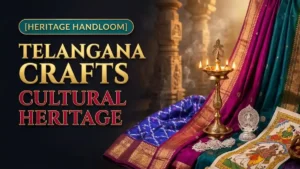
Telangana’s Geographical Indication (GI) products represent living spiritual heritage intertwined with centuries of temple rituals, deity adornments, and sacred festivals. From the sacred Gadwal vastrams presented at Tirumala to Kakatiya brass craft at Pembarthi, Cheriyal mythological scrolls, and Karimnagar silver filigree, each craft preserves sacred artisan devotion.
Legally protected under the Geographical Indications of Goods Act 1999, these master crafts reflect the timeless cultural soul and artisanal mastery of Telangana.
When you stand before the sanctum of the ancient Alampur Jogulamba temple or witness the grand procession during the Tirumala Brahmotsavams, your eyes naturally meet the divine elegance of the deity. Have you ever wondered where the sacred silk vastram adoring the deity was woven, or whose devoted hands shaped the resonant brass bell and the glowing harathi lamp held by the priest? From the humble brass diya in our home prayer alcove to the ceremonial robes presented at world-renowned pilgrimage shrines, our devotional practices are deeply rooted in the soil of Telangana.
A distinct geographical climate, hereditary artisan dexterity, and centuries of devotional dedication come together to give birth to an authentic master craft. Recognized with statutory Geographical Indication (GI) tags by the Government of India, these unique creations showcase the spiritual depth and living traditions of Telangana to the world.
Read the complete Telugu edition of this article.
Telangana Cultural GI Products — What Is a Geographical Indication and How Does It Connect to Sacred Temple Traditions?
A Geographical Indication (GI) is a statutory intellectual property right granted by the Central Government to products originating from a specific geographical region that possess unique qualities, reputation, or traditional craftsmanship. Issued by the Geographical Indications Registry in Chennai under the Ministry of Commerce and Industry, a GI tag protects traditional heritage against cheap commercial counterfeits. Unlike mass-manufactured goods, the vast majority of Telangana’s GI tags belong to sacred crafts cultivated around historic temples, royal patronages, and mythological narratives.
When a processional deity is taken around temple corridors, which community wove the sacred cloth? Where were the brass sheaths for temple flagstaffs embossed? How did ancient village storytellers narrate the epics before modern media existed? The answers lie in Telangana’s traditional handlooms, metal repousse, wood carvings, and scroll paintings.
Why Are Gadwal Vastrams Sacredly Offered During Tirumala Brahmotsavams?
Jogulamba Gadwal district immediately evokes the sacred confluence of the Krishna and Tungabhadra rivers, alongside the revered Alampur Jogulamba temple, one of the eighteen Maha Shaktipeethams. In this historic territory thrives the legendary art of Gadwal sarees (GI Registration No. 138, registered in 2010). Under the patronage of the royal Gadwal Samsthanam, these textiles were crafted for both royal durbars and temple deity adorments.
The preeminent devotional honor of Gadwal weaving is the presentation of the sacred ‘Gadwal Sesha Vastram’ during the annual Brahmotsavams of Lord Venkateswara at Tirumala. Every year, Gadwal master weavers observe disciplined spiritual vows to weave pure silk dhotis and upper vastrams with zari borders, which are ceremonially carried to the Tirumala hills as an offering. Similarly, during the Kalyanotsavam of Goddess Jogulamba and Lord Balabrahmeshwara at Alampur, Gadwal silks are traditionally offered.
Technical Mastery — The Kuttu Interlock: A genuine Gadwal saree features a lightweight fine cotton or silk body, while the temple borders and pallu are woven with heavy pure silk and real zari. Joining these contrasting materials requires the historic ‘Kuttu’ three-shuttle interlock technique. Two weavers work side by side on a handloom to interlock the threads seamlessly, adorned with sacred kumbha (temple spire), rudraksha, and peacock motifs. Wearing these vastrams during household rituals and weddings is believed in tradition to invoke auspicious blessings.
How Did Gopika Milkmaid Motifs Grace the Pallu of Siddipet Gollabhama Sarees?
In the heart of Siddipet district originated the enchanting Gollabhama handloom saree (GI Registration No. 188, registered in 2012). This craft translates the divine devotion of Vrindavan and the innocent love of Lord Krishna’s gopikas into textile poetry. The signature motif features a gopika (Gollabhama) gracefully walking with a traditional milk pot balanced on her head.
Padmashali master weavers in Siddipet and Dubbaka developed this design over six decades ago, inspired by classical folk poetry. In Vedic heritage, honoring the sacred cow and presenting milk and ghee are central devotional offerings. The Gollabhama motif is not printed; weavers lift individual warp threads by hand using an inlay extra-weft technique, constructing every milk pot and graceful silhouette thread by thread. Wearing this saree during morning prayer rituals brings an aura of serene feminine grace.
👉 Related Guide — Karthika Puja Items — Complete Essentials & Preparations
How Did Pembarthi Sheet Metal Craft Adorn Kakatiya Temple Sanctums and Sacred Utensils?
Located near Jangaon on the Warangal highway, the village of Pembarthi is celebrated for its metal craftsmanship. Originating during the glorious Kakatiya empire in the 12th century, this heritage received statutory recognition as Pembarthi Metal Craft (GI Registration No. 195, registered in 2010). Viswakarma artisan families practice the specialized sheet metal repousse technique on brass and copper sheets.
Pembarthi’s artistic footprints adorn renowned shrines across Southern India, including the Srisailam Mallikarjuna Swamy temple, Hanamkonda Thousand Pillar temple, Ramappa Rudreshwara temple, and Kolanupaka Jain temple. Sanctum door coverings, embossed dvrapalaka sculptures, and brass dhwajasthambha sheaths were crafted here. Home puja rooms cherish Pembarthi pancharathis (five-tiered lamps), sahasra linga lamps, holy water kalashams, and resonant brass bells.
Why Are Temple Crowns and Sacred Vessels Created with Karimnagar Silver Filigree?
Along the sacred Godavari river basin in Karimnagar thrives the delicate art of Silver Filigree (GI Registration No. 76, registered in 2007). Practiced for over two centuries, filigree involves melting pure silver into hair-thin pliable wires, twisting them into intricate braids, and soldering them into gossamer lace-like ornaments and ceremonial vessels.
Temples frequently commission Karimnagar filigree artisans to craft silver crowns (kiritams), divine eye ornaments (netrams), protective kavachams, sacred tridents, and Sudarshana chakras. In domestic worship during Satyanarayana Vratams and Lakshmi pujas, silver thamboolam trays, akshata containers, and camphor harathi holders showcase this ethereal lace craft.
👉 Related Guide — Kondagattu Chandanotsavam 2026 — Nijaroopa Darshanam Guide
What Role Did Cheriyal Scroll Paintings and Masks Play in Mythological Storytelling?
The Cheriyal scroll painting tradition of Siddipet district (GI Registration No. 79, registered in 2007) served as a visual gateway to the epics across rural India. Centuries before printed media, itinerant storytelling communities such as the Kaki Padagalu traveled from village to village, unfurling vibrant narrative scrolls to sing episodes from the Ramayana, Mahabharata, and Shiva Purana.
Cheriyal paintings are prepared using strictly natural materials. Khadi cotton canvas is treated with tamarind seed paste, white clay, and tree gum. Mineral pigments extracted from stones—vermilion red, haridala yellow, lamp soot black, and indigo—produce colors that remain radiant for generations. For village jataras like Komuravelli Mallanna and Medaram Sammakka-Sarakka, artisans handcraft masks of Shiva, Nandi, and Hanuman using coconut shells and sawdust paste.
How Is Ancient Lost-Wax Dokra Metal Craft Used in Tribal Deity Worship in Adilabad?
In the forested tracts of Utnoor and Jainoor in Adilabad, Ojha Gond craftspeople preserve the prehistoric lost-wax metal casting technique known as Adilabad Dokra (GI Registration No. 574, registered in 2018). Practiced in unbroken lineage since the Indus Valley Dancing Girl figurine, each brass artifact is individually hand-molded using beeswax and clay, ensuring that no two pieces in the world are identical.
Dokra casting is directly rooted in tribal worship. Gond, Kolam, and Pardhan communities commission icons of their sacred clan deities—including Goddess Jangubai, Nagoba (the serpent protector), and Bheemdev. At the annual Keslapur Nagoba Jatara, ceremonial brass bells, oil lamps, and elephant mounts created through Dokra casting form the heart of rituals.
👉 Related Guide — First Karthika Somavaram 2026: Shiva Puja at Home and Temple Visits
Sacred Ritual Fabrics — The Secrets of Pochampally Ikat and Puttapaka Telia Rumal
Bhoodan Pochampally in Yadadri Bhuvanagiri district earned worldwide distinction for its tie-and-dye weaving. As Telangana’s first registered Geographical Indication (GI Registration No. 4, registered in 2003), Pochampally Ikat is renowned for mathematically precise geometric motifs transferred onto yarn prior to weaving. Priests and pilgrims at the hill shrine of Yadadri Sri Lakshmi Narasimha Swamy temple reverently drape these sanctified silk vastrams during festivals.
Puttapaka Telia Rumal (GI Registration No. 627, registered in 2020): Hailing from Puttapaka village in Nalgonda district, the Telia Rumal represents one of the world’s most labor-intensive textile traditions. The term ‘Telia’ refers to oil; unspun cotton yarns are treated for 21 days in an emulsion of sesame and castor oil, sheep dung, and wood ashes. This ancient herbal treatment imparts natural softness, a distinct earthy aroma, and unique thermal properties that keep the wearer cool in summer and warm in winter. Woven exclusively in red, black, and white natural dyes, these textiles were historically cherished by royal courts and temple custodians as sacred seat spreads.
Auspicious Traditions of Nirmal Woodcraft, Narayanpet Silks and Lad Bazaar Lac Bangles
The town of Nirmal has been a center for woodcraft and painting since the 14th century (GI Registration No. 78, 80, 81). Using lightweight Poniki wood (Wrightia tinctoria), artisans sculpt icons of Sita, Rama, Lakshmana, and Hanuman with devotional expressions, while Nirmal paintings reproduce Kakatiya temple frescoes with distinctive golden accents.
Narayanpet handloom sarees (GI Registration No. 343), introduced during the military expeditions of Chhatrapati Shivaji Maharaj in the 17th century, feature structured temple borders and double-warp weaving favored by devotees during sacred vows. Near the historic Charminar, handcrafted Hyderabad Lac Bangles (GI Registration No. 841, registered in 2024) continue an unbroken tradition of feminine auspiciousness. Devotees visiting the nearby Bhagyalakshmi temple consider wearing these natural resin bangles during Varalakshmi Vratam and weddings as a symbol of enduring marital bliss.
What Makes Tandur Red Gram and Warangal Dhurries Essential to Temple Annadanam and Assemblies?
Cultivated in the fertile limestone and black cotton soils of Vikarabad, Tandur Red Gram (GI Registration No. 706, registered in 2022) is prized for its superior protein density, natural aroma, and rich culinary texture. Prominent temple kitchens across Telangana—including Yadadri, Vemulawada, Kondagattu, and Basara—rely on this nutritious dal for their daily mass-feeding (Nitya Annadanam) prasadams.
Complementing sacred temple gatherings, Warangal Dhurries (GI Registration No. 573, registered in 2018) provide pure cotton floor carpets for temple pavilions, spiritual discourses, and meditation halls, offering a natural and grounded setting for congregational chanting.
👉 Related Guide — Feasting Under the Sacred Amla Tree: The Joy of Karthika Vanabhojanam in Hyderabad — Spiritual & Health Significance
Comprehensive Register of Telangana Cultural Geographical Indications
The authoritative register of culturally significant Geographical Indications from Telangana certified by the Government of India:
| Product Name | Classification | District / Region | GI Number & Year | Temple & Cultural Significance |
|---|---|---|---|---|
| Pochampally Ikat | Handloom Textile | Yadadri Bhuvanagiri | GI-4 (2003) | Puja vestments, Yadadri temple festivals, geometric tie-and-dye |
| Karimnagar Silver Filigree | Handicraft (Metal) | Karimnagar | GI-76 (2007) | Deity silver crowns, netrams, puja vessels, ceremonial thamboolam trays |
| Nirmal Toys and Crafts | Handicraft (Wood) | Nirmal | GI-78 (2007) | Lightweight Poniki wood Sita-Rama idols, Navaratri Bommala Koluvu |
| Cheriyal Scroll Paintings | Handicraft (Art) | Siddipet (Cheriyal) | GI-79 (2007) | Mythological narrative scrolls, folk jatara masks for village shrines |
| Gadwal Sarees | Handloom Textile | Jogulamba Gadwal | GI-138 (2010) | Tirumala Brahmotsavam Sesha Vastrams, Alampur Jogulamba offerings |
| Siddipet Gollabhama | Handloom Textile | Siddipet (Dubbaka) | GI-188 (2012) | Vrindavan Krishna-Gopika devotion, handcrafted milkmaid motifs |
| Pembarthi Metal Craft | Handicraft (Brass) | Jangaon (Pembarthi) | GI-195 (2010) | Kakatiya temple brass doors, dhwajasthambha sheaths, pancharathi lamps |
| Narayanpet Sarees | Handloom Textile | Narayanpet | GI-343 (2013) | Shivaji era tradition, architectural temple borders, ceremonial pujas |
| Warangal Dhurries | Handloom Carpets | Warangal | GI-573 (2018) | Temple discourse carpets, meditation pavilion floor spreads |
| Adilabad Dokra Craft | Handicraft (Bell Metal) | Adilabad (Utnoor) | GI-574 (2018) | Tribal deities Jangubai, Nagoba, Bheemdev, lost-wax ritual bells |
| Puttapaka Telia Rumal | Handloom Cotton | Nalgonda (Puttapaka) | GI-627 (2020) | 21-day herbal oil treatment, sacred geometric ritual seat spreads |
| Tandur Red Gram | Agriculture | Vikarabad (Tandur) | GI-706 (2022) | Pilgrimage shrine Nitya Annadanam mass-feeding, sacred naivedyam |
| Lad Bazaar Lac Bangles | Handicraft (Resin) | Hyderabad | GI-841 (2024) | Bhagyalakshmi temple offerings, Varalakshmi Vratam, marital bliss |
The Matchstick Rule — How to Identify Genuine GI Crafts and Where to Procure Them
Commercial markets are flooded with powerloom synthetic duplicates and chemical screen prints that mimic traditional handlooms. Devotees and discerning buyers should observe the following physical verification rules before purchasing:
- The Burn Test for Pure Silk and Cotton: Carefully extract a single loose thread from the fringe of the saree. Ignite it with a matchstick. Pure natural silk burns slowly with the characteristic odor of burning hair, leaving a fine, crushable black ash. Synthetic polyester melts rapidly into a hard, plastic bead.
- Official GI Verification Logo: Ensure the product carries the official tricolor Geographical Indications certified logo and registered artisan tag issued by the Government of India.
- Handloom and Silk Certifications: Look for the official Handloom Mark and Silk Mark labels affixed to authentic weaves.
- Authorized Government Outlets: To ensure direct fair remuneration reaches artisan families, procure directly from state-run outlets such as TSCO (Telangana State Handloom Weavers Cooperative Society), Golkonda Handicrafts Emporiums, Lepakshi centers, or directly registered primary weaver cooperative societies in the respective craft clusters.
Frequently Asked Questions (FAQ)
Which product received the first Geographical Indication tag from Telangana?
Pochampally Ikat was the first product from Telangana to receive a Geographical Indication tag, officially registered on December 15, 2003, under Application No. 4. It stands among India’s earliest registered handloom GI crafts.
What is the sacred vastram presented at Tirumala from Telangana?
The sacred vastram offered during the annual Brahmotsavams at Tirumala is the Gadwal Sesha Vastram. Woven by master weavers under spiritual discipline, these pure silk dhotis and shawls have been presented to Lord Venkateswara for generations.
Where does Kakatiya temple brass metal craft originate?
Pembarthi in Jangaon district is the historic home of Kakatiya sheet metal repousse craft, specializing in sanctum brass doors, flagstaff coverings, and sacred pancharathi oil lamps.
What natural pigments are used in Cheriyal scroll art?
Cheriyal paintings use exclusively natural minerals and vegetable dyes, including white ground stone, vermilion red, haridala yellow, and lamp soot black, bound with tamarind seed gum to preserve radiance over centuries.
Where can one procure authentic certified Telangana handlooms?
Genuine products can be reliably purchased at state cooperative emporiums including TSCO, Golkonda Handicrafts, Lepakshi outlets, and local primary handloom cooperative societies.