
Sage Vyasa retained his physical body as a Jivanmukta for universal welfare and scriptural authorship, not because his realization was inferior to Shuka’s.
Is there really a difference between Jivanmukti and Videhamukti? To the question of what distinguishes Shuka’s liberation from another seeker’s spiritual practice, Yoga Vasistha responds: nothing at all. Just as wind remains wind whether it blows or stays still, both the Jivanmukta and the Videhamukta abide in the exact same truth; the difference lies only in outward appearance.
📚 Yoga Vasistha — full guide & all episodes
A Comparison Within Us All
Have you ever caught yourself thinking, “Someone else has moved far ahead of me spiritually, while I am lagging behind”? Even when two students learn under the very same master, situations often arise in life where one appears serene while the other continues to yearn. A similar comparison stirred within young Sri Rama’s mind—just as Vasistha was about to commence his discourse on the science of liberation.
The Discourse Begins
Vasistha addressed Sri Rama: “Beloved disciple Rama, I will now place before you the very wisdom of the Self that Lord Brahma taught at the dawn of creation to bring peace to the cosmos. Listen with full attention.”
Before stepping into the scripture of liberation, a doubt arose in Sri Rama’s heart. Rather than holding it back, he immediately questioned his master.
Sri Rama’s Doubt Regarding Shuka’s Liberation
“Bhagavan, please resolve one question,” Sri Rama said. “Vishwamitra mentioned earlier that Shukadeva attained Videhamukti. Yet his father and teacher, Sage Vyasa, is omniscient and possessed of supreme intellect, so why did he not attain Videhamukti? If Videhamukti is the ultimate fruit of self-realization, why did Shuka alone reach it? What was so distinctive about him?”
RECOMMENDED PRODUCT
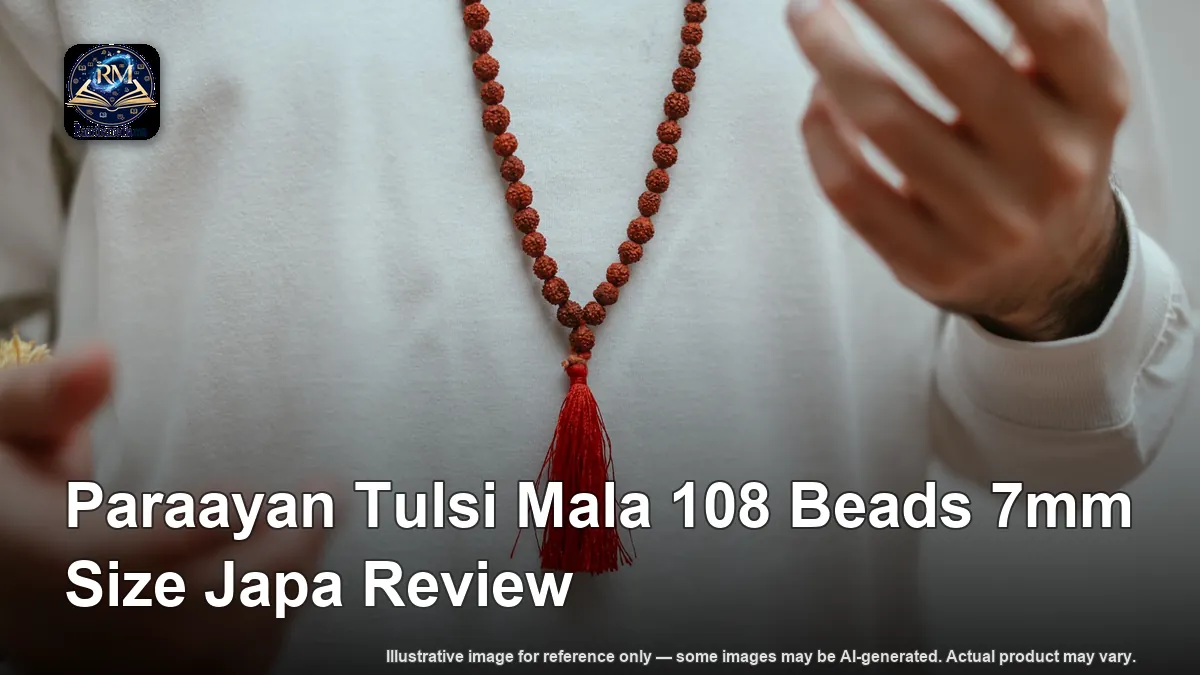
Paraayan Tulsi Mala 108 Beads 7mm Size Japa Review : How can this product help you?
This review examines the Paraayan using verified buyer feedback and the manufacturer’s listed specifications. Establishing a disciplined daily japa or morning pooja routine… The Paraayan Pure Tulsi Mala directly addresses this devotional requirement by offering a standardised 108-bead sequence formed from uniform 7mm round basil wood beads. Its… The Paraayan Pure Tulsi Mala is a traditional 108-bead prayer rosary crafted from genuine 7mm round basil wood beads for daily mantra japa and spiritual wear. It provides a…
Read more about this productBuy on Amazon
As an Amazon Associate, RamthaMedia earns from qualifying purchases.
This was not merely an inquiry about Shuka and Vyasa—it was the profound doubt of every seeker striving to understand the visible differences between two accomplished practitioners.
The Boundless Creation
Vasistha first introduced Sri Rama to the sheer vastness of creation: “O Rama, within the consciousness of the Supreme Reality, which is self-luminous like the sun, countless universes arise like particles of light. At this very moment, universes encompassing celestial realms, mortal spheres, and nether worlds are as countless as specks of dust. In the times ahead, such world-waves will continue to emerge endlessly from that great ocean of the Supreme Reality.
Beings take these worlds to be real and drown in them. In truth, all these realms are like dreams—just as a dream experienced in sleep feels intensely real yet dissolves upon waking, these worlds too dissolve upon awakening.”
The Secret of the Three Bodies
Vasistha then delineated the three layers inherent to every living being.
Gross Body (Sthula Sharira) — The physical body forged from the five great elements: water, air, fire, earth, and space. It is born, it decays, and it inevitably perishes.
Subtle Body (Sukshma Sharira) — The inner layer composed of the mind, intellect, chitta, and ego. It does not perish when the physical body dies. Likes and dislikes, desires, emotional impressions, and deep past impressions (samskaras) remain stored within it.
📖 How Did Multiple Universes Arise in One Space? | Yoga Vasistha S3 EP-47
Causal Body (Karana Sharira) — The foundational ‘inner Self’ (Pratyagatman) or ‘true nature’ underlying everything. It is the witness that precedes every experience. This is what is known as the ‘SELF’.
A living being continually undergoes transformations across these three layers driven by latent tendencies. Yet that core reality, the Causal Self, never changes.
Key Insights Table
| Body | Nature | Does It Perish? |
|---|---|---|
| Gross Body | Composed of the five elements, visible to the senses | Yes, it perishes with death |
| Subtle Body | Mind-intellect-chitta-ego, the repository of latent tendencies | No, it carries over into the next birth |
| Causal Body (Atma) | The witness consciousness, source of all existence | Never; it is eternal and immutable |
Wind, Water, and Waves
Here, Vasistha offered a delicate analogy: “Rama, wind is wind when it blows, and wind remains wind when it is still. In the same way, water in an ocean remains water whether waves rise or settle. The difference between Vyasa, who is liberated while living, and Shuka, who attained disembodied liberation, is of that very nature. Both abide in the same truth; in one, the ‘wave’ called the body remains visible, while in the other, that wave has subsided. That is the only difference—there is no division in their inner truth.”
Vyasa and Shuka — One and the Same
Vasistha addressed Sri Rama’s core inquiry: “Sage Vyasa is a Jivanmukta—meaning he lives in the body while remaining completely free from the bondage of latent tendencies. He continues to use his physical form solely for the welfare of the world and the composition of sacred scriptures. Shuka, during his spiritual journey, withdrew even from bodily interactions and turned entirely inward. This is merely a personal distinction in their paths of practice—not a difference in their realization.
RECOMMENDED BOOK

The Maya Simulation: Quantum Physics and the Science of Consciousness by A. Ravinder
Is the world around us real? Or is it just a Maya Simulation?
A guide that bridges the ancient wisdom of the Yoga Vasistha with quantum physics and modern consciousness science — for readers ready to question the nature of reality and calm the mind with practical tools like the Zero Voice Technique. It explores mind, maya and consciousness in plain language, and offers a practical path for the seeker on the spiritual journey. Available in print and ebook instant-read versions.
Buy on AmazonBuy on Ramthamedia
As an Amazon Associate, RamthaMedia earns from qualifying purchases.
The distinction between Jivanmukti and Videhamukti is merely one of outward expression. Both have reached the identical truth. Therefore, Rama, it is a mistake to think that Shuka attained ‘more’ and Vyasa attained ‘less’.”
The Spiritual Meaning in the Paths of Shuka and Vyasa
The message embedded in this teaching is profoundly practical. Whenever you find yourself comparing your spiritual path to another person’s, remember this: though external expressions differ, inner peace is the singular destination. One person may work actively in the world like Vyasa, while another may remain quiet and solitary like Shuka—yet both can be anchored in the very same reality. It is never wise to measure someone’s realization by outward appearance.
Chapter Summary — The Wisdom of Shuka and Vyasa
At the threshold of the discourse on liberation, Sri Rama asked Vasistha a question: if Shuka attained Videhamukti, why did his father Vyasa not attain it? Vasistha illuminated the vast expanse of creation, the true nature of the gross, subtle, and causal bodies, and used the metaphor of wind and water to demonstrate that no real difference exists between Jivanmukti and Videhamukti. Vyasa retained his body as a Jivanmukta for the welfare of humanity, whereas Shuka turned inward and dissolved bodily engagement—a difference in individual expression, not in wisdom.
Scriptural Notes
Yoga Vasistha clarifies here that true liberation does not depend on whether a physical body exists; it rests entirely upon complete freedom from latent tendencies. Both Vyasa and Shuka attained that very freedom, expressed merely in distinct forms.
Key insights to remember:
- “Wind is wind whether it blows or stays still.”
- “Though outward appearances differ, the inner truth is one.”
- “Liberation does not depend on the physical body, but on the eradication of latent tendencies.”
Frequently Asked Questions
What are Jivanmukti and Videhamukti? Jivanmukti is the state of living in a physical body while remaining completely free from the bondage of latent tendencies; Videhamukti is the state of total absorption in the Supreme Reality beyond physical bodily consciousness.
Why did Sage Vyasa not attain Videhamukti? Sage Vyasa retained his physical body as a Jivanmukta for universal welfare and scriptural authorship, not because his realization was inferior to Shuka’s.
📖 Did the Universe Arise from Brahman? The Secret of Dualistic Scriptures | Yoga Vasistha S3 EP-46
Is there a real difference between Jivanmukti and Videhamukti? There is no difference in the inner truth; the distinction is merely external—just as wind remains wind whether it blows or remains still.
What are the gross, subtle, and causal bodies? The gross body is the physical form composed of the five elements; the subtle body is the layer of mind, intellect, and latent tendencies; the causal body is the witness consciousness, the Atman, which is the foundation of all.
Why did Vasistha impart this teaching to Sri Rama? Vasistha gave this teaching before beginning the formal discourse on liberation to clear Sri Rama’s lingering doubt and establish a grounded understanding.
What message does this chapter offer for modern life? This chapter reminds us not to judge someone’s spiritual or personal journey by outward appearances, as inner peace remains the only true benchmark.
Conclusion
Sri Rama’s doubt dissolved in the realization that wind remains wind whether it blows or stays still. Yet behind this stillness remained another deeper inquiry—how can these latent tendencies be eradicated completely? Look forward to Vasistha’s answer in the upcoming episode.


