
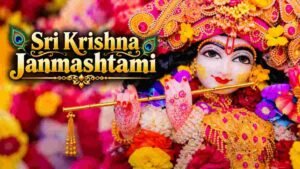
Sri Krishna Janmashtami is the sacred celebration marking the divine descent of Lord Krishna on the midnight of Shravana Krishna Ashtami under the Rohini star. It unites precise archaeo-astronomy, profound Achintya Bhedabheda philosophy, rigorous fasting traditions, and joyful community festivities such as Utla Panduga and Dahi Handi across India.
Sri Krishna Janmashtami, also celebrated widely as Gokulashtami or Krishna Jayanti, stands as one of the most vibrant and spiritually uplifting festivals within Sanatana Dharma. Celebrated across the globe with immense devotional fervor, it commemorates the divine midnight descent of Bhagavan Sri Krishna, the complete manifestation (Purna Avatara) of the Supreme Divine, who appeared to dispel the darkness of ignorance and re-establish cosmic righteousness (Dharma).
Beyond the devotional joy of rocking baby Krishna in ornate cradles, Janmashtami represents a profound convergence of ancient history, precise planetary calculations, deep metaphysical philosophy, and enduring cultural traditions. For millions of seekers, the festival is not merely an annual commemoration of an ancient birth, but a living spiritual renewal that awakens the divine consciousness resting within the human heart.
From the heavily guarded prison cell of Mathura to the joyful cowherd settlements of Gokul, the narrative of Krishna’s arrival carries immense transformative wisdom for daily life. Modern archaeo-astronomical research has substantiated the celestial descriptions recorded in ancient Sanskrit scriptures, bridging the gap between sacred lore and chronological history. Today, the festival continues to inspire social unity, selfless devotion, and remarkable economic vitality across communities.
Read the complete Telugu edition of this article.
For a related perspective, read Tirumala Srivari Salakatla Brahmotsavams — A Complete Guide to the Sacred Nine-Day Festival.
Recommended reading or puja accessory
This optional item may be useful for readers who wish to continue their study or home practice.
Ganesha idol for a home puja space →
As an Amazon Associate, Ramthamedia.in may earn from qualifying purchases.
Sri Krishna Janmashtami — The Sacred Origin — The Divine Descent in Srimad Bhagavatam
The most authentic and comprehensive account of Sri Krishna’s birth is preserved within the sacred Tenth Canto of the Srimad Bhagavata Purana, composed by Sage Veda Vyasa. The Bhagavata explicitly declares in its opening canto that while various incarnations represent plenary expansions or aspects of the Supreme, Krishna is the Original Supreme Godhead Himself (Krishnas tu Bhagavan Svayam). When the tyrannical king Kamsa usurped the throne of Mathura and his oppressive rule caused adharma to burden the earth, the Supreme Divine assured the celestial deities that He would appear as the eighth child of Mother Devaki and Vasudeva to restore cosmic equilibrium.
Confined within Kamsa’s heavily guarded subterranean dungeon, Devaki and Vasudeva endured the immense sorrow of losing their first seven newborn infants to the king’s ruthless paranoia. However, when the eighth child entered Devaki’s womb, an extraordinary celestial effulgence illuminated the dark prison walls, heralding an unprecedented cosmic transformation. At the auspicious midnight hour of Nishita Kala, during the conjunction of Krishna Paksha Ashtami and the brilliant Rohini constellation in the month of Shravana, the Lord appeared before His parents in His majestic four-armed Vishnu form, adorned with the conch, discus, mace, and lotus.
Responding to the loving prayers of Devaki, who feared Kamsa’s wrath, the Supreme Lord transformed Himself into an enchanting, delicate newborn infant. Through the mystical potency of Yogamaya, the heavy iron chains shattered, the locked prison doors swung open of their own accord, and the fierce guards fell into a deep slumber. Vasudeva placed the divine baby into a wicker basket and carried Him through a torrential downpour across the swelling Yamuna River, which parted to grant them safe passage to the pastoral sanctuary of Gokul, leaving the child in the care of Yashoda and Nanda Maharaja.
For a related perspective, read Kamakhya Devi Temple — The Sacred Mystery of the Divine Feminine.
RECOMMENDED PRODUCT

Araliyaindia Brass Flute Krishna 14cm Murti Review : How can this product help you?
This review examines the Araliyaindia using verified buyer feedback and the manufacturer’s listed specifications. Selecting an authentic deity idol for a compact modern… The Araliyaindia brass flute Krishna idol addresses this space-conscious devotional requirement by pairing a 14 cm standing height with solid brass construction in an antique… The Araliyaindia Brass Flute Krishna Idol is a handcrafted 14 cm solid brass religious figurine weighing approximately 150 g with an antique gold finish. It provides a…
Read more about this productBuy on Amazon
As an Amazon Associate, RamthaMedia earns from qualifying purchases.
The Archaeo-Astronomical Mystery — Chronology of the Divine Descent
Far from being merely a mythological tale, modern archaeo-astronomical investigations indicate that the birth of Sri Krishna represents a precise historical event recorded through astronomical markers. Renowned researchers such as Professor Narahari Achar and Nilesh Oak have utilized advanced planetarium simulation software to recreate the celestial skies described in ancient Sanskrit epics and Puranic literature, validating the historical timeline of the incarnation.
The planetary configuration at Krishna’s birth featured the Taurus ascendant (Vrishabha Lagna), signifying grounded spiritual stability and profound emotional depth, aligned with the brilliant red giant star Rohini (Aldebaran), the most luminous star in the Vedic lunar zodiac. The eighth lunar day (Ashtami) of the dark fortnight corresponds to Saturn’s energetic influence, symbolizing the inevitable triumph of karmic balance and the dismantling of adharmic tyranny. The midnight Nishita Kala represents the exact hour when pure sattvic energy reaches its zenith.
Software reconstructions place this unique cosmic conjunction at midnight on July 27, 3112 BCE, providing scientific resonance to ancient calendar records, in contrast to Lord Rama’s documented astronomical advent on the Chaitra Shukla Navami under Punarvasu nakshatra on January 10, 5114 BCE. In the traditional Indian astronomical system, whenever the Ashtami tithi coincides perfectly with the Rohini nakshatra, it is termed ‘Jayanti Yoga,’ making this festival universally revered as Sri Krishna Jayanti.
For a related perspective, read Jyotirlinga Temples — Sacred Guide to the Twelve Manifestations of Lord Shiva.
Smartha and Vaishnava Calendar Variations
Devotees often observe that Sri Krishna Janmashtami is marked across two consecutive days in standard Indian calendars. This distinction arises from the differing calendrical methodologies maintained by the Smartha and Vaishnava traditions. Smartha practitioners, who follow the general Smartapanchanga guidelines, determine the festival based on the exact presence of the Ashtami tithi during the midnight Nishita Kala period, regardless of whether the Rohini nakshatra is fully present during the day.
In contrast, Vaishnava traditions—including ISKCON, the Gaudiya sampradaya, Sri Vaishnavas following Ramanuja, and the Madhva sampradaya—require the Ashtami tithi to prevail at sunrise (Udayatithi) and place paramount importance on its conjunction with the Rohini constellation. Consequently, the Vaishnava celebration typically falls one day after the Smartha observance. During the 2026 calendar cycle, the Smartha Nishita Kala midnight puja takes place on the night of September 4, while the grand Vaishnava celebrations and the public Dahi Handi festivities culminate on September 5.
For a related perspective, read Kamakhya Shakti Peeth Darshan: Entering the Sacred Womb Before Rebirth.
The Philosophical Zenith — Achintya Bhedabheda Tattva
The theological depth of Janmashtami finds its ultimate exposition in the doctrine of Achintya Bhedabheda, formulated in the fifteenth century by Sri Chaitanya Mahaprabhu. This sublime philosophy harmonizes the non-dualistic Advaita of Adi Shankara with the dualistic Dvaita of Sri Madhvacharya. It posits that the individual soul (Jiva) and the Supreme Godhead (Brahman) are simultaneously one and different in a manner that transcends finite human logic and mental speculation.
Just as a drop of ocean water possesses the same chemical quality as the vast ocean yet lacks its infinite magnitude, the individual soul shares divine qualities of consciousness and bliss (Cit and Ananda) with the Supreme, without ever becoming the omnipotent creator of the cosmos. On Janmashtami, this philosophy allows the devotee to perceive Krishna simultaneously as the boundless cosmic ruler and as a helpless infant whom they can cradle, feed, and love with intimate maternal and fraternal affection.
Sacred Fasting Rules, Nishita Kala Worship, and Nandotsav
The spiritual observance of Janmashtami involves strict fasting disciplines aimed at purifying the body and elevating consciousness. Devotees undertake either a waterless fast (Nirjala) or a fruit-based fast (Phalahara) from sunrise until the midnight hour. Grains, cereals, lentils, onions, and garlic are completely abstained from, with seekers consuming only light sattvic ingredients like barnyard millet (samak or samalu), tapioca pearls (sabudana), and fox nuts (makhana).
At the precise stroke of midnight during Nishita Kala, the deities of Laddu Gopal (infant Krishna) receive a grand ceremonial bath (Abhishekam) using Panchamrita—a sacred mixture of milk, yogurt, honey, clarified butter (ghee), and sugar—accompanied by the blowing of conch shells and Vedic chanting. The baby deity is then dressed in resplendent silk garments, adorned with peacock feathers, and placed in an intricately decorated cradle where devotees tenderly rock Him while singing devotional hymns. The following morning erupts into the jubilant celebrations of Nandotsav, commemorating the ecstatic joy of Nanda Maharaja and the residents of Gokul upon the child’s arrival.
Sacred Culinary Traditions and the Story of Poha
The offerings prepared for Janmashtami carry both immense devotional significance and deep nutritional wisdom. The foremost offering is Makhan Mishri, a simple blend of freshly churned white butter and rock sugar crystals, reflecting Krishna’s pure delight in natural simplicity. Another essential prasadam is Dhaniya Panjiri, an aromatic roasted coriander seed powder blended with powdered sugar, dry fruits, and ghee, renowned for its cooling, digestive properties following a day of strict fasting.
Above all lavish delicacies, the humble offering of flattened rice (poha or atukulu) holds the most exalted position during the festival. This sacred tradition derives from the moving narrative of Krishna and His childhood friend Sudama (Kuchela). Having studied together at the ashram of Sage Sandipani, the two shared an unbroken bond of unconditional affection. While Krishna later reigned as the king of Dwarka, Sudama lived in extreme, abject poverty with his family.
Urged by his devoted wife to seek help from his royal friend, Sudama journeyed to Dwarka carrying only a handful of coarse, borrowed flattened rice tied in a tattered cloth. Upon Sudama’s arrival, Krishna descended from His golden throne, embraced His impoverished friend with tears of joy, and reverently washed Sudama’s dust-covered feet alongside Queen Rukmini. When Krishna discovered the hidden pouch of poha, He eagerly consumed it with boundless delight, demonstrating that the Divine values humble, unpretentious love far above any ostentatious wealth.
📖 Varalakshmi Vratam: Significance, Sacred Story, and Step-by-Step Puja Rituals
Utla Panduga and the Economic Vitality of the Festival
In the Telugu states of Andhra Pradesh and Telangana, Janmashtami is celebrated through the exuberant folk tradition of Utla Panduga, mirroring the famous Dahi Handi of Maharashtra. This festival reenacts the endearing pastimes of Bala Krishna, affectionately known as the Makhan Chor (butter thief), who formed human pyramids with His cowherd playmates to reach the clay pots of butter hung high from village ceilings.
In towns and rural hamlets, earthen pots filled with milk, yogurt, turmeric water, and fragrant flowers are suspended high on wooden poles or overhead ropes. Enthusiastic groups of youth form multi-tiered pyramids to break the pot amidst joyous cheers, energetic drums, and splashing streams of water. The fifteenth-century saint-composer Tallapaka Annamacharya beautifully immortalized this spectacle in his renowned kirtana, describing the festive butter-splashing games of Lord Krishna in the heart of Tirumala.
Beyond its spiritual and cultural magnificence, Janmashtami serves as a massive economic engine across India. According to trade assessments by the Confederation of All India Traders (CAIT), the festival generates an annual commercial turnover exceeding ₹25,000 crore. The skyrocketing demand for dairy products invigorates dairy farmers, the flower market experiences unprecedented trade, retail garment sectors flourish through festive deity clothing, and local potters, sweet makers, and artisans find substantial seasonal livelihoods.
RECOMMENDED BOOK

The Maya Simulation: Quantum Physics and the Science of Consciousness by A. Ravinder
Is the world around us real? Or is it just a Maya Simulation?
A guide that bridges the ancient wisdom of the Yoga Vasistha with quantum physics and modern consciousness science — for readers ready to question the nature of reality and calm the mind with practical tools like the Zero Voice Technique. It explores mind, maya and consciousness in plain language, and offers a practical path for the seeker on the spiritual journey. Available in print and ebook instant-read versions.
Buy on AmazonBuy on Ramthamedia
As an Amazon Associate, RamthaMedia earns from qualifying purchases.
The Deeper Spiritual Significance
The dramatic narrative of Krishna’s birth carries profound allegorical depth for the spiritual practitioner. King Kamsa represents the entrenched human ego (Ahamkara) and tyrannical ignorance that ruthlessly imprisons the higher spiritual faculties. The dark subterranean dungeon symbolizes the conditioned physical body, encumbered by sensory attachments and worldly delusions. The death of Devaki’s first six children signifies the destruction of the six internal psychological enemies—lust, anger, greed, delusion, pride, and envy—which must be overcome before the supreme consciousness can manifest. The seventh child, Balarama, represents spiritual strength (Bala), preparing the pristine ground for the Lord’s arrival.
The appearance of Krishna at the dark hour of midnight signifies that divine illumination does not wait for ideal external conditions; rather, it descends precisely when the darkness of ignorance is at its deepest, provided the human heart calls out with total surrender. The mysterious opening of the prison gates and the falling asleep of the guards illustrate the instantaneous dissolution of worldly bondage (Maya) when the Supreme Lord awakens within human awareness. Vasudeva carrying Krishna across the turbulent Yamuna represents the aspirant’s journey of faith, carrying the newly awakened divine flame safely through the stormy waters of worldly life under divine protection.
The practice of rocking baby Krishna in an ornate swing emphasizes the transformation of reverence into unreserved, unconditional intimacy. While the majestic forms of the Divine inspire awe and fear, the child form of Krishna invites spontaneous love, free from the barriers of ritualistic formality. Janmashtami reminds every seeker that devotion is not an intellectual exercise of dry philosophy, but an affectionate relationship where the individual soul nurtures and cherishes the Divine as their most intimate companion, protector, and eternal guide.
In our fast-paced contemporary lives filled with relentless pressure, emotional alienation, and ethical compromises, the timeless message of Janmashtami offers essential guidance. Krishna’s early life teaches us how to remain joyful, fearless, and spiritually grounded amidst hostile external circumstances. Embracing the simple sattvic food habits of the festival, honoring friendships with the humility of the Sudama narrative, and actively participating in selfless community celebrations can restore balance to modern minds. By purifying our inner consciousness through sincere contemplation and ethical living, we transform our everyday lives into sacred spaces where inner peace and divine wisdom can truly take birth.
📖 Sri Rama Navami Significance: The Sacred Day Dharma Was Restored on Earth
Chapter Summary
Sri Krishna Janmashtami represents an extraordinary synthesis of historical reality, celestial timing, metaphysical philosophy, and cultural exuberance. Celebrated on the Shravana Krishna Ashtami under the Rohini star, the festival marks the descent of Bhagavan Sri Krishna, the Purna Avatara who arrived to eradicate tyranny and re-establish Dharma. Archaeo-astronomical research validates this event around 3112 BCE, aligning sacred Puranic texts with observable planetary cycles. The theological doctrine of Achintya Bhedabheda revealed by Sri Chaitanya Mahaprabhu provides the philosophical bedrock for loving Krishna as both the infinite Supreme Lord and the tender child in the cradle. Devotees honor this sacred occasion through rigorous day-long fasting, midnight Panchamrita abhishekam, singing devotional kirtanas, and relishing sacred offerings such as Makhan Mishri, Dhaniya Panjiri, and humble flattened rice (atukulu), reminiscent of Sudama’s unconditional devotion. Regional celebrations like Utla Panduga in Telugu states and Dahi Handi in Maharashtra invigorate social camaraderie, while the festival simultaneously injects immense economic vigor across indigenous artisan, agrarian, and commercial communities.
Scripture Notes
- Main Message: The central scripture guiding Janmashtami is the tenth canto of the Srimad Bhagavata Purana, complemented by the seminal declaration in Canto 1, Chapter 3, Verse 28: ‘Ete camsha-kalah pumsah krishnas tu bhagavan svayam’. The text proclaims that while various divine manifestations appear in different cosmic eras to maintain order, Sri Krishna is the complete, original fountainhead of divinity. The Bhagavata emphasizes that true liberation is achieved not through dry asceticism or mechanical rituals alone, but through unalloyed, ecstatic devotion (Prema Bhakti) that engages every human emotion in the loving service of the Divine.
- Philosophical Teaching: The philosophical core of Janmashtami is anchored in Sri Chaitanya Mahaprabhu’s Achintya Bhedabheda Tattva as recorded in the Chaitanya Charitamrita. This profound Vedantic teaching explains that the finite living entity is simultaneously non-different from and distinct from the infinite Supreme Being. Just as the rays of the sun share the heat and light of the sun without being the celestial sun itself, the individual soul shares the conscious nature of the Supreme Lord while remaining His eternal servitor. This philosophy establishes that devotional surrender is the highest expression of conscious existence, reconciling intellectual knowledge with ecstatic devotional love.
Frequently Asked Questions
The Sacred Origin: The Divine Descent in Srimad Bhagavatam?
The most authentic and comprehensive account of Sri Krishna’s birth is preserved within the sacred Tenth Canto of the Srimad Bhagavata Purana, composed by Sage Veda Vyasa. The Bhagavata explicitly dec
The Archaeo-Astronomical Mystery: Chronology of the Divine Descent?
Far from being merely a mythological tale, modern archaeo-astronomical investigations indicate that the birth of Sri Krishna represents a precise historical event recorded through astronomical markers
Smartha and Vaishnava Calendar Variations?
Devotees often observe that Sri Krishna Janmashtami is marked across two consecutive days in standard Indian calendars. This distinction arises from the differing calendrical methodologies maintained
The Philosophical Zenith: Achintya Bhedabheda Tattva?
The theological depth of Janmashtami finds its ultimate exposition in the doctrine of Achintya Bhedabheda, formulated in the fifteenth century by Sri Chaitanya Mahaprabhu. This sublime philosophy harm
Sacred Fasting Rules, Nishita Kala Worship, and Nandotsav?
The spiritual observance of Janmashtami involves strict fasting disciplines aimed at purifying the body and elevating consciousness. Devotees undertake either a waterless fast (Nirjala) or a fruit-bas


