
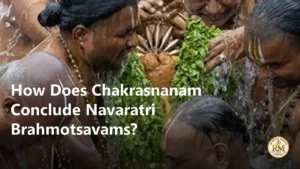
What is Chakrasnanam? Chakrasnanam is the sacred concluding purificatory bath, known as Avabhritha Snanam, offered to Sri Sudarshana Chakrathalwar to mark the sanctifying completion of the divine Brahmotsavam sacrifice. During the 2026 Navaratri Brahmotsavam, this celestial bathing ceremony takes place on the morning of October 20 at 6:00 AM in the sacred waters of the Swami Pushkarini at Tirumala. It represents the supreme spiritual finale that bestows the complete fruit of the sacred festival and the all-encompassing grace of Lord Venkateswara.
Devotees navigating the relentless fatigue, mundane trials, and spiritual restlessness of daily worldly life constantly look toward sanctified pilgrimage shrines to discover lasting inner peace and divine connection. In the sacred abode of Tirumala, the holy event of Chakrasnanam performed during the auspicious Navaratri Brahmotsavam is deeply revered by pilgrims as a celestial benediction that cleanses the heart and bestows profound spiritual fulfillment.
Among the majestic concluding ceremonies of the Navaratri festival, the morning procession of the Swarna Ratham (golden chariot) and the evening Ashwa Vahanam (horse vehicle) on October 19, followed by the momentous Chakrasnanam on October 20, evoke extraordinary devotional joy among millions of pilgrims. A thorough exploration of the profound philosophical symbolism and Vaikhanasa Agama traditions behind these magnificent festive rituals reveals the timeless spiritual wisdom preserved on the sacred Seven Hills.
Read the complete Telugu edition of this article.
For the wider festival background, read our Tirumala Salakatla and Navaratri Brahmotsavams main guide.
October 19 Swarna Ratham Differs from the Wooden Great Chariot
On the eighth morning of the Tirumala Navaratri Brahmotsavam, corresponding to October 19 at 7:00 AM, Lord Sri Malayappa Swami, accompanied by His divine consorts Sridevi and Bhudevi, ascends the resplendent Swarna Ratham to grace the four sacred Mada Streets. In place of the colossal wooden chariot procession traditionally conducted during the annual Salakatla Brahmotsavam, the ceremonial rolling of the golden chariot during the Navaratri festival serves as an exclusive Agama custom. Moving through the sacred pathways bathed in the golden radiance of the morning sun, this magnificent procession fills the assembled devotees with boundless devotion and aesthetic awe.
According to canonical Agama injunctions, the eighth morning of the annual Salakatla Brahmotsavam is strictly reserved for the grand procession of the massive wooden chariot, known as the Rathotsavam. However, during the Navaratri Brahmotsavam organized in lunar leap years (Adhika Masa), the great wooden chariot is not operated, and the temple administration instead deploys the glorious golden chariot, which is exceptionally dear to the Lord. Pilgrims must clearly appreciate this canonical ritual difference to understand the true liturgical distinction between the twin Brahmotsavam celebrations.
The majestic sight of Lord Venkateswara alongside Sridevi and Bhudevi, brilliantly enthroned upon the gold-gilded chariot that shimmers with celestial luminescence, awakens supreme spiritual joy within every onlooker. It has been a cherished time-honored tradition for thousands of eager pilgrims, especially women devotees, to participate enthusiastically in pulling the sacred chariot ropes with deep reverence and heartfelt surrender. As the reverberations of auspicious temple music, traditional drums, and thunderous chants of Govinda Nama echo through the Mada Streets, the entire sacred precinct of Tirumala is transformed into a realm of pure spiritual splendor.
Puranic traditions and cultural lore attribute profound spiritual symbolism to this golden chariot procession. While Goddess Sridevi personifies infinite spiritual wealth and divine prosperity, Goddess Bhudevi represents the endless abundance of the earth and sustained nurture. The Supreme Protector of the cosmos traversing the holy pathways in radiant golden brilliance flanked by His dual consorts signifies His eternal cosmic sovereignty, bestowing profound tranquility and inner joy upon the souls of devoted seekers.
Generations of devout pilgrims have held the firm belief that witnessing this golden chariot procession with a pure heart confers immense auspiciousness, peace, and spiritual well-being. From an operational and logistical standpoint, recognizing the clear difference between the wooden chariot and the Swarna Ratham assists pilgrims in aligning their devotional schedule with the exact official timing. Devotees desiring to participate in this auspicious event are advised to prepare well in advance for the 7:00 AM commencement on the morning of October 19.
Body and Mind Control in the Symbolism of the Chariot
The profound philosophical essence underlying the chariot festival has been expounded with remarkable depth across the principal Upanishads. In the revered verses of the Katha Upanishad, classical Vedanta presents the striking allegory that the human physical body is like a chariot, while the indwelling immortal Atman is the true master or rider of the chariot. The grand ceremonial chariot procession in Tirumala serves as an evocative visual reminder of this eternal metaphysical truth, illustrating that guiding the human body along the path of righteous dharma is the ultimate objective of spiritual endeavor.
In this classic Upanishadic analogy, the discerning intellect (Buddhi) acts as the wise charioteer, the conscious mind (Manas) serves as the guiding reins, and the five sensory faculties (Indriyas) are compared to spirited horses. To prevent these powerful sensory horses from running uncontrollably down the tumultuous streets of worldly temptations, the discriminating intellect must maintain a resolute and balanced hold upon the reins of the mind. Scriptural preceptors frequently explain that if sensory impulses are left undisciplined, the chariot of human life inevitably derails from the path of truth.
RECOMMENDED PRODUCT

Ekhasa Brass Durga Idol Sacred Home Decor Assessment : How can this product help you?
Devotees seeking to furnish a home mandir, office desk, or small prayer shelf often need an authentic brass deity sculpture that fits tight spaces without tipping over during… The Ekhasa idol fits crowded shrines with its space-saving profile while staying grounded during devotional practices. Its detailed multi-armed posture and bright golden glow… The Ekhasa Pure Brass Durga Maa Idol is a solid 390-gram cast brass devotional sculpture featuring traditional Sherawali Mata multi-armed iconography and a polished golden…
Read more about this productBuy on Amazon
As an Amazon Associate, RamthaMedia earns from qualifying purchases.
To behold the Supreme Lord seated majestically upon the chariot is to recognize and venerate the divine inner presence (Antaryamin) that continuously guides the bodily chariot of every living being. Although thousands of devotees exert physical energy to draw the material chariot forward in the temple streets, the deeper philosophical realization is that the supreme cosmic consciousness pervades and animates the entire universe. Cultivating this humble awareness that the Supreme Lord is the ultimate prime mover behind every action serves to eliminate egoism and arrogance from the seeker’s mind.
Devotees reflect that contemplating this chariot metaphor awakens the vital discriminative wisdom (Atma-Anatma Viveka) that distinguishes the transient physical body and the subtle mental sheath from the eternal, unchanging Self. For modern human beings lost in the dizzying pursuit of external material possessions, the serene vision of the chariot inspires an inward contemplative journey. Sanatana Dharma consistently emphasizes that discovering the transcendental reality that lies behind all decorative external forms represents the true dawn of spiritual awakening.
Just as Lord Sri Krishna assumed the role of the charioteer to guide Arjuna’s chariot upon the battlefield in the Bhagavad Gita, this sacred ritual inspires seekers to completely surrender the chariot of their own mortal lives at the lotus feet of the Divine. Rather than viewing the chariot festival merely as a grand public spectacle, earnest pilgrims benefit greatly by treating it as an instructive guide for inner spiritual sadhana. Vedantic philosophy affirms that approaching the sacred festival with such contemplative insight nurtures mental restraint, serene composure, and unblemished devotion.
Traditional Message of Sense Restraint in Ashwa Vahanam
On the evening of October 19 at 7:00 PM, Lord Sri Malayappa Swami mounts the majestic Ashwa Vahanam (horse vehicle) to process along the Mada Streets, bestowing His compassionate darshan upon the gathering of devotees. As the culminating nocturnal vehicle procession of the nine-day Navaratri Brahmotsavam, the horse vehicle service occupies a unique and revered status in temple tradition. Taking place between 7:00 PM and 9:00 PM, this nocturnal procession moves through Tirumala in grand spiritual splendor amidst thunderous devotional chants of the divine name.
According to the philosophical perspectives articulated in the Krishna Yajurveda, swift and galloping horses represent the dynamic, turbulent senses of human beings. Spiritual elders explain that the core philosophical message embedded in the Ashwa Vahana procession is the imperative need to restrain these restless sensory faculties, channel them toward righteous living, and redirect them toward the Supreme Divinity. Vedic tradition makes it clear that only an aspirant who exercises conscious mastery over sensory desires can attain enduring mental equilibrium and ultimate spiritual truth.
According to Puranic prophecies, at the conclusion of the present Kali Yuga, the Supreme Lord is destined to manifest as the Kalki Avatar, riding upon a divine horse to eliminate adharma and firmly re-establish righteous cosmic order. Devotees believe that by appearing in the majestic form of an equestrian monarch, the Lord inspires souls to conquer the inner enemies of spiritual life—the Arishadvargas, consisting of lust, anger, greed, attachment, pride, and jealousy. This avataric symbolism reminds devotees that continuous remembrance of the divine name is the most effective discipline to transcend the degenerative influences of the current age.
The extraordinary speed, strength, and unwavering alertness of the horse are considered symbolic reflections of the intense devotion and spiritual dispassion (Vairagya) required of every earnest seeker. The vehicle service serves as an inspiring lesson that true sense-control consists of reigning in the mind when it rushes headlong toward worldly distractions and anchoring it firmly in divine contemplation. Master preceptors state that through disciplined and steady inner practice, a person can elevate human consciousness to its highest spiritual perfection.
Traditional devotional beliefs maintain that witnessing the Ashwa Vahana procession with sincere reverence purifies the inner consciousness (Antahkarana) and cleanses residual mental dross. Throughout the nine-day cycle of divine vehicle services, the horse vehicle stands out as a crucial spiritual milestone that fosters resolute dispassion and dedicated devotional intent within pilgrims. With the completion of this glorious nocturnal procession, the entire sequence of evening vahana services for the Navaratri Brahmotsavam reaches its formal conclusion.
📖 Why Is Pushpaka Vimanam Special to Navaratri Brahmotsavams?
The Sacred Chakrasnanam on October 20 at Six in the Morning
On the culminating tenth morning of the Tirumala Navaratri Brahmotsavam, corresponding to October 20 at 6:00 AM, the sacred and eagerly awaited ritual of Chakrasnanam commences. Regarded as the supreme concluding ceremony that brings the entire nine-day festival to full spiritual fruition, the Chakrasnanam Mahotsavam is conducted in Tirumala with meticulous adherence to ancient Vaikhanasa Agama injunctions. Countless devotees gather across the tiers and promenades surrounding the holy Swami Pushkarini to witness this exalted spiritual climax.
During this sacred concluding phase of the Brahmotsavam, the processional deities—Lord Sri Malayappa Swami along with His consorts Sridevi and Bhudevi—are ceremoniously escorted alongside Sri Sudarshana Chakrathalwar, the living embodiment of the Lord’s divine cosmic weapon, to the Sri Bhu Varahaswami Temple Mukhamandapam situated on the northern bank of the holy tank. There, the temple archakas conduct the elaborate Snapana Tirumanjanam (celestial bath) with profound Vedic chanting and traditional solemnity. The priests perform preliminary rites including Vishvaksena Aradhana, Punyahavachanam, ceremonial cleansing, and the formal offering of royal honors such as decorative umbrellas and whisks.
The archakas perform a grand bathing ablution using thousands of sanctified streams of milk, curd, honey, tender coconut water, turmeric paste, and aromatic sandalwood paste over Sri Sudarshana Chakrathalwar and the processional deities. Throughout this sanctifying ablution, learned Vedic scholars chant majestic portions from the sacred scriptures, including the Upanishads, Purusha Suktam, Sri Suktam, and Vishnu Suktam. Simultaneously, under the supervision of the revered Jeyars, scholars recite the sublime Tamil Divya Prabhanda Pasurams with immense devotion, enveloping the entire temple precinct in celestial spiritual vibrations.
Upon the formal and canonical completion of the elaborate Snapana Tirumanjanam rituals, the presiding archakas reverently carry Sri Sudarshana Chakrathalwar directly into the sanctified waters of the Swami Pushkarini, immersing the sacred disc at the precisely designated astrological muhurtham. Sacred Agama treatises declare that the exact moment when Chakrathalwar is immersed in the Pushkarini waters signifies the official spiritual culmination of the Brahmotsavam, radiating cosmic peace, spiritual harmony, and supreme auspiciousness across all the worlds.
This sanctifying ritual, commencing from 6:00 AM onwards, is believed to transmit the entire fruit of the nine-day cosmic sacrifice directly to the devoted participants. The deep-rooted devotional conviction among pilgrims is that witnessing Chakrasnanam at the conclusion of the nine-day festival allows one to receive the unified grace of every sacred vehicle service offered during the entire festival. This sacred event ignites boundless spiritual vitality and divine resonance across the holy landscape of Tirumala.
The Spiritual Significance of Sudarshana Chakrathalwar Avabhritha Snanam
In the sacred Vedic tradition, the purificatory ablution performed at the successful conclusion of any great Vedic yajna or sacrifice is reverently known as the ‘Avabhritha Snanam.’ Because the Navaratri Brahmotsavam of Lord Venkateswara is celebrated as an exalted cosmic sacrifice instituted for universal welfare (Loka Kalyana), canonical Agama treatises classify the concluding Chakrasnanam as the sublime Avabhritha bath of this cosmic festival. With this sanctified bath, the comprehensive nine-day spiritual endeavor attains its crowning fulfillment and sacred perfection.
Traditional beliefs hold that if any inadvertent procedural errors, minor liturgical omissions, or subtle Agama infractions occurred during the elaborate nine-day festival, the Avabhritha Snanam effectively expiates all such deficiencies, ensuring that the sacrifice yields its absolute, undiminished spiritual fruit. This expiatory and sanctifying bath holds immense significance because it distributes the aggregate spiritual benefits of the sacred festival equally among the archakas, administrative officers, and all participating pilgrims.
The celestial Sudarshana Chakra held in the right hand of Lord Sriman Narayana serves as the supreme emblem of the Divine Will (Sankalpa Shakti) and eternal cosmic protection. In the Sri Vaishnava tradition, the Sudarshana disc is affectionately and reverently worshipped as ‘Chakrathalwar.’ He is venerated as an active divine intelligence that tirelessly subdues demonic forces, safeguards cosmic righteousness (Dharma), and pierces through the dense veil of spiritual ignorance obscuring the seeker’s mind, serving as a direct manifestation of the Lord’s boundless compassion and protective power.
Devotees maintain the profound conviction that the physical immersion of Chakrathalwar elevates the sacredness of the Swami Pushkarini waters to an extraordinary spiritual zenith. It is widely held in traditional belief that taking a holy dip in that sanctified water, or reverently sprinkling a few drops upon one’s head at that auspicious hour, washes away accumulated sinful impressions and spiritual impurities. Pilgrims revere the Pushkarini during this exalted moment as being fully identical to the holy waters of the sacred River Ganga.
The deeper philosophical truth embedded within Chakrasnanam is the total surrender of individual egoism, pride, and worldly illusions to the supreme cosmic will of the Divine. Scriptural preceptors teach that witnessing this sacred Avabhritha bath infuses the seeker with renewed spiritual vigor, emotional clarity, and unshakeable inner tranquility. Attaining inner purification of the mind and heart alongside the outer cleansing of the physical body represents the true, ultimate objective of this extraordinary concluding ritual.
RECOMMENDED BOOK

The Maya Simulation: Quantum Physics and the Science of Consciousness by A. Ravinder
Is the world around us real? Or is it just a Maya Simulation?
A guide that bridges the ancient wisdom of the Yoga Vasistha with quantum physics and modern consciousness science — for readers ready to question the nature of reality and calm the mind with practical tools like the Zero Voice Technique. It explores mind, maya and consciousness in plain language, and offers a practical path for the seeker on the spiritual journey. Available in print and ebook instant-read versions.
Buy on AmazonBuy on Ramthamedia
As an Amazon Associate, RamthaMedia earns from qualifying purchases.
Viewing the September Chakrasnanam Report as a Historical Precedent
In earlier annual Salakatla Brahmotsavams, such as the Chakrasnanam Mahotsavam observed on September 23, 2026, extensive crowds of pilgrims congregated at the Swami Pushkarini, as documented in official TTD news releases. It is essential for modern pilgrims to understand that such archival press reports serve strictly as historical precedents to help understand how liturgical rituals were organized in past instances, rather than functioning as a direct operational blueprint for the October Navaratri arrangements.
During that past September 2026 observance, the Snapana Tirumanjanam ceremony in the Sri Bhu Varahaswami Temple Mukhamandapam between 6:00 AM and 9:00 AM, followed by the concluding dip of Chakrasnanam in the Pushkarini, was executed in full accordance with scriptural norms. Official information releases noted that temple administrators, archakas, and vigilance personnel worked in close organizational harmony to ensure the smooth execution of the complex religious ceremony.
However, historical security deployment statistics, volunteer figures, or specialized police deployment ratios from the September Salakatla Brahmotsavam must never be mechanically projected onto the October Navaratri festival. For every unique festival occasion, the Tirumala Tirupati Devasthanams independently drafts fresh operational action plans tailored specifically to prevailing on-ground conditions, logistical variables, and the dynamic density of visiting pilgrim crowds.
Examining archival records of past celebrations provides seekers with a useful conceptual understanding of the overarching ceremonial sequence, but it cannot be regarded as an official administrative guarantee for current October arrangements. Wise pilgrims treat past operational bulletins purely as informative historical context while remaining fully aware that operational parameters, barricading lines, and security arrangements are updated dynamically on the ground.
Devotees should continuously monitor the latest announcements, travel guidelines, and regulatory advisories published directly through the official TTD portal to organize their pilgrimage effectively. The documented experiences of the September 2026 festival stand as valuable historical illustrations reflecting the unbroken continuity of ancient temple traditions, but they do not serve as binding contemporary regulations for the October festival period.
Pushkarini Darshan Entry and Safety as Distinct Elements
Viewing Chakrasnanam, reaching the Pushkarini and entering the water are separate matters. Announcement of the ritual does not guarantee everyone access to the same place. Watching an official live broadcast, if available, is another option. Whichever approach a visitor considers, decisions should follow information issued for that occasion.
Before approaching the Pushkarini, identify the officially designated route and follow staff directions for current crowd and access conditions. Do not assume a gate used during an earlier festival will be available again. Staying together as a family and consulting staff when a route is closed are sensible parts of a visit plan.
Safety arrangements described in September’s Chakrasnanam reports concerned that event. This guide does not confirm identical staffing or deployment for October. Respect the boundaries set by the officials on duty, avoid entering areas where access is not permitted, and leave room for fellow visitors to move as directed.
Earlier reports describe the Pushkarini’s sanctity throughout Chakrasnanam day as a traditional belief. That belief is not an announcement of access hours. It should not be interpreted as permission to enter the water without restriction at any time after the morning ritual. Confirm the arrangements for that day with TTD or officials on duty.
Families visiting with older people or children should consider their members’ needs in advance. Account for steps, crowds and waiting, and decide according to conditions on the ground. Being unable to approach closely need not be treated as a spiritual failing. Cooperating with staff and respecting family members’ comfort are also responsible ways to participate in the festival.
Navaratri Festival Culmination Without Dhwajavarohanam
In the standard annual Salakatla Brahmotsavam, the nine-day festivities draw to a formal close on the ninth night with the ceremonial lowering of the sacred Garuda flag from the golden flagstaff, a liturgical ceremony known as ‘Dhwajavarohanam.’ However, pilgrims formulating their temple itinerary must clearly note that this Dhwajavarohanam ceremony is entirely absent during the Navaratri Brahmotsavam celebrated in October. This distinct Agama difference highlights the unique ceremonial character of the Navaratri festival.
Because the Navaratri Brahmotsavam is an extraordinary, specialized celebration organized during lunar leap years, canonical Vaikhanasa Agama treatises dictate that it features neither the preliminary flag-hoisting ritual (Dhwajarohanam) at its commencement nor the formal flag-lowering rite (Dhwajavarohanam) at its conclusion. The absence of these two flagstaff rites—which respectively invite the thirty-three crore celestial devatas to attend the yajna and subsequently bid them farewell—makes the operational rhythm of the festival distinct from the annual Salakatla celebration.
Consequently, with the conclusion of the sacred Chakrasnanam ceremony commencing at 6:00 AM on the morning of October 20, the primary Vedic and liturgical rites of the nine-day Navaratri Brahmotsavam reach their official, complete conclusion. The festival regulations make it explicit that devotees need not wait until the late night hours within the temple complex expecting a flag-lowering ritual. The morning Chakrasnanam event itself marks the comprehensive culmination of the sacred festival.
For pilgrims who have experienced the divine presence of the Lord across every vehicle procession from the festival’s commencement to its conclusion, the sacred Chakrasnanam provides a deeply satisfying sense of spiritual closure. Even though flagstaff-related ceremonies are not included, the nine-day Navaratri Brahmotsavam unfolds with unmitigated spiritual grandeur and scriptural authenticity, allowing every pilgrim to become a worthy recipient of Lord Venkateswara’s boundless compassion.
Grasping this precise Agama distinction enables devotees to plan their Tirumala pilgrimage smoothly and conclude their spiritual journey with clarity. The divine darshan of the Lord and the sacred memory of the Chakrasnanam bath at the finale of the Navaratri Brahmotsavam leave an indelible impression of lasting spiritual peace and renewed inner vigor in the hearts of all devoted pilgrims.
📖 Why Navaratri Brahmotsavams Again? Tirumala October 2026 Dates
Comparison of Chariot and Bathing Rituals in Tirumala Brahmotsavams
| Aspect | Swarna Ratham / Navaratri Chakrasnanam | Wooden Chariot / Salakatla Finale |
|---|---|---|
| Vehicle Form | Magnificent Golden Chariot (Swarna Ratham) at 7:00 AM on October 19 | Massive wooden great chariot procession (Rathotsavam) |
| Agama Injunction | Golden Chariot replaces the wooden chariot in Navaratri Brahmotsavams | Massive wooden chariot is drawn on the eighth morning during Salakatla Brahmotsavams |
| Concluding Ritual | Festivals conclude with Chakrasnanam at 6:00 AM on October 20 | Festivals conclude with Chakrasnanam followed by Dhwajavarohanam at night |
| Flagstaff Tradition | No Dhwajarohanam or Dhwajavarohanam in Navaratri Brahmotsavams | Traditional Garuda Dhwajarohanam and Dhwajavarohanam are performed |
The Eternal Message of the Holy Kshetra
The three sublime concluding ceremonies—the Chariot, the Horse vehicle, and the Chakrasnanam—stand as magnificent spiritual metaphors for the human journey. The eternal truth taught by the chariot and the horse processions is that the individual soul can attain communion with the Supreme Divinity only when the physical body is guided by the discerning intellect and the sensory faculties are kept under steady control.
The concluding Avabhritha Chakrasnanam washes away human egoism, doubt, and inner impurities, bestowing absolute mental clarity and spiritual peace. This divine finale reminds us of the paramount philosophy of total surrender (Sharanagati), demonstrating that lasting fulfillment is achieved only when we submit our personal ego entirely to the supreme cosmic will symbolized by the Sudarshana Chakra.
Devotees visiting the sacred shrine must maintain composure and discipline at the Pushkarini ghats. One should view Chakrasnanam not merely as an external physical ablution, but as a consecrated inner vow to wash away mental impurities and egoistic attachments.
Chapter Summary
During the Tirumala Navaratri Brahmotsavams, the divine Swarna Ratham procession takes place on October 19 at 7:00 AM, followed by the Ashwa Vahanam at 7:00 PM. On October 20, the sacred Chakrasnanam (Avabhritha bath) of Sri Sudarshana Chakrathalwar is performed at 6:00 AM at the sacred Swami Pushkarini. Unlike annual Salakatla festivals, the Navaratri festival features neither the wooden chariot nor Dhwajavarohanam, concluding officially with Chakrasnanam. Devotees are advised to observe all safety protocols around the temple tank.
Scripture Notes
- Main Message: Attaining inner purification through the restraint of senses and mind, culminating in total surrender at the lotus feet of the Divine.
- Philosophical Teaching: The physical body is the chariot and the inner Self is the charioteer; in the yajna of mortal life, true fulfillment lies in surrendering completely to the Divine Will.
Inner peace is realized only when the restless mind is reined in by the intellect through discrimination.
The holy waters sanctified by Sri Sudarshana Chakrathalwar dispel ignorance and awaken the light of divine wisdom in the earnest seeker.
Frequently Asked Questions
What time is Chakrasnanam conducted during the Navaratri Brahmotsavam?
Chakrasnanam commences at 6:00 AM on the morning of October 20. Following the elaborate Snapana Tirumanjanam performed for Lord Sri Malayappa Swami, His consorts, and Sri Sudarshana Chakrathalwar, the sacred Avabhritha bath is solemnly conducted in the Swami Pushkarini.
Why is the Swarna Ratham held instead of the wooden chariot on October 19?
According to Vaikhanasa Agama rules, the massive wooden chariot is not operated during the Navaratri Brahmotsavam, which takes place in lunar leap years. Instead, Lord Venkateswara graces the Mada Streets upon the magnificent Golden Chariot (Swarna Ratham) at 7:00 AM on October 19.
What is the spiritual significance of the Ashwa Vahanam procession?
The Ashwa Vahanam symbolizes mastery over the turbulent human senses. In Vedantic philosophy, the senses are compared to wild horses; guiding them along righteous paths toward God while overcoming the afflictions of Kali Yuga is the core message of this service.
Why is there no Dhwajavarohanam at the end of the Navaratri Brahmotsavam?
Vaikhanasa Agama dictates that the Navaratri Brahmotsavam celebrated during an Adhika Masa does not include Dhwajarohanam or Dhwajavarohanam. Therefore, the nine-day festivities conclude officially with the sacred morning Chakrasnanam on October 20.
What safety and entry guidelines should pilgrims follow during Chakrasnanam?
Follow current TTD announcements and on-site staff directions for entry routes and permitted times on 20 October. The traditional belief that the Pushkarini remains sacred throughout the day does not mean unrestricted admission is available all day.
What is the importance of the Avabhritha Snanam of Sudarshana Chakrathalwar?
The Avabhritha Snanam is the concluding sanctifying bath performed at the end of a grand Vedic sacrifice to expiate any procedural shortcomings and ensure universal peace. Immersing the protective Sudarshana Chakra in the Pushkarini extends the divine fruits of the festival to all beings.
Conclusion
The radiant brilliance of the Swarna Ratham, the imposing majesty of the Ashwa Vahanam, and the sanctifying waters of Chakrasnanam fill the hearts of devotees with deep spiritual fulfillment. Recognizing the transcendent philosophical truth behind these magnificent external rituals represents the highest form of devotion to Lord Venkateswara.
External Source Links
- Official TTD Navaratri Brahmotsavam Schedule
- Significance of Leap Year Twin Brahmotsavams
- TTD Official Chakrasnanam Report
- Pushkarini Chakrasnanam Arrangements
Information checked: 28 September 2026. Cover background: TTD archive dated 2026-09-23; not a photograph of the forthcoming October 2026 festival. TTD News


