
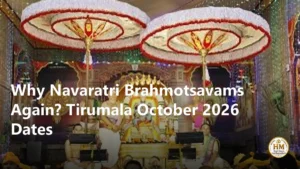
Why does Tirumala hold Navaratri Brahmotsavams after the September festival? The tradition of holding two Brahmotsavams in an Adhika Masa year brings the second festival on 12–20 October 2026, preceded by Ankurarpanam on 11 October. TTD’s 27 September announcement confirms that October has no flag hoisting, great wooden chariot procession or flag lowering.
Whenever individuals encounter trials, burdens, and uncertainties in worldly life, our enduring cultural tradition inspires us to seek spiritual solace within sacred pilgrimage shrines. The very instant a seeker sets foot upon the sanctified hills of Tirumala—revered as Kaliyuga Vaikuntham, the earthly abode of the Divine—the accumulated anxieties and tribulations of mundane existence disperse, enveloped by an indescribable atmosphere of celestial tranquillity and grace.
Within this illustrious pilgrimage centre of Tirumala, the observance of Navaratri Brahmotsavams during the occurrence of the lunar Adhika Masam offers devotees a magnificent, twofold experience of spiritual grandeur and devotional ecstasy. Scheduled to take place from October 12 to October 20, 2026, this comprehensive guide explores the profound religious significance, scriptural distinctions, traditional liturgical ceremonies, and the complete authoritative schedule of these nine-day divine festivities.
Read the complete Telugu edition of this article.
For the wider festival background, read our Tirumala Salakatla and Navaratri Brahmotsavams main guide.
Why Navaratri Brahmotsavams Bring a Second Festival
According to the ancient computational principles of the traditional Hindu lunar calendar (Chandramana), the arrival of an intercalary leap month, known as Adhika Masam or Mala Masam, occurs naturally once approximately every three years (or thirty-two to thirty-three solar months). This supplementary lunar month is systematically formulated in Vedic astronomy and astrological calculations to reconcile and harmonise the mathematical discrepancy between the 365-day solar year (Sauramana) and the approximately 354-day lunar year. Because of this celestial astronomical alignment, the sacred hill shrine of Tirumala, venerated as the earthly Vaikuntha of Lord Sri Venkateswara Swamy, preserves the glorious antiquity of observing the supreme Brahmotsavam festival twice within the span of a single Gregorian calendar year.
In the authoritative taxonomy established by the Vaikhanasa Agama Shastra, the grand annual festival celebrated during Kanya Masam (Bhadrapada month) is formally designated as the Salakatla Annual Brahmotsavam, whereas the celebratory festival observed during Ashwayuja Masam in conjunction with the sacred Dussehra festivities is venerated as the Navaratri Brahmotsavam. In the annual canonical liturgical cycle of Lord Srinivasa, both of these grand celebrations carry immense spiritual sanctity, providing devotees with the exceptionally rare and blessed opportunity to witness the Lord’s celestial Vahana Sevas (divine vehicle processions) twice in the very same year, multiplying their spiritual joy and devotional contemplation.
In strict adherence to the celestial movements of the sun and moon that govern seasonal harmonization, the Vaikhanasa tradition prescribes the performance of extraordinary religious observances (Visesha Kainkaryams) to the Supreme Lord during this sanctified Adhika Masam. According to revered Puranic lore and devotional belief, the supreme purpose of conducting this second series of festivities is to perpetuate without interruption the eternal cyclical lineage of cosmic worship initially inaugurated by Lord Brahma Himself for the protection, peace, and universal welfare of all living beings (Loka Kalyanam). These sacred spiritual observances serve as sanctified rituals envisioned by ancient Vedic rishis to invoke divine grace, balance the cosmic elements, and bestow auspiciousness upon the entire creation.
In the present calendar year of 2026, the Salakatla Brahmotsavalu were celebrated with immense majesty from September 15 to September 23, while the grand Navaratri Brahmotsavams are observed from October 12 to October 20. While standard years without an intercalary month host only a single annual Brahmotsavam, the advent of Adhika Masam transforms the sacred Seven Hills into a luminous spectacle of heightened devotional ecstasy and religious celebration. Devotees and pilgrims across the globe revere this auspicious astronomical convergence as an extraordinary period for acquiring divine merit, spiritual purification, and contemplative absorption in the Lord’s presence.
The organization, procedural governance, and schedule determination of both these festivals are finalized in accordance with the official administrative resolutions of the Tirumala Tirupati Devasthanams (TTD) under the strict canonical guidance of the temple’s Agama advisors and chief priests. By meticulously correlating astronomical almanac calculations (Panchangam) with scripturally mandated lunar tithis and festival days, the TTD governing board proclaims the definitive dates for the public. In this manner, the Navaratri Brahmotsavams conducted atop the holy hill of Tirumala stand as an exceptional spiritual lighthouse, guiding pilgrims toward meaningful devotional contemplation, inner discipline, and the rare fortune of beholding the Lord in His multifaceted divine majesty.
Three Major Ritual Ceremonies Absent When Compared to Salakatla
When examining the canonical structure of the regular annual Salakatla Brahmotsavam celebrated during Bhadrapada month alongside the Ashwayuja Navaratri Brahmotsavam observed during an Adhika Masam year, three primary Agama-mandated ritual distinctions emerge. It is fundamentally important to understand that these distinctions do not diminish the outer majesty, spiritual beauty, or decorative splendour of the processions, but rather pertain strictly to specific Vedic, tantric, and ritual boundaries laid down in the Vaikhanasa treatises. Possessing a clear awareness of these subtle liturgical differences enriches the devotional comprehension of pilgrims journeying to Tirumala.
The foremost procedural distinction is the total omission of Dhwajarohanam (the ceremonial flag hoisting). During the annual Salakatla Brahmotsavam, the festival officially commences with the sanctified raising of the sacred Garuda Dhwaja (flag bearing the insignia of Garuda) atop the gilded Dhwajastambham (temple flagstaff) amidst Vedic incantations to invoke and invite the thirty-three crore devatas, celestial beings, and the guardians of the eight cardinal directions (Ashta Dikpalakas) to witness and participate in the celebrations. In the Navaratri Brahmotsavam, however, this ceremonial invitation through Dhwajarohanam is intentionally omitted; instead, the nine-day festivities commence directly and auspiciously on the morning of the first day with the majestic Bangaru Tiruchi (golden palanquin) procession of Lord Malayappa Swamy.
The second significant structural variation is the absence of the immense wooden Rathotsavam (Maha Ratham or great wooden chariot procession). During the eighth morning of the Salakatla Brahmotsavam, the Lord, accompanied by His divine consorts Sridevi and Bhudevi, mounts a colossal multi-tiered wooden chariot which is pulled through the four Mada Streets by thousands of ecstatic devotees surging with collective devotion. In the Navaratri Brahmotsavam sequence, this immense wooden chariot procession is not conducted; instead, on the designated eighth morning, Lord Malayappa Swamy along with His consorts graces the sacred Mada Streets exclusively upon the shimmering Swarna Ratham (Golden Chariot), bestowing His divine darshan upon the assembled multitude.
The third canonical distinction occurs at the very conclusion of the nine-day cycle, marked by the absence of Dhwajavarohanam (the ceremonial flag lowering). On the final night of the Salakatla Brahmotsavam, the Garuda flag is reverently lowered with scriptural Vedic rites, formally bidding farewell to the assembled devatas and cosmic deities who answered the initial invocation. Because the Navaratri Brahmotsavam begins without the initial invocation of Dhwajarohanam, the scriptural codes dictate that the concluding farewell ritual of Dhwajavarohanam is likewise non-existent and inapplicable to this supplementary festival.
Notwithstanding the scriptural omission of these three distinct Vedic rituals, all other traditional Vahana Sevas, exquisite alankarams (ornamental decorations), and majestic processions continue with full liturgical sanctity and resplendent grandeur. Every morning and night, the sacred Mada Streets come alive as the divine vehicle processions distribute boundless spiritual bliss and aesthetic joy to the gathered pilgrims. By scrupulously preserving these Agama-prescribed parameters, the Tirumala Tirupati Devasthanams ensures that the spiritual integrity of the rituals is rigorously guarded while allowing the celebratory splendour to shine with unmitigated brightness.
How the October 11 Ankurarpanam Counts in the Nine-Day Schedule
Serving as the sanctified prelude to the grand Navaratri Brahmotsavams of Lord Venkateswara at Tirumala, the auspicious rite of Ankurarpanam is performed according to strict scriptural mandates in the temple’s Yagashala (sacrificial hall) on the night of October 11 between 7:00 PM and 9:00 PM (19:00 to 21:00 IST). In the venerable framework of the Vaikhanasa Agama Shastra, the formal sowing of nine sacred seeds (Bija Vapanam) is an indispensable preliminary duty that must precede any major religious festival. This profound ceremony serves as the consecrated spiritual resolve (Sankalpa) to ensure the flawless execution, divine harmony, and complete spiritual efficacy of the forthcoming nine-day celebrations.
During the sacred performance of Ankurarpanam, temple priests sow the Navadhanyas (nine varieties of sacred grains) into specialized earthen receptacles known as Palikas within the sacred precinct of the Yagashala. In the esoteric symbolism of the Agama treatises, the germination and sprouting of these consecrated seeds signify cosmic creation, vegetative growth, spiritual fertility, and divine abundance across the universe. The chief archakas explain that this ritual is deliberately performed at night under the cool, nurturing rays of the moon, who is venerated in Vedic thought as the divine lord of flora, medicinal herbs, and vegetative sustenance (Sasyakaraka).
As an integral component of this preliminary liturgical ceremony, Sri Vishvaksena—the supreme Commander-in-Chief of Lord Vishnu’s divine forces—is taken in a sacred procession to oversee the gathering of sanctified earth from an anthill (Mrittika Sangrahanam / Medini Puja) to invoke the blessings of Bhudevi (Mother Earth). The priests place the sacred earth into the Palikas, deposit the nine grains representing the nine celestial planetary deities (Navagrahas), and chant the sacred Oshadhi Suktas from the Vedas with resonant precision. Devotional lore holds that the lushness, vitality, and health with which these sacred sprouts emerge during the festival period prophetically mirror the grandeur, peace, and spiritual success of the Brahmotsavalu.
From a calendar perspective, although the foundational Ankurarpanam ceremony occurs on the evening of October 11, the primary divine vehicle processions commence on October 12 and culminate with the sanctifying Chakrasnanam on the morning of October 20. Consequently, the nine-day duration spanning October 12 through October 20 is officially and liturgically designated as the primary core Brahmotsavam period. The preceding night of Ankurarpanam is classified as a consecrated preliminary threshold rather than a full independent day of public street processions.
In this manner, the Ankurarpanam ritual forms the spiritual bedrock upon which the entire nine-day festival architecture is erected, harmonizing every subsequent liturgical proceeding with cosmic alignment. Pilgrims planning their spiritual visit to Tirumala can view this sacred commencement as a vital milestone to structure their travel itineraries and darshan aspirations. This scripturally rooted beginning serves as a sublime devotional gateway, ushering in the awe-inspiring majesty of the divine Vahana Sevas that unfold across the sanctified mountain.
The First Day Sequence Beginning with Bangaru Tiruchi on October 12
On the morning of October 12 at 9:00 AM (09:00 IST), the official procession sequence of the Navaratri Brahmotsavams commences with the resplendent Bangaru Tiruchi (Golden Palanquin) Utsavam. Because this festival omits the preliminary Dhwajarohanam ceremony, this magnificent golden palanquin procession marks the very first occasion when Lord Malayappa Swamy emerges from the inner sanctum to traverse the four sacred Mada Streets and grant His direct, benevolent darshan to the awaiting devotees. Beholding the Supreme Lord seated inside the glittering, intricately crafted golden palanquin as morning sunlight cascades across the temple gopurams is revered by pilgrims as an utterly purifying visual feast.
📖 How Does Chakrasnanam Conclude Navaratri Brahmotsavams?
Following the peaceful conclusion of the morning Bangaru Tiruchi procession, the grand evening celebrations begin on that same night of October 12 at 7:00 PM (19:00 IST) with the highly prestigious and deeply venerated Pedda Sesha Vahana Seva. Flanked by His divine consorts, Goddess Sridevi and Goddess Bhudevi, Lord Malayappa Swamy ascends the colossal, majestic seven-hooded golden serpent vehicle (Adisesha) to glide gracefully through the illuminated Mada Streets. Vaishnava theological traditions elucidate that this premier vehicle procession embodies the quintessential spirit of selfless devotional service (Dasya Bhakti) and the supreme philosophical doctrine of absolute surrender (Sharanagati) to the Divine.
In Puranic scripture, Adisesha is extolled as the primal, eternal devotee and servant of Lord Maha Vishnu, serving the Lord perpetually as His divine couch, seat, parasol, footwear, and protective canopy. The epics celebrate how Adisesha incarnated as Lakshmana to serve Lord Rama in the Treta Yuga, and as Balarama alongside Lord Krishna in the Dvapara Yuga, exemplifying unwavering proximity and dedication to the Lord; thus, ascending Adisesha as His premier vehicle is deeply cherished by Lord Srinivasa. As the nocturnal procession moves through the Mada Streets under dazzling illuminations, the majestic spectacle of the seven golden hoods sheltering the radiant Lord immerses the surrounding sea of devotees in overwhelming spiritual ecstasy.
These two distinct processions on the opening day establish a grand and uplifting tone for the entire nine-day festival. While the morning Bangaru Tiruchi offers an atmosphere of serene majesty and early-morning contemplative joy, the evening Pedda Sesha Vahana unleashes a wave of vibrant devotional fervor and collective adoration. The holy four Mada Streets surrounding the ancient temple reverberate with the thunderous chanting of ‘Govinda! Govinda!’ intertwined with the melodious rhythms of traditional Nadaswaram and percussion instruments.
Pilgrims arranging their darshan schedules for the inaugural day must note with precision the distinct timings: the morning Bangaru Tiruchi commencing at 9:00 AM, and the evening Pedda Sesha Vahana beginning at 7:00 PM. Arriving well in advance to occupy seats within the orderly open-air galleries lining the four Mada Streets allows devotees to avoid travel fatigue and secure peaceful viewing positions. Familiarity with this opening-day sequence provides visitors with an organized and auspicious beginning to their holy Tirumala pilgrimage.
How to Read the Official Nine-Day Schedule
To navigate the festival period smoothly, pilgrims must carefully examine and comprehend the comprehensive nine-day Vahana Seva timetable officially promulgated by the Tirumala Tirupati Devasthanams (TTD) on September 27. From October 12 to October 20, morning and evening vehicle processions will take place daily around the sacred Mada Streets. Under standard scheduling protocols, morning Vahana Sevas are conducted between 8:00 AM and 10:00 AM (08:00 to 10:00 IST), while evening Vahana Sevas take place between 7:00 PM and 9:00 PM (19:00 to 21:00 IST), subject to explicitly designated liturgical exceptions.
On October 13, the Lord graces the morning procession on the graceful Chinna Sesha Vahanam (five-hooded serpent vehicle) representing Vasuki, followed in the evening by the Hamsa Vahanam (celestial swan vehicle), symbolizing supreme spiritual discrimination and wisdom. On October 14, the fierce Simha Vahanam (lion vehicle) symbolizing courage, sovereignty, and the eradication of ego takes place in the morning, followed at night by the enchanting Mutyapu Pandiri Vahanam (pearl canopy vehicle) signifying pure devotion and peace. On October 15, Lord Malayappa Swamy accompanied by His consorts processes upon the Kalpavriksha Vahanam (wish-fulfilling celestial tree) in the morning, and upon the majestic Sarvabhupala Vahanam (all-kings vehicle) in the evening, with each vehicle embodying unique Vedic and Puranic allegories.
On October 16, the morning procession features the Lord adorned in the bewitching Mohini Avatharam (the enchanting female form that distributed divine nectar), while the evening witnesses the crown jewel of the Brahmotsavam—the supreme Sri Garuda Vahana Seva. On October 17, the morning is sanctified by the Hanumantha Vahanam (devotion personified by Lord Hanuman), followed in the afternoon at 4:00 PM by the radiant Pushpaka Vimanam, and concluding at night with the regal Gaja Vahanam (elephant vehicle). On October 18, the Lord blesses the cosmos atop the effulgent Surya Prabha Vahanam (sun vehicle) in the morning, and the soothing Chandra Prabha Vahanam (moon vehicle) at night.
On October 19, the morning brings the dazzling Swarna Ratham (Golden Chariot) starting early at 7:00 AM, followed at night by the spirited Ashwa Vahanam (horse vehicle) symbolizing the Kalki avatar and cosmic order. On the culminating final day, October 20, the sacred Chakrasnanam (holy bath of Sri Sudarshana Chakrathalwar) is performed at 6:00 AM at the sacred Swami Pushkarini holy tank. Following elaborate Visesha Abhishekam ceremonies performed to Sri Chakrathalwar and the processional deities of Lord Malayappa Swamy and His consorts, the consecrated immersion in the sacred waters officially brings the Navaratri Brahmotsavams to a glorious canonical conclusion.
When reviewing this authoritative timetable, devotees must pay close attention not only to the standard morning and evening hours but also to the non-standard timings designated for high-importance processions. Because all processions commence precisely at their scheduled hours, pilgrims waiting in the street galleries should plan their entry, personal hydration, and rest periods accordingly. This official schedule serves as an indispensable blueprint, enabling pilgrims to transform their visit into a serene, spiritually enriching, and flawlessly organized journey.
Garuda, Pushpaka, and Swarna Ratham Timings Differing from Standard Hours
While the vast majority of vehicle processions throughout the Brahmotsavam adhere to the standard slots of 8:00 AM to 10:00 AM in the mornings and 7:00 PM to 9:00 PM in the evenings, the temple administration has established distinct, non-standard schedules for several exceptionally significant religious events. Understanding these specific timing variations in advance is critical for pilgrims, as these premier events draw massive crowds and require meticulous personal planning.
On the fifth day, October 16, the supreme Garuda Vahana Seva commences earlier than usual at 6:30 PM (18:30 IST) and continues until 11:30 PM (23:30 IST). Spanning five extensive hours, this protracted procession allows hundreds of thousands of devotees packing the Mada Streets to catch a transcendent glimpse of the Lord mounted upon the king of birds, adorned with the legendary Makarakanti and historic diamond jewels. In view of the immense congregation of pilgrims and to ensure safety, security, and comfortable darshan, the TTD administration allocates this elongated nocturnal window exclusively for Garuda Seva.
On the sixth day, October 17, the enchanting Pushpaka Vimanam procession commences at 4:00 PM (16:00 IST). Departing from the usual 7:00 PM nocturnal window, this special daytime aerial chariot procession winds through the Mada Streets in the late afternoon. Later that same night, from 7:00 PM to 9:00 PM, the regular evening schedule resumes with the majestic Gaja Vahana Seva, providing devotees with a double procession on a single evening.
On the eighth day, October 19, the celebrated Swarna Ratham (Golden Chariot) commences at 7:00 AM (07:00 IST), moving one full hour earlier than the conventional 8:00 AM morning slot so that the radiant golden chariot can complete its circuit comfortably in the soft morning light. Furthermore, on the grand finale of October 20, the sacred Chakrasnanam commences at 6:00 AM (06:00 IST) on the steps of the holy Swami Pushkarini, enabling thousands of eager devotees to take their simultaneous holy dip in the consecrated waters right after the Sudarshana Chakra immersion.
In light of these specific non-standard hours, pilgrims should review their daily itineraries and align their gallery waiting times well in advance. For extraordinary events like Garuda Seva, Pushpaka Vimanam, and Swarna Ratham, entering the Mada Street galleries several hours before the scheduled procession start time ensures a secure and comfortable vantage point. Practising punctual time management allows devotees to witness the breathtaking splendour of Lord Venkateswara’s vahanams with complete mental peace and spiritual satisfaction.
Why the September 27 Press Release Takes Precedence Over Older Announcements
Over the preparatory months preceding the Brahmotsavalu, the Tirumala Tirupati Devasthanams releases periodic informational press releases to update the public and administrative agencies. While preliminary statements were issued on August 31 and September 9, 2026, it is the official TTD Press Release No. 334857 issued on September 27 that provides the final, definitive, and authoritative schedule of all events. Consequently, pilgrims and research institutions must assign overriding precedence to this latest official communication.
Preliminary announcements typically contain broad thematic guidelines, generic event overviews, and tentative operational schedules. In contrast, the final press release reflects the definitive decisions finalized during comprehensive high-level review meetings conducted by senior TTD officials, security personnel, and the temple’s Agama board as the festival draws near. Operational logistics, crowd-control strategies, and exact starting times are firmly codified in this final document to guarantee safety and liturgical precision.
For instance, when cross-referencing multilingual public notices, the Telugu official press release provides definitive clarification regarding minor typographical or linguistic ambiguities present in certain preliminary English summaries. Specifically, regarding the first night’s Pedda Sesha Vahana Seva, the September 27 release explicitly confirms a 7:00 PM start time (19:00 IST), clarifying that it represents a single, grand evening procession rather than two fragmented processions, thereby eliminating any potential confusion among outstation pilgrims.
Pilgrims must rely exclusively upon the latest official releases published on the official TTD news portal (news.tirumala.org) rather than outdated circulars or unverified third-party blogs. Relying on the most recent official announcements guarantees that pilgrims have access to accurate, validated timing information, thereby preventing unexpected travel disruptions, missed processions, or logistical confusion during their holy pilgrimage.
Clear and accurate information saves devotees precious time, energy, and travel stress. By following the verified details in the September 27 release, devotees can plan their daily darshan schedules with absolute confidence and immerse their minds entirely in the spiritual experience of the Navaratri Brahmotsavams. Placing trust solely in authorized temple communications remains the most reliable and beneficial practice for every devotee of Lord Srinivasa.
What the 2023 Navaratri Koluvu Teaches Us About Temple Tradition
To fully appreciate the rich interior tapestry of the Navaratri Brahmotsavams, historical records of past observances offer illuminating insights into centuries-old temple traditions. A notable documented precedent occurred during the Navaratri Brahmotsavam on October 15, 2023, when the temple celebrated the sacred ‘Navaratri Koluvu’ (traditional ceremonial court) inside the historic Ranganayakula Mandapam within the sanctum complex of the Tirumala shrine. This sacred liturgical custom highlights the distinctive devotional charm that characterizes the Dussehra Navaratri season at Tirumala.
Held for approximately one hour immediately following the conclusion of the nocturnal Vahana Seva, this traditional durbar takes place within the serene confines of the Ranganayakula Mandapam. Temple archakas explain that the inner spiritual purpose of conducting this intimate Durbar is to offer loving respite and soothing comfort to Lord Malayappa Swamy and His divine consorts, Goddess Sridevi and Goddess Bhudevi, relieving Their divine fatigue after the long, elaborate procession through the crowded Mada Streets.
During this private ceremony, the processional deities are gracefully seated upon the Pedda Sesha Vahana inside the mandapam, where the priests perform the traditional Shodashopachara Seva (sixteen ceremonial offerings) accompanied by sanctified incense, lamps, arghya, padya, and achamaniya. Concurrently, eminent Vedic scholars and Prabandha parayandars chant the sacred hymns of the Divya Prabandham with deep devotional melody. Following the conclusion of the worship, the traditional honours of Shatari and prasadam felicitations are formally presented to the participating Vedic scholars and temple priests.
In documented past observances, such as the 2023 festival, the TTD Garden Department adorned the Ranganayakula Mandapam with a magnificent ‘Bommala Koluvu’ (artistic doll exhibition). Featuring beautifully sculpted miniature idols depicting the Dashavatara (ten incarnations of Lord Vishnu) alongside Goddess Lakshmi Devi, and decorated with elaborate arrangements of fresh fruits, cut flowers, and fragrant blossoms, the durbar pavilion was transformed into an enchanting visual tribute that captivated temple servitors and chroniclers alike.
These historical practices demonstrate that the Dussehra Navaratri celebrations at Tirumala possess a profound internal spiritual life beyond the public street processions. Such intimate sanctum rituals illustrate the exquisite tenderness, reverent care, and deep personal love with which the Vaikhanasa Agama tradition serves the Supreme Lord, viewing Him not merely as a cosmic sovereign, but as a living divine presence deserving of the most intimate devotional care.
Things to Consider Before Converting a Vahana Date into a Travel Plan
Devotees aspiring to witness the celestial Vahana Sevas during the Tirumala Brahmotsavalu should formulate their personal travel itineraries with prudence, foresight, and comprehensive preparation. Rather than making hasty travel commitments based solely on the vehicle timetable, pilgrims should carefully evaluate the prevailing crowd dynamics, accommodation availability, transportation networks, and hill-entry regulations before finalizing their journey dates.
📖 Why Is Pushpaka Vimanam Special to Navaratri Brahmotsavams?
Watching a vahanam procession on the Mada Streets does not require a Special Entry Darshan ticket. Gallery capacity, access routes and the day’s official directions still apply. Procession viewing does not confer temple admission. Check current TTD instructions separately for ticketed darshan, Sarva Darshan and other arrangements; an advance online ticket is not a universal requirement for every form of temple darshan.
Due to the influx of hundreds of thousands of pilgrims during Brahmotsavam periods, securing accommodation atop the Tirumala hills is exceptionally challenging and subject to heavy demand. Consequently, many seasoned pilgrims adopt the practical strategy of booking comfortable lodging in the foothills at Tirupati town, ascending the hill via road or footpaths well ahead of the scheduled Vahana Seva, and returning to Tirupati after witnessing the procession.
Families traveling with elderly relatives, individuals with medical conditions, or small children must exercise extra caution on high-density days such as Garuda Seva (October 16). Carrying an adequate supply of drinking water, light snacks, and essential routine medications is strongly recommended. Devotees can also avail themselves of the continuous free Annaprasadam meals, clean drinking water distribution, and round-the-clock primary medical aid stations operated throughout Tirumala by the temple administration.
Approaching the sacred hills with patience, humility, and an unhurried mind is the true essence of a holy Tirumala Yatra. Thorough advance planning eliminates unnecessary stress and enables devotees to immerse themselves fully in spiritual contemplation. By abiding strictly by the official guidelines and procession timings established by the TTD, pilgrims can ensure a safe, peaceful, and profoundly uplifting darshan of Lord Sri Venkateswara Swamy.
Official Schedule of Tirumala Sri Venkateswara Swamy Navaratri Brahmotsavams 2026
| Date & Day | Morning Vahana Seva & Timing | Evening / Night Vahana Seva & Timing |
|---|---|---|
| 11-10-2026 (Sunday) | — | Ankurarpanam (7:00 PM to 9:00 PM) |
| 12-10-2026 (Monday) | Bangaru Tiruchi Utsavam (9:00 AM) | Pedda Sesha Vahanam (7:00 PM) |
| 13-10-2026 (Tuesday) | Chinna Sesha Vahanam (8:00 AM – 10:00 AM) | Hamsa Vahanam (7:00 PM – 9:00 PM) |
| 14-10-2026 (Wednesday) | Simha Vahanam (8:00 AM – 10:00 AM) | Mutyapu Pandiri Vahanam (7:00 PM – 9:00 PM) |
| 15-10-2026 (Thursday) | Kalpavriksha Vahanam (8:00 AM – 10:00 AM) | Sarvabhupala Vahanam (7:00 PM – 9:00 PM) |
| 16-10-2026 (Friday) | Mohini Avatharam (8:00 AM – 10:00 AM) | Garuda Vahanam (6:30 PM – 11:30 PM) |
| 17-10-2026 (Saturday) | Hanumantha Vahanam (8:00 AM – 10:00 AM) | Pushpaka Vimanam (4:00 PM), Gaja Vahanam (7:00 PM) |
| 18-10-2026 (Sunday) | Surya Prabha Vahanam (8:00 AM – 10:00 AM) | Chandra Prabha Vahanam (7:00 PM – 9:00 PM) |
| 19-10-2026 (Monday) | Swarna Ratham (7:00 AM) | Ashwa Vahanam (7:00 PM – 9:00 PM) |
| 20-10-2026 (Tuesday) | Chakrasnanam (6:00 AM) | — |
The Inner Spiritual Message Conveyed by Navaratri Brahmotsavams
The Supreme Lord traversing the pilgrim avenues mounted upon diverse divine vehicles conveys a profound allegory for human life and spiritual evolution. The serpent vehicle (Sesha) exemplifies selfless servitude (Dasya Bhakti), the swan (Hamsa) signifies pure spiritual discrimination (Viveka), the lion (Simha) represents majestic inner courage and conquest over the ego, and Garuda personifies complete, unreserved surrender (Sharanagati) to the Divine.
Beneath the resplendent pageantry of external festivities lies a timeless contemplative discipline for purifying human consciousness. Learning to rein in the turbulent horses of the sensory organs while anchoring the mind in unswerving divine remembrance is the true spiritual fruit of witnessing the Brahmotsavam processions.
Rather than becoming perturbed by festival crowds or travel delays, consciously training the wandering mind to remain centered on the radiant form of the Lord during darshan constitutes true spiritual practice.
Chapter Summary
During the 2026 Adhika Masam (leap month), the sacred shrine of Tirumala celebrates the grand Navaratri Brahmotsavams from October 12 to October 20. In contrast to the annual Salakatla festival of September, this festival omits Dhwajarohanam, the wooden Maha Ratham, and Dhwajavarohanam. Starting with the preparatory Ankurarpanam on the night of October 11, the festival features major highlights including Bangaru Tiruchi, Garuda Seva, Pushpaka Vimanam, and Swarna Ratham, concluding with Chakrasnanam on October 20. Pilgrims are advised to follow official timings and plan their journey with foresight.
Scripture Notes
- Main Message: Inaugurated by Lord Brahma for universal peace and cosmic welfare, the sacred Brahmotsavalu of Tirumala serve as a sanctified channel for all living beings to receive divine grace.
- Philosophical Teaching: Through the consecrated rites of the Vaikhanasa Agama, the individual soul (Jiva) is encouraged to transcend worldly attachments and experience communion with the Divine.
A mind completely absorbed in the contemplation of the Lord’s vehicle processions attains relief from the burning anxieties of worldly life.
Humble servitude combined with unreserved surrender remains the supreme pathway for spiritual liberation in human life.
Frequently Asked Questions
When are the Navaratri Brahmotsavams celebrated?
The Navaratri Brahmotsavams are celebrated at Tirumala from October 12 to October 20, 2026. Preceding the main vehicle processions, the sacred preliminary rite of Ankurarpanam is performed according to Vaikhanasa Agama in the temple Yagashala on the night of October 11 between 7:00 PM and 9:00 PM.
What is the primary difference between Salakatla and Navaratri Brahmotsavams?
The Navaratri Brahmotsavams omit three major Vedic rituals found in the Salakatla Brahmotsavam: Dhwajarohanam (ceremonial flag hoisting), the immense wooden Rathotsavam (great chariot), and Dhwajavarohanam (ceremonial flag lowering). Instead, the festival begins directly with Bangaru Tiruchi, and the wooden chariot is replaced by the Swarna Ratham (Golden Chariot).
On which date and time is the Garuda Vahana Seva conducted?
The famous Garuda Vahana Seva takes place on Friday, October 16, 2026, from 6:30 PM to 11:30 PM (18:30 to 23:30 IST). During this five-hour nocturnal procession, Lord Malayappa Swamy ascends His celestial eagle mount to grace the four Mada Streets and bless the assembled devotees.
What are the specific timings for the Pushpaka Vimanam and Swarna Ratham processions?
The Pushpaka Vimanam procession is held on October 17 at 4:00 PM (16:00 IST), while the Swarna Ratham (Golden Chariot) takes place on October 19 at 7:00 AM (07:00 IST). Pilgrims should note that these specific events begin earlier than the standard morning and evening vehicle hours.
Are special darshan tickets required to watch the Vahana Sevas?
A Special Entry Darshan ticket is not required for procession viewing, but gallery capacity and official directions apply. For temple darshan, check the current TTD instructions for your chosen arrangement separately.
What is Navaratri Koluvu and where is it conducted?
Navaratri Koluvu is a traditional post-procession ceremonial durbar held inside the Ranganayakula Mandapam within the temple complex. Conducted after the nocturnal vehicle procession, priests perform Shodashopachara rituals and chant Divya Prabandham hymns to offer loving respite and comfort to the Lord and His consorts.
Conclusion
The sacred Navaratri Brahmotsavams celebrated atop the Tirumala hills kindle profound devotion in human hearts and bestow enduring inner peace. Beholding the enchanting divine form of Lord Sri Venkateswara and aligning one’s daily life with righteousness and surrender represents the ultimate fruit of this holy festival.
External Source Links
- SRIVARI NAVARATRI BRAHMOTSAVAMS FROM OCTOBER 12-20
- TTD RELEASES BRAHMOTSAVAM BOOKLET
- TWIN BRAHMOTSAVAMS TO BLESS DEVOTEES _ సాక్షాత్తు బ్రహ్మదేవుడు జరిపే ఉత్సవాలు-శ్రీవారి బ్రహ్మోత్సవాలు
Information checked: 28 September 2026. Cover background: TTD archive dated 2026-09-15; not a photograph of the forthcoming October 2026 festival. TTD News